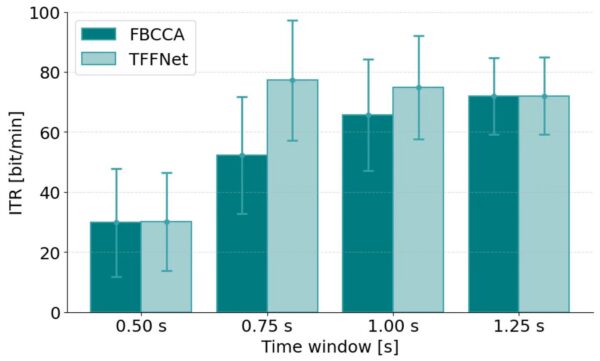
Researchers at the University of Naples Federico II in Italy report that the SSVEP-TFFNet deep-learning model outperforms filter bank canonical correlation analysis (FBCCA) at classifying steady-state visual evoked potentials (SSVEP) recorded in extended reality (XR), where headset visuals degrade EEG quality. They used an open XR benchmark dataset of 30 subjects and 1200 trials acquired with Microsoft HoloLens 2. Cutting the montage from 8 channels to 6 or 4 left performance close to the full set, supporting lightweight, wearable XR-BCI designs.