
中 / EN

BCIwiki — Brain-computer interface news, research and industry database

Top picks

1 Columbia Collaboration Finds BCI Control in 13 of 41 Clinically Unresponsive Patients 2 Hanix United Becomes Chair Organization of Shenzhen BCI Industry Association 3 Qingdao University Reviews Flexible BCI Electrode Fabrication and Stability Challenges

Latest

November 2026

Technical University of Denmark Collaboration Studies EEG and Context for Sentence Retrieval

A study proposes a hierarchical alignment framework to retrieve a read sentence using EEG signals and context. It focuses on sentence-level EEG-to-text classification, rather than directly generating sentences or identifying arbitrary thoughts from EEG alone. The authors note that much prior decoding research has focused on phonemes, letters, and words, while sentences carry richer meaning. They also describe sentence classification as less studied than sentence generation. The framework explores EEG-text relationships to inform the choice between retrieval and generation. Non-invasive assistive communication is its application context, not an established benefit for people with communication disabilities.
Why it matters The key distinction is between retrieving a sentence and generating one. Context is also an input, so the task should not be interpreted as reading thoughts from EEG alone.
Wuyi University and Partners Improve Mean Accuracy on Three Public EEG-fNIRS Tasks

Researchers from Wuyi University and partner institutions proposed a method that combines EEG and functional near-infrared spectroscopy signals, reporting mean accuracy above the best baselines by 2.34, 0.59 and 1.47 percentage points on public-dataset tasks involving mental arithmetic, motor imagery and emotion recognition, respectively. The latter two differences were not statistically significant. The method separates information shared by the two signal types from information specific to each, then combines these representations for prediction. It addresses redundant multimodal information and difficulties in capturing temporal and spatial relationships. The authors interpret the findings as evidence of improved hybrid BCI decoding and strong generalization. These public-dataset results do not establish real-time performance or clinical effectiveness.
Why it matters The approach separates shared and signal-specific information before fusion rather than merely combining the data. This helps explain the redundancy problem it targets and keeps the reported gains grounded in their public-dataset evaluation setting.

Sun Yat-sen University Study Addresses Unreliable Labels in EEG Emotion Recognition

Researchers propose VARY to address a problem in EEG emotion recognition: an emotion label assigned to an entire recording may not fit every short segment. The framework combines two-stage selection of segments with reliable labels and EEG-specific data augmentation. Tests used two public datasets, three network architectures, and multiple label-noise settings. The authors report maximum accuracy gains of 11.54% on DREAMER and 5.39% on SEED compared with the best-performing baseline. These are maximum gains in dataset tests, not average improvements across all settings.
Why it matters Dividing an EEG recording into short segments does not mean every segment reflects the same emotion. This study targets that mismatch while learning from coarse labels rather than requiring fine-grained annotations.
October 2026

Guangxi University and Partners Test Skin-Mimetic Electrodes in an 8-Hour EEG Recording Session

Researchers from Guangxi University, Wuming Hospital of Guangxi Medical University, Tsinghua University and partner institutions developed a skin-mimetic gradient electrode, softer at the scalp and firmer at the circuit connection, with graded pores for sustained electrolyte release. Two male participants completed an 8-hour daily-activity recording session and a 14-hour session, respectively. In the latter, hourly SSVEP input tasks maintained accuracy above 95%, and mVEP tasks above 90%. Each long-duration session involved one participant; the results do not establish population-wide performance or clinical efficacy.
Why it matters Rather than making the entire electrode equally soft, the design accommodates different needs at the scalp and circuit connection. Its graded pore structure also sustains electrolyte release, providing another material-design angle on the reported recording duration.

Aalborg University Study Enables Tongue-Based Cursor Control in All 10 Able-Bodied Participants

A proof-of-concept study by Aalborg University authors tested two-dimensional cursor control in 10 able-bodied participants with no prior brain-computer interface experience. Participants used either executed or imagined tongue movements, with a state machine providing up, right, down and left options. All participants achieved control with executed movements, with a completion rate of 96.0 ± 4.9%; seven achieved control with motor imagery, with a completion rate of 41.0 ± 36.2%. Average completion times for successful targets were 30.8 ± 17.6 s and 66.5 ± 26.8 s, respectively; the latter included only the seven participants with at least one successful trial. Potential muscle artifacts during executed movements were not controlled for. This was a feasibility test in able-bodied participants, not evidence of clinical efficacy in people with severe motor impairments.
Why it matters The study assigns direction selection to a state machine, leaving the BCI to distinguish movement-related activity from idle activity rather than decode four directions directly. Reporting executed movement and motor imagery separately helps distinguish their performance.

Shenzhen Society for Brain Science Launches Brain-Computer Interface Industry Association with Partners

The Shenzhen Brain-Computer Interface Industry Association has been launched, with the Shenzhen Society for Brain Science leading its formation alongside enterprises and innovation organizations in the field. Its stated priorities include collaboration among government, industry, universities, research, healthcare and finance, joint development of industry standards, and support for the industry ecosystem. It also plans to build platforms for regular industry exchanges, resource matching and brand showcases in the Guangdong-Hong Kong-Macao Greater Bay Area, while connecting with innovation networks in China and abroad. These are the association's announced work priorities.
Why it matters The proposed collaboration extends beyond companies and researchers to healthcare and finance. Concrete exchanges, resource-matching activities and standards projects will help distinguish subsequent work from the plans announced at launch.

Yonsei University Collaboration Tracks Partial Cortical Network Recovery Without Return to the Pre-Stroke State in Mice

A collaboration involving Yonsei University used a fully soft, liquid metal-based multichannel neural interface to record stable electrophysiological signals in freely moving mice and compare cortical networks within the same animals before and after ischemic stroke. Analyses of population-level activity patterns and functional connectivity both showed acute suppression followed by partial recovery. The peri-infarct networks did not return to their pre-stroke state, instead reorganizing into a distinct, reproducible functional configuration. The study demonstrates an approach to tracking network reorganization during recovery, rather than treating stroke with the interface or establishing rehabilitation benefits in humans.
Why it matters Using each animal's pre-stroke recordings as a reference allows direct comparison with its recovering network. Agreement between population-level and functional connectivity analyses provides a concrete basis for distinguishing partial recovery from restoration of the original state.

University of Pittsburgh Collaboration Finds Largely Stable BCI Control During Dual-Tasking in Two Participants

Researchers from the University of Pittsburgh and Carnegie Mellon University tested whether changes in attentional load affected intracortical BCI control in two participants with tetraplegia. Participants moved and clicked a 2D cursor while completing a working memory task. EEG measures and difficulty ratings suggested increased attentional load during dual-tasking, but BCI performance remained largely stable across the dual-task conditions. P2 showed small but significant increases in trial completion time and normalized path length under mild compared with moderate load. The authors suggested that differences in signal quality between participants may have influenced the results; this remains an interpretation rather than an established causal relationship.
Why it matters Some measures were worse under mild than moderate load, so the study did not show a simple pattern of poorer control with greater distraction. Considering attentional state alongside signal quality offers a specific way to investigate differences between users.

Three Experiment Rounds Find BCI-VR User Experience Comparable to Traditional VR Controls

Researchers proposed an attention-driven hybrid interaction model combining brain-computer interfaces and virtual reality, then evaluated it in three rounds of user experiments. The study reported user experience comparable to traditional VR control methods. Named Attention-BrainVerse, the model combines attention-centered input, adaptive processing and visual feedback to address usability challenges. It uses dynamic thresholds and continuous difficulty adjustment, with feedback mechanisms including attention visualization. The reported comparison concerns user experience, not equivalence in neural decoding accuracy, operating speed or hardware cost.
Why it matters The study focuses on interaction design: not just how commands enter a system, but how it adjusts difficulty and presents feedback. It offers a combined design approach; comparable overall experience does not establish the independent effect of each component.

Zunyi Hospital Collaboration Defines BCI’s Adjunctive Role in Stroke Reconstruction Consensus

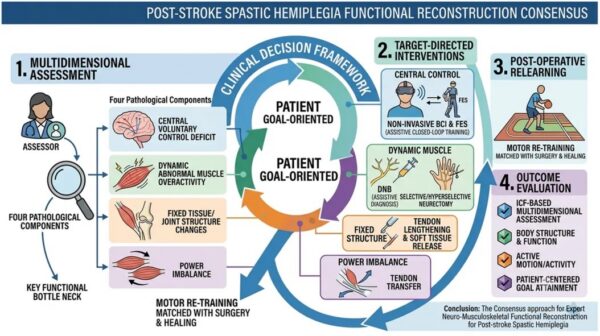
A multidisciplinary expert panel developed a consensus on functional reconstruction for post-stroke spastic hemiplegia. It recommends distinguishing impaired voluntary motor control, abnormal muscle overactivity, fixed structural restrictions, and muscle force imbalance before selecting treatment according to functional goals and the main limiting factor. Task-oriented motor training remains fundamental when voluntary control is impaired, while non-invasive BCI-based closed-loop training may be an adjunct for selected patients. The consensus also addresses diagnostic motor nerve block, peripheral nerve surgery, and tendon and soft-tissue reconstruction. Because evidence quality varies, no universal treatment sequence or combination strategy is currently supported.
Why it matters Similar movement difficulties can arise from different limiting factors. The consensus links BCI training, nerve surgery, and structural reconstruction to specific problems rather than treating them as interchangeable interventions.

© 2026 BCIwiki.com Digest Topics Tips Subscribe Revisions About