/ EN
September 2026

Anhui Pushes BCI Milestones to 2028, Hands Research Lead to USTC

Anhui issued a 2026-2030 BCI action plan on June 15, 2026 that sets its near-term milestones in 2028 rather than 2027 and frames every target as a minimum, including at least three approved invasive BCI clinical trials. Research leadership goes to the University of Science and Technology of China, with Hefei as the hub, Bengbu handling key components and Wuhu clinical translation.

Beijing's BCI Plan Sets No Output Targets, Bets on Companies Instead

Beijing issued China's first provincial-level brain-computer interface (BCI) action plan on January 7, 2025, setting every 2027 and 2030 target in terms of companies and platforms rather than output or revenue. The plan calls for three to five unicorns or would-be unicorns by 2027 and around 100 innovative small and medium-sized firms by 2030. On the payment side, Beijing prices invasive BCI implantation at RMB 7,980 per procedure and covers all three BCI service fees under Category A of basic medical insurance, limited to four hospitals.

Shanghai Aims to Partially Restore Sight With BCIs by 2030

Shanghai's science and technology commission issued a BCI action plan on January 10, 2025, pledging to help blind patients partially regain sight by 2030 and to have more than five invasive or semi-invasive products complete medical device type testing by 2027. The city's healthcare security bureau created three BCI service fee items in August 2025 but left prices to hospitals and explicitly excluded them from basic medical insurance payment.

Sichuan Targets 3,000 Invasive BCI Operations a Year by 2030

Sichuan's industry department and seven other agencies issued a BCI and human-machine interaction plan on May 12, 2025, targeting 3,000 invasive BCI operations a year by 2030 and the registration of three invasive and five non-invasive products by 2027. The province prices BCI services in five tiers by hospital grade, with implantation ranging from RMB 6,583 to RMB 4,389, all paid out of pocket.

Shandong Health Commission Leads 16-Agency Push on BCI Clinical Validation

Shandong's health commission and 15 other agencies issued a BCI clinical translation plan on July 7, 2026, following a 2025 industry plan led by the provincial science department. The 14-measure plan sets up a clinical research alliance and a provincial clinical database, cuts review time for Class II devices to 90 working days, and targets more than 30 multicenter validation projects and a RMB 2 billion industry by 2028.

Jiangxi Sets 10-Day Clock for Mutual Recognition of BCI Ethics Reviews

Jiangxi issued BCI support measures on November 26, 2025 that set no numeric targets but called for mutual recognition of clinical research ethics reviews, and its health commission followed on May 26, 2026 with guidance requiring participating sites to finish recognition reviews within 10 working days. Invasive projects for neurological or psychiatric treatment also need provincial expert review within 20 working days.

Jiangsu Opens BCI Trials to Nuclear, Mining and Power Industries

Jiangsu's industry department and eight other agencies issued a BCI action plan in March 2026 that invites companies in hazardous chemicals, nuclear power, mining and electric power to pilot the technology first. Nearly all its numeric targets, including at least 20 registered medical products, fall in 2030, and a widely cited RMB 6,600 implant price appears only in a 2025 draft, not in the province's final pricing notice.

Tianjin Stakes BCI Product Targets on Non-Invasive Devices

Tianjin's municipal government issued a 2026-2030 BCI action plan on May 26, 2026 that limits every numeric product target to non-invasive devices, aiming for more than ten in large-scale clinical use by 2030, while invasive products get a single unquantified approval goal. The plan also targets an industry fund cluster of more than RMB 10 billion by 2030.

Guangdong Plans 200 BCI Wards and Splits Roles Between Shenzhen and Guangzhou

Guangdong's provincial Party science and technology committee office issued a 2026-2030 BCI plan on June 5, 2026 that calls for 200 BCI hospital wards serving more than 500,000 patients cumulatively by 2030. The plan assigns invasive devices and signal decoding to Shenzhen and non-invasive systems to Guangzhou, and follows provincial BCI prices set nine months earlier, with implantation capped at RMB 6,600.

Zhejiang, First to Reimburse BCI Fees, Cuts Device Review to 40 Days

Zhejiang became the first Chinese province to reimburse a BCI service when it covered non-invasive fitting fees under Category B insurance from September 1, 2025, limited to smart bionic prosthesis fittings. Its 18 industry-academia-research measures, dated July 16, 2026, cut review of qualifying Class II BCI devices to 40 working days and offer research hospitals up to RMB 8 million per project.

Neuracle Registers Cortical Electrode in China's NMPA Device Identifier Database

Neuracle Medical Technology (Shanghai) Co., Ltd. has registered a cortical electrode, model 1014-35, in the medical device unique identification (UDI) database of China's National Medical Products Administration (NMPA), under registration certificate Guoxiezhuzhun 20263120536. Neuracle's product line spans EEG acquisition equipment and implantable electrodes. The electrode belongs to an implantable EEG electrode kit (cortical electrode, blank electrode, electrode dilator, tunneler, torque wrench, lead fixation clip, fixation screws and electrode protective sleeve) that holds its own registration certificate and is also a component of an implantable BCI hand motor function compensation system. That system comprises a BCI implant, the electrode kit, an EEG signal transceiver, a pneumatic glove, a single-use surgical toolkit, and three software packages for EEG decoding, medical testing and clinical management.

FDA Clears Pascall Systems' EEG Software Under 510(k)

Pascall Systems, Inc. received U.S. Food and Drug Administration (FDA) 510(k) clearance for its Pascall Sensor Unit (PSU1) on August 19, 2026, with the agency finding the device substantially equivalent. The device is a Class II medical device under regulation number 882.1400, classification name Non-Normalizing Quantitative Electroencephalograph Software.
August 2026

Shenzhen Drafts China's First BCI Industry Rules, Requiring Separate Brain Data Consent

The Shenzhen Municipal Bureau of Science, Technology and Innovation (深圳市科技创新局) in southern China and the city's Bureau of Justice have opened public consultation on draft regulations to promote the brain-computer interface industry in the Shenzhen Special Economic Zone, a status that carries authority to write binding local rules of the city's own. According to Jiemian News, a Chinese business news outlet, the draft defines a BCI as technology that opens an information channel between the brain and external devices for coordinated interaction between biological and machine intelligence, and states that the municipal government shall write BCI industry development into the city's economic and social development plan and its science and innovation plan. On data, the report says processing brain data and other sensitive personal information would require separate written consent from the individual, alongside strict compliance with national rules on cross-border data transfer; legislating specifically for the BCI industry in special economic zone regulation form is a first in China.

Seven Chinese Ministries Put Brain-Machine Tech in Elder Care Product Plan

Seven Chinese ministries, led by the Ministry of Commerce and including the National Development and Reform Commission and the Ministry of Industry and Information Technology, jointly issued implementing opinions on expanding and upgrading consumer goods (《关于推动商品消费扩容升级的实施意见》). In a section on products for older adults, the document calls for stronger R&D on key technologies and core components and for wider use of brain-machine integration and artificial intelligence in age-friendly products and rehabilitation aids. Brain-computer interfaces have until now figured mainly in China's science and industrial planning documents; framing them as consumption policy aimed at two named product categories is new, and the text was published in the State Council's policy document database, the central government's official repository for such documents.

Guangdong Drafts 2027 Rules for a Standalone BCI Research Track

The Guangdong Provincial Department of Science and Technology in southern China (广东省科学技术厅) has opened public consultation on the 2027 application guidelines for a brain-computer interface track within the province's key-fields R&D program, one of the main channels through which Guangdong allocates research money. A dedicated track gives the field its own entry point rather than making it compete inside a broader category. Because such guidelines normally set research directions, funding levels and eligibility, comments at this stage bear directly on where next year's money goes; the notice went up on the department's own website and does not carry the text of the guidelines.

BCI Plans Across 10 Chinese Provinces All Target 2030, Only Zhejiang and Beijing Reimburse

Ten provincial-level regions have issued 12 brain-computer interface (BCI) policy documents as of August 2026, with hard numeric targets almost exclusively set for 2030, which makes the next four years critical for clearing regulatory and payment hurdles. The payment gate is the tightest constraint, as only Zhejiang and Beijing have moved BCI items into basic medical insurance reimbursement, each with conditions attached. This means most provinces still have to solve reimbursement before the 2030 targets can be met.

Chinese Insurers Begin Covering BCI Procedures and Surgical Risk

Chinese insurers have begun introducing BCI-related coverage. Shanghai's 2026 Hu-huibao plan added up to 150,000 yuan for out-of-pocket materials used in inpatient BCI surgery, PICC Property and Casualty underwrote an invasive-BCI surgical accident policy for the Second Affiliated Hospital of Zhejiang University School of Medicine, and China Pacific Property Insurance covered patients receiving Neuracle's NEO implant at Huashan Hospital.

Fujian Targets a 3 Billion Yuan BCI Industry by 2030

Six Fujian government departments jointly issued a provincial BCI action plan for 2026–2030. It calls for key technical breakthroughs, more than five innovative small and medium-sized companies, one cross-strait joint laboratory and two provincial innovation platforms by 2027; by 2030, Fujian aims to have 30 companies, a complete industry chain and an industry worth more than 3 billion yuan.

BCI Pricing in Eleven Chinese Jurisdictions: Implantation RMB 4,389-7,980, Insurance Coverage in Two

Eleven Chinese provincial-level jurisdictions had published prices for brain-computer interface medical services. The invasive implantation fee runs from RMB 4,389 at the lowest hospital tier in Sichuan to RMB 7,980 in Beijing (approx. $650 to $1,180 at RMB 6.74 to the dollar, the mid-August 2026 rate), and the non-invasive fitting fee from RMB 643 to 990. Sichuan, Hainan, Qinghai and Xinjiang tier prices by hospital grade, Shanghai leaves the amount to each hospital, and Jiangsu's three figures appear only in a July 2025 draft. Beijing lists all three fees as Class A at four named hospitals; Zhejiang covers the fitting fee as Class B, limited to prosthetic fitting. Sichuan, Jiangxi, Hainan, Qinghai and Xinjiang assign Class C, Shanghai excludes the fees, and Hubei and Guangdong have prices without a coverage decision.

Zhejiang Cuts BCI Device Review to 40 Days

The General Office of China's Zhejiang Provincial People's Government issued Several Measures for Promoting Industry-University-Research Coordination in Brain-Computer Interfaces, document number Zhe Zheng Ban Fa [2026] No. 33, dated July 16, 2026 and released on August 12, comprising 18 measures in five areas. Class II BCI devices of clear clinical value may enter a special review procedure with the timeline cut to within 40 working days, while medical consumables are listed through a green channel within 10 working days. Funding comes in four tiers: up to 10 million yuan for a provincial major science and technology project, up to 8 million yuan for research hospitals deeply involved in preclinical work and product launch, up to 3 million yuan for applied basic research, and 1 million, 500,000 and 100,000 yuan for leading international, national and local standards. Beds used solely for clinical research are exempt from efficiency and DRG performance assessment.

China's First National Standards for Brain-Computer Interfaces Take Effect

Two national standards for brain-computer interfaces took effect in China on 1 August 2026, the first foundational standards the field has had there. GB/T 47023 defines a reference architecture for BCI systems; GB/T 47127 sets a common format for multimodal data, down to directory structure and file naming. Both carry the GB/T prefix, marking them as recommended rather than mandatory, so they bind no one by law and work only as far as industry and procurement choose to adopt them.
July 2026

NeuroXess 'Sanquan' BCI Enters CMDE Innovative Medical Device Review Program

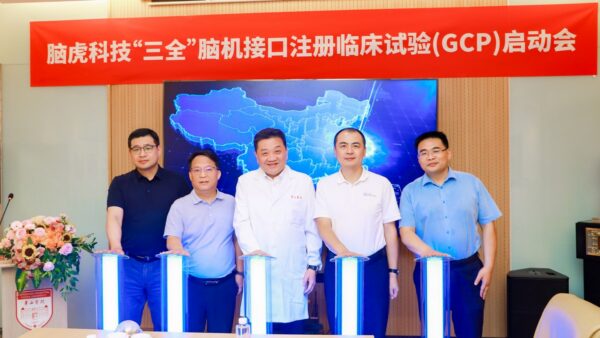
NeuroXess announced that its self-developed implantable brain-computer interface system for hand motor function compensation — the 'fully implanted, fully wireless, fully functional' ('Sanquan') system — has passed public notice and formally entered the innovative medical device special review program of the National Medical Products Administration's Center for Medical Device Evaluation (CMDE), commonly known as the green channel. The company describes it as the first subdural implantable flexible BCI product in China to enter the program. The system began a GCP registration clinical trial at Huashan Hospital, Fudan University on July 7, 2026, run as a multicentre study across 15 Class III hospitals nationwide, with trial data intended to support a Class III medical device registration application with the NMPA. The system remains in the review and clinical-trial stage and has not yet been approved for market; the registration timeline reflects company statements and remains subject to regulatory notice.

China Integrates BCI in Rehabilitation Device Innovation

Chinese authorities recently issued a three-year action plan for the rehabilitation assistive-device industry that integrates brain-computer interface (BCI), artificial intelligence and flexible electronics with rehabilitation device development, and pursues medical-engineering collaboration to drive technical breakthroughs in materials and components.

Shandong Bids to Be China BCI Testing Hub

Sixteen departments in China's Shandong province, led by the Health Commission, issued the Work Plan for Accelerating Clinical Translation and Application Innovation of Brain-Computer Interfaces, document number Lu Wei Yi Zi [2026] No. 13, dated July 7, 2026 and released on July 8. It is the only provincial BCI document led by a health authority and Shandong's second after the science department's industry plan. The plan advances a positioning it summarises as validated in Shandong, applied globally, working through an alliance, scenarios, policy and industry follow-through. Targets rise in four steps: an operating clinical research alliance in 2026; about 20 core technology breakthroughs and 30 technology SMEs by 2027; at least 30 alliance members, more than 20 foreign and domestic teams setting up validation bases, more than 30 multicentre projects and a 2 billion yuan industry by 2028; and a national validation cluster by 2030.

© 2026 BCIwiki.com Digest Topics Tips Subscribe Revisions About