中 / EN
November 2026

Technical University of Denmark Collaboration Studies EEG and Context for Sentence Retrieval

A study proposes a hierarchical alignment framework to retrieve a read sentence using EEG signals and context. It focuses on sentence-level EEG-to-text classification, rather than directly generating sentences or identifying arbitrary thoughts from EEG alone. The authors note that much prior decoding research has focused on phonemes, letters, and words, while sentences carry richer meaning. They also describe sentence classification as less studied than sentence generation. The framework explores EEG-text relationships to inform the choice between retrieval and generation. Non-invasive assistive communication is its application context, not an established benefit for people with communication disabilities.
Wuyi University and Partners Improve Mean Accuracy on Three Public EEG-fNIRS Tasks

Researchers from Wuyi University and partner institutions proposed a method that combines EEG and functional near-infrared spectroscopy signals, reporting mean accuracy above the best baselines by 2.34, 0.59 and 1.47 percentage points on public-dataset tasks involving mental arithmetic, motor imagery and emotion recognition, respectively. The latter two differences were not statistically significant. The method separates information shared by the two signal types from information specific to each, then combines these representations for prediction. It addresses redundant multimodal information and difficulties in capturing temporal and spatial relationships. The authors interpret the findings as evidence of improved hybrid BCI decoding and strong generalization. These public-dataset results do not establish real-time performance or clinical effectiveness.

Sun Yat-sen University Study Addresses Unreliable Labels in EEG Emotion Recognition

Researchers propose VARY to address a problem in EEG emotion recognition: an emotion label assigned to an entire recording may not fit every short segment. The framework combines two-stage selection of segments with reliable labels and EEG-specific data augmentation. Tests used two public datasets, three network architectures, and multiple label-noise settings. The authors report maximum accuracy gains of 11.54% on DREAMER and 5.39% on SEED compared with the best-performing baseline. These are maximum gains in dataset tests, not average improvements across all settings.
October 2026

Guangxi University and Partners Test Skin-Mimetic Electrodes in an 8-Hour EEG Recording Session

Researchers from Guangxi University, Wuming Hospital of Guangxi Medical University, Tsinghua University and partner institutions developed a skin-mimetic gradient electrode, softer at the scalp and firmer at the circuit connection, with graded pores for sustained electrolyte release. Two male participants completed an 8-hour daily-activity recording session and a 14-hour session, respectively. In the latter, hourly SSVEP input tasks maintained accuracy above 95%, and mVEP tasks above 90%. Each long-duration session involved one participant; the results do not establish population-wide performance or clinical efficacy.

Aalborg University Study Enables Tongue-Based Cursor Control in All 10 Able-Bodied Participants

A proof-of-concept study by Aalborg University authors tested two-dimensional cursor control in 10 able-bodied participants with no prior brain-computer interface experience. Participants used either executed or imagined tongue movements, with a state machine providing up, right, down and left options. All participants achieved control with executed movements, with a completion rate of 96.0 ± 4.9%; seven achieved control with motor imagery, with a completion rate of 41.0 ± 36.2%. Average completion times for successful targets were 30.8 ± 17.6 s and 66.5 ± 26.8 s, respectively; the latter included only the seven participants with at least one successful trial. Potential muscle artifacts during executed movements were not controlled for. This was a feasibility test in able-bodied participants, not evidence of clinical efficacy in people with severe motor impairments.

Yonsei University Collaboration Tracks Partial Cortical Network Recovery Without Return to the Pre-Stroke State in Mice

A collaboration involving Yonsei University used a fully soft, liquid metal-based multichannel neural interface to record stable electrophysiological signals in freely moving mice and compare cortical networks within the same animals before and after ischemic stroke. Analyses of population-level activity patterns and functional connectivity both showed acute suppression followed by partial recovery. The peri-infarct networks did not return to their pre-stroke state, instead reorganizing into a distinct, reproducible functional configuration. The study demonstrates an approach to tracking network reorganization during recovery, rather than treating stroke with the interface or establishing rehabilitation benefits in humans.

University of Pittsburgh Collaboration Finds Largely Stable BCI Control During Dual-Tasking in Two Participants

Researchers from the University of Pittsburgh and Carnegie Mellon University tested whether changes in attentional load affected intracortical BCI control in two participants with tetraplegia. Participants moved and clicked a 2D cursor while completing a working memory task. EEG measures and difficulty ratings suggested increased attentional load during dual-tasking, but BCI performance remained largely stable across the dual-task conditions. P2 showed small but significant increases in trial completion time and normalized path length under mild compared with moderate load. The authors suggested that differences in signal quality between participants may have influenced the results; this remains an interpretation rather than an established causal relationship.

Three Experiment Rounds Find BCI-VR User Experience Comparable to Traditional VR Controls

Researchers proposed an attention-driven hybrid interaction model combining brain-computer interfaces and virtual reality, then evaluated it in three rounds of user experiments. The study reported user experience comparable to traditional VR control methods. Named Attention-BrainVerse, the model combines attention-centered input, adaptive processing and visual feedback to address usability challenges. It uses dynamic thresholds and continuous difficulty adjustment, with feedback mechanisms including attention visualization. The reported comparison concerns user experience, not equivalence in neural decoding accuracy, operating speed or hardware cost.

Zunyi Hospital Collaboration Defines BCI’s Adjunctive Role in Stroke Reconstruction Consensus

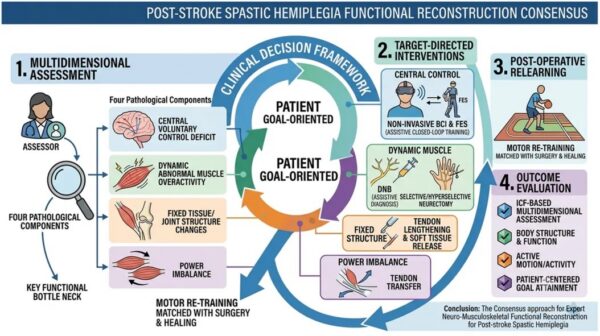
A multidisciplinary expert panel developed a consensus on functional reconstruction for post-stroke spastic hemiplegia. It recommends distinguishing impaired voluntary motor control, abnormal muscle overactivity, fixed structural restrictions, and muscle force imbalance before selecting treatment according to functional goals and the main limiting factor. Task-oriented motor training remains fundamental when voluntary control is impaired, while non-invasive BCI-based closed-loop training may be an adjunct for selected patients. The consensus also addresses diagnostic motor nerve block, peripheral nerve surgery, and tendon and soft-tissue reconstruction. Because evidence quality varies, no universal treatment sequence or combination strategy is currently supported.

Shandong Second Medical University and Partners Propose a Lifecycle Safety Framework for Implanted BCIs

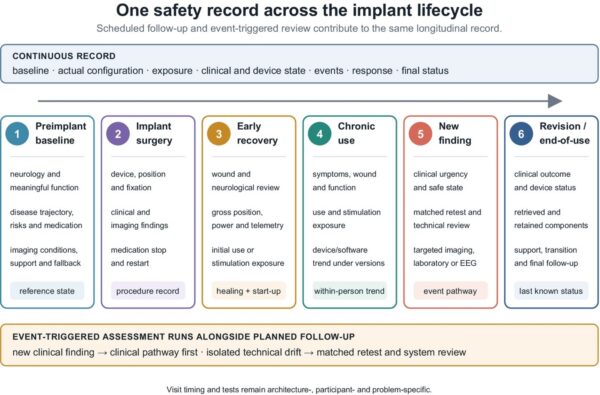
A review examines clinical safety evidence for intracortical, cortical-surface and cerebral-venous brain-computer interfaces and proposes an assessment framework spanning preimplant evaluation through end-of-use. The authors identify barriers to comparison: small and sometimes overlapping cohorts, inconsistent exposure denominators, incomplete long-term surveillance and limited retrieval data. Their framework combines a common dataset with architecture-specific assessments and an event-triggered process for confirmation, attribution, escalation and outcome recording. They stress that no single test establishes chronic safety. Prospective multicentre testing, independent adjudication and registry follow-up are needed before the approach can inform formal guidance.

València Polytechnic Collaboration Proposes a 20-Component BCI Study Framework

Researchers proposed an integrated dual framework for motor imagery and steady-state visually evoked potential BCIs, focusing on rehabilitation and robotics research. Developed through a scientific literature review, it organizes 20 components into experimental and BCI system sections, covering both non-technical phases critical to study validity and technical architecture. A supporting taxonomy and checklist help structure terminology and check whether study elements are present. Documentation assessment in three BCI studies demonstrated the framework's applicability as a design and reporting tool, rather than rehabilitation efficacy or robot-control performance.

964th Hospital Collaboration Reviews 16 BCI Stroke Trials Without Establishing a Superior Output Modality

A systematic review and network meta-analysis synthesized 16 randomized controlled trials comparing BCI-triggered functional electrical stimulation, BCI-controlled robotic rehabilitation and conventional rehabilitation for motor recovery after stroke. Electrical stimulation showed a benefit over conventional rehabilitation, while the effect of robotic rehabilitation remained uncertain. However, no trial directly compared the two BCI approaches, and their indirect comparison did not establish a difference. The findings therefore do not establish that electrical stimulation is superior to robotics; confidence in that comparison is very low, and direct head-to-head trials are needed.

Kunming Collaboration Proposes a BCI Theory Framework With Four Experimental-Design Results

Researchers from Kunming University of Science and Technology and collaborating institutions proposed a theoretical system for basic BCI research, formalizing BCIs as closed-loop probabilistic information-processing models through information theory and statistical decision-making. The work addresses system decodability, performance boundaries and dynamic constraints. It organizes scientific hypotheses, neuroscience principles, fundamental theorems and basic laws, derives four results that can guide experimental design, and uses motor imagery BCIs to illustrate application boundaries. The authors aim to provide a unified analytical benchmark and support a shift from experience-driven algorithm optimization toward theory-driven system analysis and design.

Kocaeli Collaboration Reports 95.6% Four-Class fNIRS Accuracy on a 29-Participant Dataset

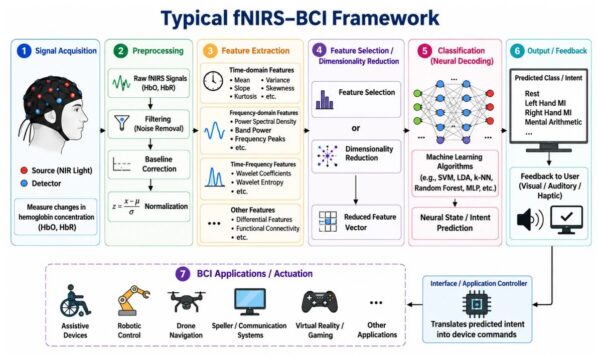
Researchers from Kocaeli University and collaborating institutions proposed an adaptive multi-domain feature-fusion framework to distinguish left-hand motor imagery, right-hand motor imagery, mental arithmetic and rest from functional near-infrared spectroscopy signals. Using subject-independent leave-one-subject-out cross-validation on an open-access dataset of 29 participants, the framework achieved 95.6% mean accuracy, compared with 90.7% for temporal features alone, 95.0% for cepstral features alone and 95.2% for direct concatenation. Accuracy gains over direct concatenation ranged from 0.2 to 0.7 percentage points for every participant. Most of the gain over temporal features came from the cepstral domain, with adaptive weighting adding a small, consistent improvement.

Huashan Hospital Collaboration Recruits 90 People to Map EEG Features of Continence Intent

A descriptive feasibility study involving Huashan Hospital, Fudan University recruited 90 participants: 30 healthy young adults, 31 healthy older adults and 29 people with spinal cord injury. It recorded 32-channel EEG during continence motor attempts. Groups showed broadly consistent sensorimotor rhythm changes. During suppression, an older-versus-younger high-frequency difference was significant, while the spinal cord injury group’s similar trend was not. Frontal high-frequency findings may reflect residual artifacts. This characterizes intent-related EEG rather than testing restoration of bowel or bladder function.

Shaanxi University of Science and Technology Reports 64.38%–81.43% Cross-Subject Motor Imagery Accuracy Across Three Datasets

Researchers at Shaanxi University of Science & Technology developed DWDANet to address EEG differences between people that limit cross-subject generalization. The framework combines multi-scale spatiotemporal feature modeling with dynamically weighted domain alignment. Cross-subject accuracy reached 70.61%, 81.43% and 64.38% on BCI IV-2a, BCI IV-2b and SHU-MI, respectively, outperforming the existing methods compared on all three datasets. The study also reported within-subject results. These evaluation conditions differ: higher within-subject accuracy should not be treated as performance for a new user, and the dataset findings do not establish rehabilitation efficacy.

Kunming University Reviews Three Neurofeedback Modalities for PTSD

Researchers at Kunming University of Science and Technology reviewed the mechanisms and outcome evaluation of neurofeedback for post-traumatic stress disorder. They compared EEG, real-time functional magnetic resonance imaging and functional near-infrared spectroscopy in feedback targets, spatiotemporal resolution and clinical applicability. Neurofeedback provides real-time information about brain activity to guide patients in regulating abnormal neural patterns. Using clinical scales, neurophysiological measures and functional recovery indicators, the review discusses its clinical position relative to first-line treatments and potential synergy with psychological interventions. The authors identify inadequate control designs and non-standardized training parameters as ongoing limitations; therapeutic potential should not be treated as established efficacy.

UNAM Collaboration Reviews Neural Population Geometry and BCI Applications

A review surveys tools for studying the collective activity of neural populations and discusses how low-dimensional structure can help explain sensory coding, working memory, decisions, and sensorimotor transformations. The authors emphasize that cognitive signals can occupy separable or near-orthogonal population dimensions, reducing interference without requiring distinct cell classes: individual neurons in a shared population can still respond to multiple kinds of information. The review also considers recurrent neural networks as testbeds for mechanistic hypotheses and intracortical brain-computer interfaces as an application in which population geometry becomes a control signal. This is a review, not a new clinical efficacy study.

NUS Collaboration Selects Signal Lags, Raising Mean R² by 4.1% Across Three Benchmark Tasks

Researchers introduced a method for selecting signal lags to identify when one signal's history is most useful for predicting another. Across three benchmark tasks using existing monkey-experiment data, the selected lags achieved the highest or equal-best coefficient of determination, R², with mean R² improving by 4.1% relative to the strongest competing baseline. Called ATEMPO, the method estimates information relationships across history depths and temporal positions with a single fit, reducing the need for repeated fitting. On datasets with known lags, its lag-detection accuracy was 0.98±0.04. The findings concern dataset prediction performance, not clinical efficacy.

Hengyang Collaboration Tests a Lightweight EEG Model With About 8,000 Parameters

Researchers from Hengyang Normal University and Chongqing University of Education in China jointly proposed NCEL, a lightweight EEG decoder evaluated on five benchmark datasets. It achieved 82.75% mean classification accuracy on BCIC IV-2b. Relative to EEGNet reference values, mean performance improved by 12.53 percentage points on P300 and 9.54 percentage points on BCIC IV-2b, with approximately 0.008M parameters. However, additional subject-specific evaluations with disjoint sessions found cross-session performance comparable to EEGNet on BCIC IV-2a and a mean improvement of 1.80 percentage points on BCIC IV-2b. The study demonstrates classification capabilities in a compact model, while broader cross-session generalization still needs validation.

CUHK-Shenzhen Collaboration Combines EEG Signals and Images, Reaching 65.67% Benchmark QA Accuracy

A CUHK-Shenzhen collaboration introduced OneEEG for multitask EEG question answering. Standard 19-channel tasks use numerical signals and waveform images; non-standard tasks use images only. On the closed-set OneEEG-Bench, Overall accuracy reached 65.67% and Macro accuracy 68.24%, versus 50.39% Overall for baseline GPT-5.5. OneEEG received EEG-specific training; baselines used only images and text. These differences preclude interpreting the result as a general model or clinical diagnostic ranking.

Beijing University of Technology Collaboration Tests EEG Emotion Feature Selection With Missing Labels

Researchers from Beijing University of Technology and collaborating institutions proposed REFS to select EEG features for multi-dimensional emotion recognition when some emotional labels are missing. The method reconstructs incomplete labels while reducing redundancy among selected features, addressing modeling challenges posed by high-dimensional features and relatively few high-quality samples. Tests used DREAMER, DEAP and HDED, three datasets with different EEG channel configurations, at varying label-missing ratios. REFS consistently outperformed the 13 advanced feature-selection methods compared in robustness under these conditions. These dataset findings do not establish performance in deployed affective BCIs.

Berkeley Collaboration Tests fNIRS Model Transfer on Three External Datasets

A collaboration involving UC Berkeley, USC and Microsoft Research introduced MtReNIRS, pretrained on 12 public fNIRS datasets covering 268 subjects and about 567 recording hours, then evaluated on three unseen datasets. It aligns probe layouts for cross-subject transfer and within-subject calibration with two to eight labels per class. Cross-subject results were not uniformly significantly better than fully supervised baselines, and few-shot gains varied by dataset. Device effects were not isolated because device, task and montage differences co-occurred.

NYU Abu Dhabi Tests EEG Compression, Cutting FP16 Board Energy by Up to 16.20%

Researchers introduced ORBITAL, a framework for compressing EEG decoders while evaluating resistance to adversarial attacks and actual hardware costs. Across nine subjects and three random seeds on BCI Competition IV-2a, S25-TRADES achieved the highest observed mean true-union robustness among the tested compressed EEGNet models: 23.06%, versus 21.27% for standard Full, with 26.27% fewer parameters and 25.10% fewer multiply-accumulate operations. Hardware tests also showed that lower numerical precision did not necessarily save energy or time: native INT8 incurred about twice the FP16 latency and energy. These results do not establish comprehensive reliability in real-world use.

Shengjing Hospital Reports AIS A-to-C Change After a Year of Combined Intervention in One SCI Patient

A patient with chronic complete spinal cord injury improved from AIS A to AIS C and regained partial voluntary movement after one year of combined neuromodulation and conventional rehabilitation. The 53-year-old man had a T9 injury and received sequential spinal cord electrical stimulation, BCI training, motor cortex stimulation, and peripheral magnetic stimulation of both iliopsoas muscles, alongside 12 months of rehabilitation. His left lower limb motor score rose from 0 to 6, spontaneous defecation and penile erection returned, and his neuropathic pain score fell from 8 to 0. This uncontrolled case suggests a possible association with functional recovery but cannot distinguish the contributions of individual interventions or exclude spontaneous neurological recovery.

China Rehabilitation Research Center Reports Motor Score Rise From 20 to 56 After Eight Months in One Stroke Case

A patient with a large-area stroke showed improvements in cognition, language, movement, and daily living after an 8-month, dynamically adjusted rehabilitation program. The 38-year-old man had right hemiplegia and global aphasia following a large left hemispheric infarction, with limited response to conventional rehabilitation. Guided by periodic assessments, a multidisciplinary team combined conventional therapy with staged magnetic stimulation, BCI-robotic training, task-oriented virtual reality, and gait correction. His FMA motor score increased from 20 to 56, and his MBI daily living score rose from 40 to 91. This single case documents recovery occurring alongside intervention; it does not establish an independent benefit from BCI or any other component.

Qingdao University Reviews Flexible BCI Electrode Fabrication and Stability Challenges

A review from Qingdao University examines how flexible brain-computer interface electrodes are fabricated and optimized for signal recording and long-term stability. Mechanical mismatch between rigid electrodes and brain tissue may cause tissue damage and reduce recording stability during long-term implantation; flexible electrodes offer better mechanical compatibility. The review covers microelectromechanical systems, printing and transfer, laser processing, thermal drawing, and electrospinning, alongside deposition and surface modification for performance enhancement. It also identifies challenges in large-scale manufacturing, long-term stability, and the physical and clinical limitations of electrodes with different levels of invasiveness. This is a technology review, not a clinical efficacy study of a new device.

West China Hospital Collaboration Improves Gesture Decoding in Glioma Patients

A collaboration involving West China Hospital of Sichuan University combined healthy neural recordings with biophysical constraints to decode motor signals affected by pathology. In a gesture classification task using high-density electrocorticography from patients with gliomas infiltrating the motor cortex, the study reported improved classification accuracy. Correlation between motor-command representations and healthy canonical representations increased from r = 0.66 to r = 0.94. The authors interpret the model's behavior as an "inverse weighting" strategy that downweights high-power pathological noise and redirects spatial attention toward functional compensatory regions. This is a proof of concept for decoding in compromised networks, not evidence of restored motor function.

Japan’s University of Electro-Communications Raises Visual BCI Transfer Rate by Up to 11.30 Bit/Min

A study from The University of Electro-Communications in Japan proposes enhancing brain signals without model training. The method repeatedly samples and pastes EEG signals to strengthen steady-state visual evoked potential components, which visual brain-computer interfaces use to identify target commands. In experiments with synthesized signals and open benchmark datasets, it outperformed conventional methods at every tested signal length, improving information transfer rate by up to 11.30 bit/min. The approach addresses the training-data requirements and upfront costs of learning-based methods; the reported gains come from signal and dataset experiments.

Columbia Collaboration Finds BCI Control in 13 of 41 Clinically Unresponsive Patients

A prospective single-centre study involving Columbia University Medical Center found that 13 of 41 clinically unresponsive, critically ill patients with acute brain injury (32%) could control a brain-computer interface. The system analyzed EEG in real time and translated attempted movement into changes in sound. Clinical consciousness returned by discharge in 4/13 patients with BCI control versus 1/28 without it. At 12 months, 6/13 versus 2/28 met the study's definition of functional independence. BCI control was associated with subsequent recovery, but the findings do not show that device use caused recovery. The tested interface was one-way; bidirectional communication remains a future possibility.

© 2026 BCIwiki.com Digest Topics Tips Subscribe Revisions About