

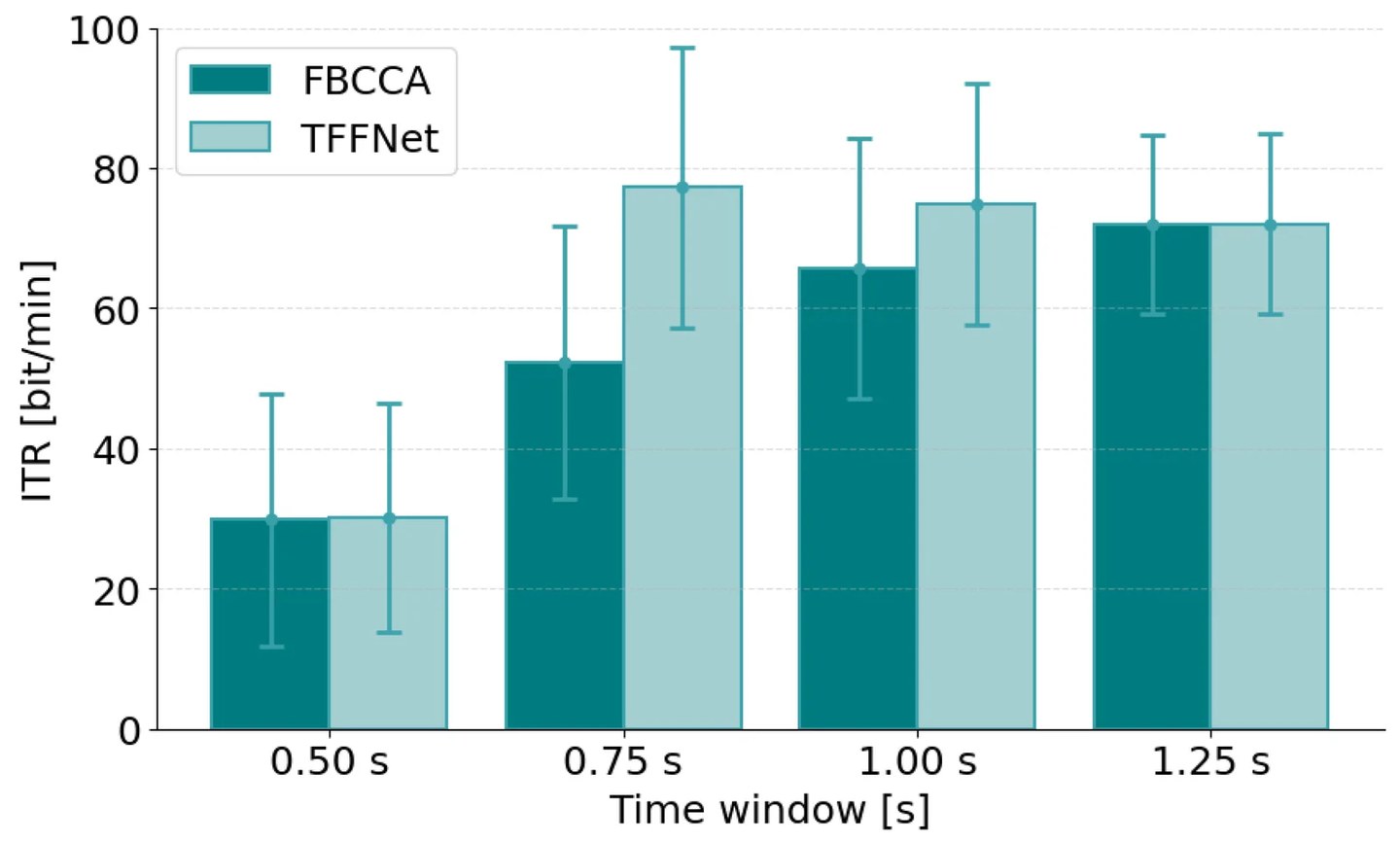
BCIwiki (bciwiki.com) — Visual stimulation in extended reality (XR) can degrade EEG signal quality, but a new study shows that deep learning models can still maintain high classification accuracy. Researchers at the University of Naples Federico II, Italy, reported in Sensors on August 27, 2026, that the SSVEP-TFFNet model outperformed the traditional filter bank canonical correlation analysis (FBCCA) for classifying steady-state visual evoked potentials (SSVEP) under XR conditions.
The study used an open XR benchmark dataset comprising 30 subjects and 1200 trials acquired using Microsoft HoloLens 2. Results showed that SSVEP-TFFNet outperformed FBCCA in the considered XR conditions. Further analysis showed that reducing electrodes from 8 to 6 or 4 channels preserved classification performance close to the full 8-channel montage. The study also assessed classification accuracy and information transfer rate with uncertainties according to the Guide to the Expression of Uncertainty in Measurement (GUM), incorporating intra- and inter-subject variability.
The study was conducted by Angrisani L, De Benedetto E, De Maria A, Duraccio L, and Tedesco A, affiliated with the Department of Electrical Engineering and Information Technology and the Department of Public Health at the university. The findings provide evidence for lightweight, wearable XR-BCI implementations, showing that suitably selected deep learning models can effectively classify SSVEP signals in XR environments.