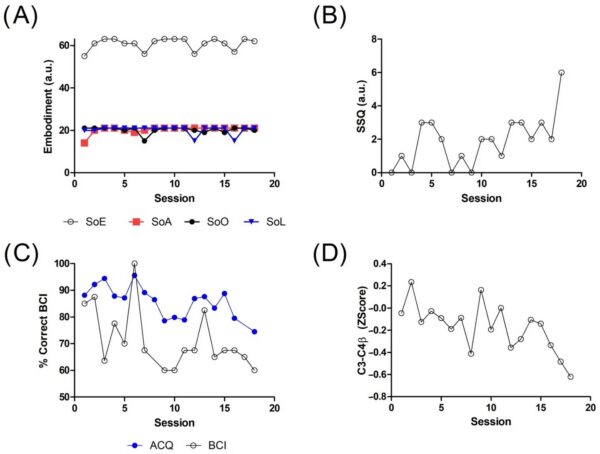
A single-case study of a participant with chronic spinal cord injury found that sense of embodiment was positively associated with frontal theta activity, while simulator sickness was negatively associated with sensorimotor beta activity, during extended reality brain-computer interface (XR-BCI) use. Analyzing 17 XR-BCI sessions with Bayesian correlation and multiple linear regression, researchers at Escola Superior de Saúde do Alcoitão, Universidade de Aveiro and Universidade Católica Portuguesa found simulator sickness to be the only variable independently associated with sensorimotor beta activity, a result they report as robust; the study appeared in Life on August 27, 2026. Different dimensions of subjective experience during XR-BCI operation therefore appear to have partly distinct neurophysiological correlates, a basis for reading user experience from EEG in real time and tuning BCI training and interaction design.