

BCIwiki (bciwiki.com) — A case study in a participant with chronic spinal cord injury found that sense of embodiment was positively associated with frontal theta activity, while simulator sickness showed a negative association with sensorimotor beta activity during extended reality brain-computer interface (XR-BCI) use. The study, by researchers at Escola Superior de Saúde do Alcoitão, Universidade de Aveiro, and Universidade Católica Portuguesa, was published in Life (Basel, Switzerland) on August 27, 2026.
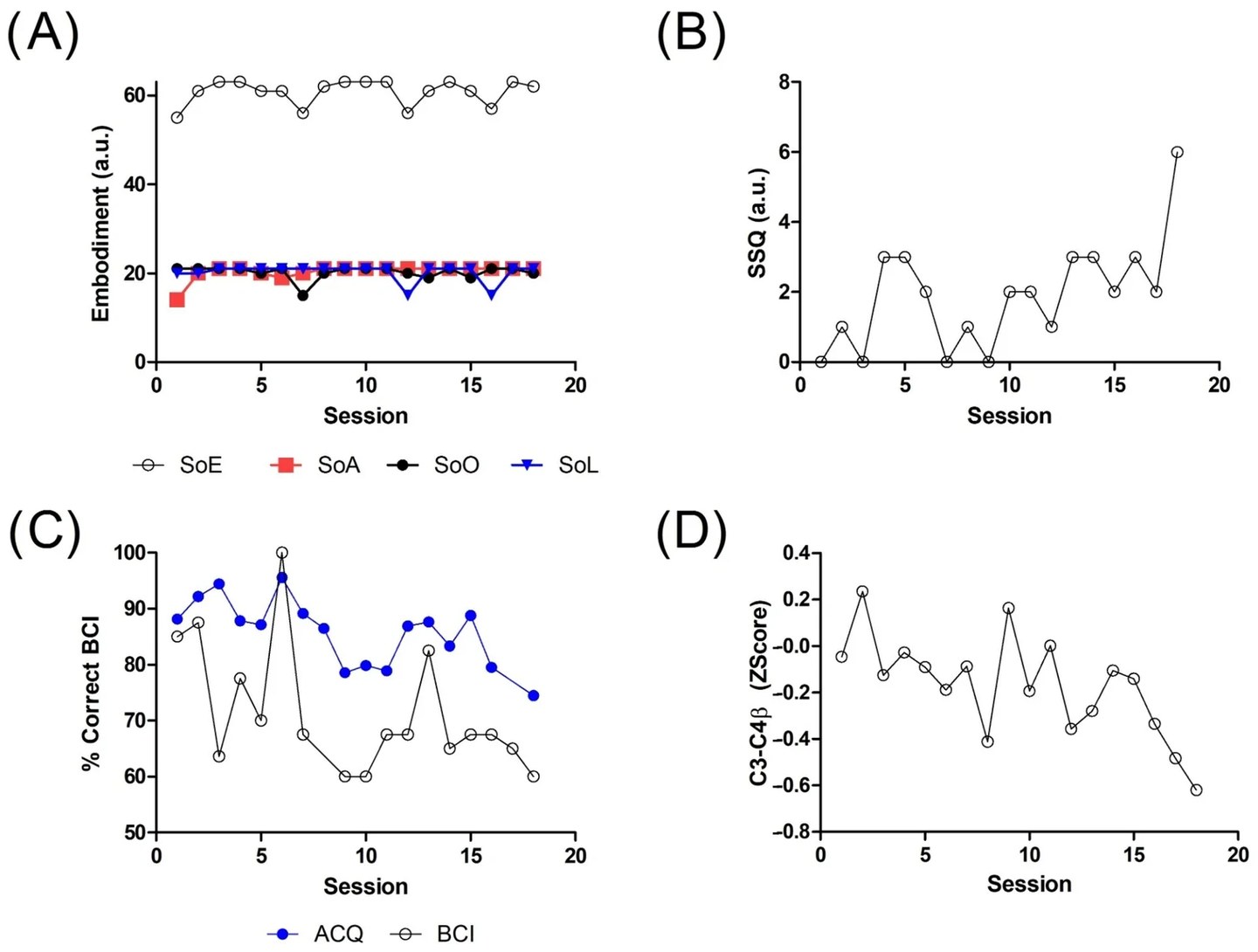
The study analyzed data from 17 XR-BCI sessions performed by one participant with chronic complete spinal cord injury. Bayesian correlation analyses examined associations among embodiment, simulator sickness, BCI performance, and EEG activity, and multiple linear regression identified variables independently associated with sensorimotor beta activity. Results showed that sense of embodiment was positively associated with frontal theta activity (F3), while simulator sickness showed a negative association with sensorimotor beta activity (C3-C4). Multiple regression demonstrated that simulator sickness was the only variable independently associated with C3-C4 beta activity after accounting for embodiment and BCI performance, and this association remained robust following bootstrap estimation and leave-one-out sensitivity analyses.
The researchers noted that, although limited to a single participant, the findings suggest that different dimensions of subjective experience during XR-BCI operation are associated with partially distinct neurophysiological correlates, with simulator sickness being the variable most consistently associated with sensorimotor beta activity across all analyses. These findings provide a foundation for future longitudinal investigations of the neural mechanisms linking subjective experience and cortical dynamics during XR-BCI use.