

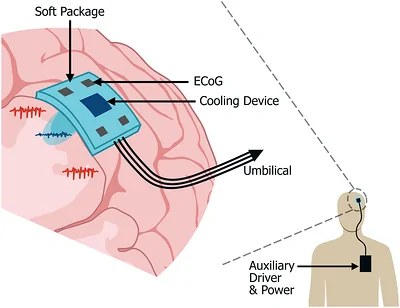
BCIwiki (bciwiki.com) — A 3D-printed soft implant placed on the cortical surface of rodents produced rapid, stable, localized hypothermia while recording electrocorticography (ECoG), and suppressed seizure-like activity in an epilepsy model, researchers from the Leibniz Institute for Polymer Research Dresden, TUD Dresden University of Technology, the University of Sheffield and other institutions reported in Advanced Science on September 27, 2026.
The authors say limits of electrical neuromodulation are pushing development of neuroprosthetic systems that add optical, thermal, fluidic or electrical modalities, but integrating that hardware into miniaturized implants remains a key challenge. Their design framework, inspired by fast prototyping, combines extrusion-based 3D printing of silicones with discrete electronic components to fit thermal neuromodulation and electrical recording into soft packages. The team says the approach could reduce the complexity, fabrication time and bulk of multimodal neural interface systems.
Linked to an autonomous auxiliary driver unit, the packages cooled tissue locally while recording ECoG. In a rodent model of epilepsy induced with 4-aminopyridine, the researchers demonstrated hypothermia-induced suppression of seizure-like activity.
The authors say the approach may advance clinical translation of focal hypothermia as an alternative therapy for drug-resistant focal epilepsies. The results come from animal experiments only; no human safety or efficacy data were reported.