/ EN

Closed-loop Systems

25 entries

Closed-loop BCIs sense neural activity in real time and automatically deliver adaptive stimulation, forming an autonomous sense-decide-act loop. This topic covers closed-loop neuromodulation for seizure suppression, motor recovery, and mood regulation.

September 2026

New Filtering Pipeline Keeps BCI Decoding at 76% During Brain Stimulation

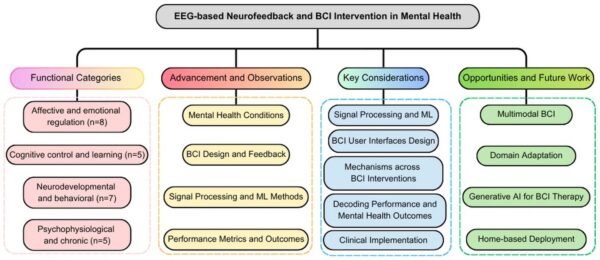
Running a motor-imagery BCI while transcranial alternating current stimulation (tACS) is switched on has been difficult, because stimulation artifacts swamp the brain rhythms the decoder relies on and push accuracy close to chance. In a controlled test with 14 healthy participants, a real-time spatial filtering pipeline combining spatio-spectral decomposition with beamforming held accuracy at 76 ± 9% during stimulation, while a standard Laplacian filter managed only 58 ± 9%. That makes closed-loop "stimulate while reading" operation feasible at the signal level; whether it actually improves BCI performance or produces neuroplastic changes, the paper explicitly leaves to future research.
Parkinson's Patients Learn to Control Deep Brain Stimulation Through a BCI Game

Researchers at the University of California, San Francisco (UCSF), a public research university known for its neuroscience work, had two Parkinson's disease patients train at home with a brain-computer interface (BCI) airplane-simulator game, learning to down-regulate cortical beta activity and thereby control the intensity of their own deep brain stimulation (DBS). The work, posted as a preprint on medRxiv on August 17, 2026, points to BCI applications in neuromodulation and to more personalized treatment for Parkinson's and other conditions; its conclusions have not yet been peer reviewed.

Shandong Hospital Registers Retrospective Cohort Study of Closed-Loop BCI Exoskeleton in Stroke Recovery

The study asks whether adding closed-loop BCI exoskeleton training to conventional rehabilitation improves lower-limb recovery in stroke patients. The retrospective cohort plans to enroll 58 patients in a closed-loop training group and 57 in a conventional rehabilitation group, with the primary endpoint being change in FMA-LE score from baseline to week 6. Secondary outcomes include motor imagery-related EEG features, the 10-Meter Walk Test and the Berg Balance Scale, indicating the researchers want to track both walking function and the brain signals themselves. The trial is self-funded by the research team and has not yet begun recruiting.

Researcher Proposes Slow-Fast Framework to Keep BCIs from Overfitting Short-Term Goals

A researcher warns that AI-assisted brain-computer interfaces may over-optimize short-term proxies of success and drift from users' durable goals, a closed-loop failure mode she names neuroadaptive overfitting. Artificial intelligence is turning BCIs from task-specific neural decoders into adaptive systems that complete language, smooth movement, regulate rehabilitation support and adjust stimulation. Her Slow-Fast framework paces AI assistance according to decoder evidence, uncertainty, clinical stakes, fatigue and user-defined goals, distinguishing fast, guarded and slow assistance across communication, motor control, neurorehabilitation and closed-loop neuromodulation.
August 2026

Memory Prosthetics Near First-in-Human Trials

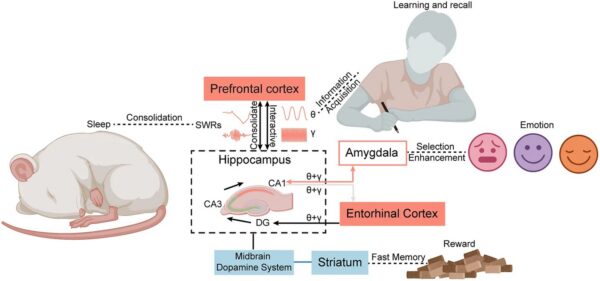
Memory prosthetics — closed-loop brain-computer interfaces that decode hippocampal activity and deliver adaptive stimulation — are moving from animal proof-of-concept toward first-in-human trials, according to a review in iScience. The authors argue that chronically implantable systems require co-design of three subsystems that have been treated in isolation: biocompatible electrode interfaces, on-chip neuromorphic computation, and closed-loop control hardware. The review maps neuroscientific findings such as theta-phase tracking, theta-gamma coupling and sharp-wave ripple detection onto engineering specifications for latency, sampling and charge injection, and onto materials requirements for impedance, switching endurance and chronic stability. It also flags where small-cohort clinical results have been over-generalized.

Review Maps How Closed-Loop BCIs May Support Post-Stroke Recovery

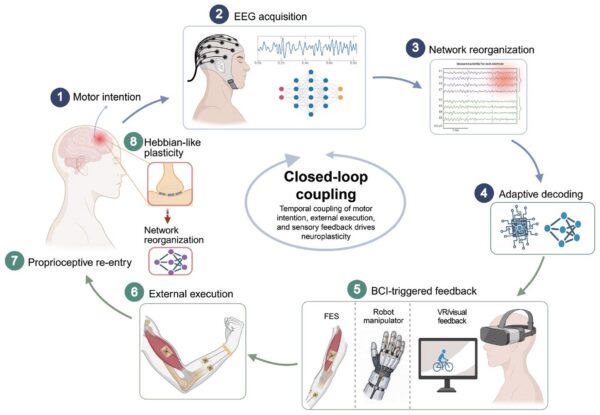
A review in *Frontiers in Neuroscience* describes closed-loop BCIs as systems that detect motor imagery, motor attempts or sensorimotor rhythms and trigger contingent electrical stimulation, robotic assistance, virtual reality, multisensory feedback or neuromodulation. The authors argue that restoring the timing between intent, assisted movement and sensory feedback may promote activity-dependent plasticity, while stressing that outcomes vary with patient selection, signal quality, dose, feedback modality and trial design.

Review Proposes 'Brain-Inspired BCIs' for Low-Power, Closed-Loop Neurotech

A review published on August 20, 2026 in npj Biomedical Innovations proposes brain-inspired brain-computer interfaces (BI-BCIs), a framework that unifies neuromorphic computing with BCI design to make neurotechnology lower-power, smaller and capable of closed-loop operation. The authors, from Aarhus University, Stanford University, the University of Southern Denmark, the University of Genoa, Forschungszentrum Jülich and RWTH Aachen University, say the approach could advance neuroprosthetics and neuromodulation for neurological disorders.

Stanford Team Records Psychiatric Brain Circuits at Millisecond Precision

A Stanford program is recording brain activity in psychiatric inpatients at millisecond precision, combining noninvasive electrode arrays with deep brain recording electrodes to trace the circuits behind schizoaffective disorder, borderline personality disorder, autism and cancer-induced depression. The Human Neural Circuitry program, led by neuroscientist Karl Deisseroth at the Wu Tsai Neurosciences Institute, has run for three years and moves data over fiber-optic and copper links fast enough for round trips of under half a millisecond, allowing the system to sense and respond in a closed loop. Deisseroth said the key innovation is getting results at millisecond precision, which he called a crucial step toward understanding complex psychiatric symptoms.

Review Identifies Three Shared Bottlenecks Across DBS and BCIs

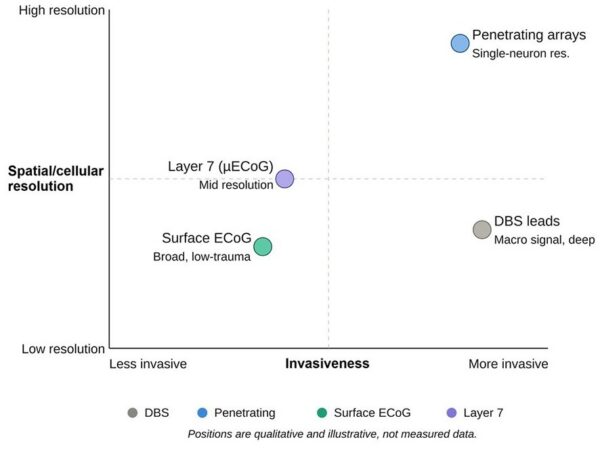
A mini-review places deep-brain stimulation, brain-computer interfaces and speech neuroprostheses within a shared closed-loop architecture of sensing, decoding, stimulation or output, power, telemetry and chronic validation. It identifies long-term stability, neural coding and equitable access as recurring constraints across all three fields and argues that governance must advance alongside engineering.

SpikeGadgets Hardware Closes the Loop on Rat Hippocampus in Milliseconds

SpikeGadgets says its hardware, using low-latency Ethernet and the TrodesNetwork API, lets researchers detect a neural activity pattern and trigger a perturbation within milliseconds. Two UCSF studies show it in use: one continuously decoded hippocampal population activity in rats to run a neurofeedback system, training the animals to volitionally generate specific memory representations for reward; the other triggered theta-phase-specific optogenetic stimulation in real time and showed that theta rhythm and replay are mechanistically separable.

2-Block EEG Gait Decoder Reaches 70.5 ms Latency

This preprint reports a 2-block lightweight architecture for real-time EEG gait decoding that the authors say enables closed-loop lower-limb exoskeleton control. In closed-loop deployment, the study reports a 55.3% gait initiation success rate with Rex assistance and 52.7% volitionally, with a mean end-to-end processing time of 70.5 ms (±41.5). The authors add that the manuscript was accepted for publication at the 2026 IEEE International Workshop on Machine Learning for Signal Processing (MLSP 2026).
July 2026

Miniscope Enables Real-Time Neural Decoding

Beijing Normal University researchers developed a low-cost structured-illumination miniscope weighing less than 3 g. The system uses a Ronchi grating and time-multiplexed excitation for HiLo imaging, providing optical sectioning in freely behaving mice. It suppresses out-of-focus background fluorescence while retaining the speed, field of view, and accessibility of widefield miniscopes, and it supports optically sectioned multiplane imaging to increase neuronal yield. In hippocampal recordings, the researchers observed better region-of-interest signal quality and spatial-information readout. They also demonstrated a proof-of-principle closed-loop brain-machine interface supported by rapid online signal extraction and real-time neural decoding. The work is a bioRxiv preprint and has not been peer reviewed.

Preprint: Dendrite, a Real-Time Python Application for Online BCI Research and Development

A preprint introduces Dendrite, an open-source (GPL-3.0) Python application that bundles multimodal physiological signal acquisition, decoder training and real-time inference into a single modifiable application. It records multiple signal streams concurrently at their native sample rates, fits decoders either from a trained model or live during the pipeline, and tracks every recording, decoder and training run in a database so deployed decoders can be traced to their configuration and training source. The system was validated end-to-end on in-house and public BCI datasets, training and updating decoders in real time; the study has not been peer reviewed.

Successful Single-Session Neural Self-Regulation Through Neurofeedback Varies Between Features

A study of 20 healthy participants who trained self-regulation of four cortical rhythms — frontal midline theta, occipital alpha, unilateral central-temporal sensorimotor rhythm, and central beta — across four neurofeedback sessions found that all could regulate at least two features, but none could regulate frontal midline theta. The authors argue this shows 'non-learners' is not a personal trait that generalizes across features, informing future neurofeedback and BCI training protocol design.
June 2026

Northwestern Polytechnical University Registers BCI Stroke Rehabilitation Trial With 4 Arms

A newly registered trial tests a brain-computer interface in post-stroke rehabilitation across 4 parallel arms: full cross-domain (emotion-cognition-motor) adaptive training, integrated cognitive and motor task training, single-dimension motor training, and conventional rehabilitation. Each arm plans 22 participants, 88 in total. It enrolls patients aged 30 to 80 with a first cerebral infarction or hemorrhage 3 months to 1 year earlier, unilateral hemiplegia, and upper-limb Brunnstrom stage II to IV. The primary outcome is a motor function score; secondary outcomes include EEG motor imagery event-related synchronization/desynchronization, prefrontal theta/alpha power ratio, and EEG-fNIRS coupling.

Suzhou Hospital Registers Closed-Loop BCI Trial Using fNIRS and rTMS for Female Overactive Bladder

Women with overactive bladder often rely on drugs and behavioral training, with limited relief. A newly registered trial at The First Affiliated Hospital of Soochow University takes a different route: patients perform a task while functional near-infrared spectroscopy reads prefrontal brain activity, and an algorithm decides when to deliver transcranial magnetic stimulation, closing the loop. The interventional, parallel-design trial plans to enroll 66 women aged 18 to 75, 33 in the experimental arm and 33 in a control arm that receives open-loop sham stimulation, with the overactive bladder symptom score as the primary endpoint. No device model or results are disclosed in the registration, and recruitment has not yet started.
May 2026

Xi'an Jiaotong University Second Hospital Registers BCI Ankle Rehabilitation Trial in 120 Stroke Patients

The multicenter randomized controlled trial pits closed-loop BCI ankle training against conventional active and passive ankle training in subacute stroke patients who are 4 to 12 weeks past onset and have less than 10 degrees of active ankle dorsiflexion. Primary endpoints are active ankle dorsiflexion range of motion and Manual Muscle Testing of the ankle; secondary endpoints include Functional Ambulation Classification, the Berg Balance Scale and the Fugl-Meyer Motor Assessment of the Lower Limb. The trial plans to enroll 120 patients, 60 per arm, with first enrolment set for May 31, 2026.

Binzhou Medical University Hospital Registers BCI Plus Electrical Stimulation Trial in Parkinson's Disease

The trial plans to enroll 40 patients with Parkinson's disease aged 40 to 80, randomized into 2 groups: one adds brain-computer interface rehabilitation training to functional electrical stimulation, the other receives functional electrical stimulation alone. Both arms train 20 minutes per day for the upper extremities and 20 minutes per day for the lower extremities, completing 12 treatment days within 2 weeks. The primary endpoint is a motor symptom rating scale, with diffusion tensor imaging, magnetic resonance spectroscopy, resting-state fMRI, and sleep, cognitive and mood scales as secondary endpoints, testing whether adding BCI training produces measurable change beyond motor symptoms.
February 2024

China's Neuracle Registers 96-Patient Trial of Closed-Loop Epilepsy Implant

Chinese registry ChiCTR2400081380 describes a 96-patient trial of an implantable closed-loop recording and stimulation system for focal drug-resistant epilepsy in people aged 6 to 70. All participants are to receive the implant and then be randomized one month later to active or sham stimulation, 48 per group. The registry provides no evidence that enrollment had passed 50%.
June 2023

UT Austin Trial Tests Closed-Loop Stimulation for Cognitive Control in Older Adults

The University of Texas at Austin has registered a study on ClinicalTrials.gov, NCT05907343, testing whether non-invasive stimulation can strengthen cognitive control in older adults, enrolling both people with cognitive impairment and people without it. It asks whether theta burst stimulation, a form of transcranial magnetic stimulation, can restore a range of cognitive functions, and whether delivering it in closed loop, timed to ongoing brain activity rather than on a fixed schedule, changes the result.
© 2026 BCIwiki.com Digest Topics Tips Subscribe Revisions About