

BCIwiki (bciwiki.com) – BELT, a modular Bayesian edge-cloud architecture, brought average motor imagery BCI latency down to 6.75 ms per sample on ARM Cortex-A7 hardware against EEGNet at 8.36 ms, a 21% speed gain that cost roughly 2.7 percentage points of accuracy. The work was published in PLOS ONE on August 21, 2026.
The paper argues that deep learning has advanced brain-computer interfaces without solving their practical problems: designs tied to single applications, poor scalability and portability, the need for user-specific adaptation, and privacy exposure. BELT is organised around three principles – Bayesian priors and posteriors to balance generalisation with subject-specific learning, lightweight classifiers suited to embedded devices, and compression that reduces bandwidth between edge and cloud while improving privacy. As a feasibility demonstration the authors implemented BELT-lite, built only from linear time-invariant operations so that it maps directly onto digital signal processing hardware.
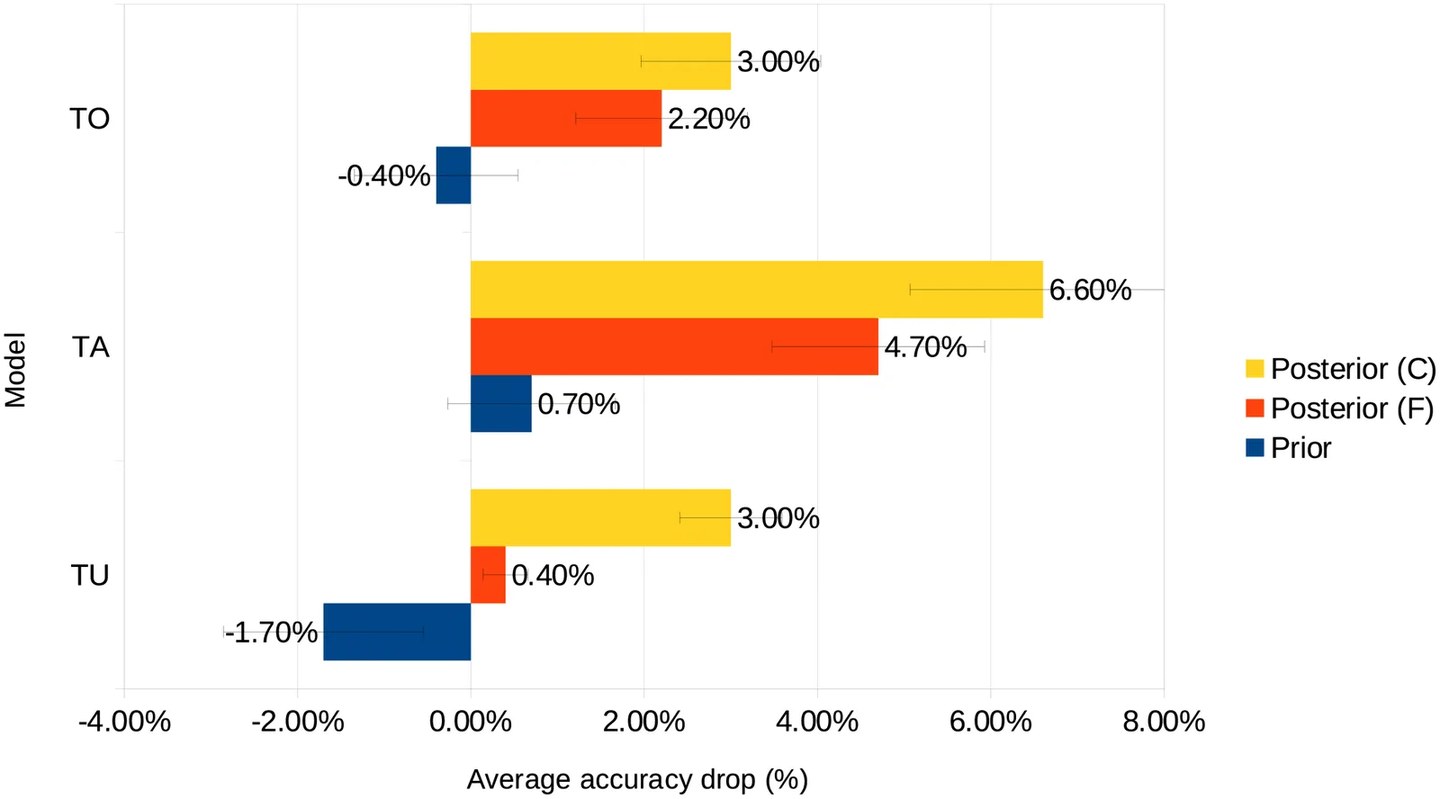
Evaluation used the BCI Competition IV-2a and IV-2b motor imagery datasets, covering 18 subjects with ten-fold cross-validation. After subject-specific fine-tuning, mean accuracy reached 87.9% ± 6.8% on Dataset B and 80.6% ± 8.6% on Dataset A. On compression, a task-unaware autoencoder reduced data size by 3.3 times while prior-model performance stayed within about 1% of the uncompressed baseline.
The paper also reports a counterintuitive finding: that task-unaware autoencoder, trained solely to reconstruct its input, consistently outperformed autoencoders that also carried classification objectives, giving the best accuracy-compression trade-off across every fine-tuning scenario. The authors are based at the University of Tehran, the Institute for Research in Fundamental Sciences, and Henry Ford Health System.