

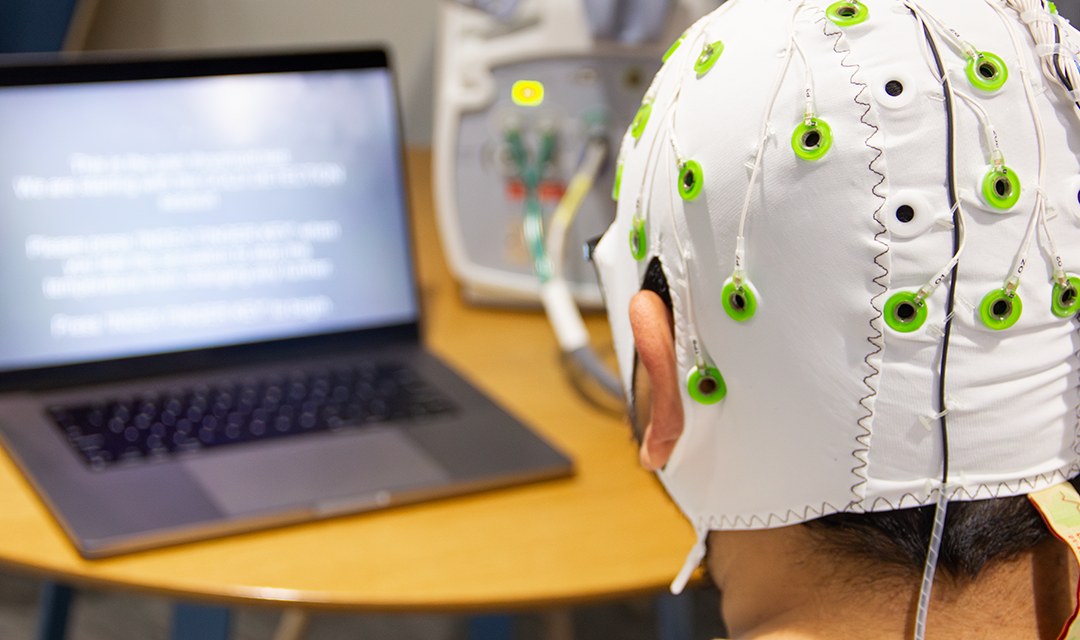
BCIwiki (bciwiki.com) — Training the user and the decoder at the same time let 31 people with no prior brain-computer interface (BCI) experience control a cursor with imagined movement at 86% average discrete accuracy in one dimension, a Carnegie Mellon University team led by biomedical engineering professor Bin He reported in Nature Communications.
The researchers say humans learn through trial, feedback and neural rewiring, while decoders update by fixed mathematical rules, so the two can drift apart. Their 'sensory-guided joint learning' framework addresses that mismatch. Participants sat before a monitor wearing an EEG cap, with vibrotactile actuators under both wrists. Tactile stimulation steered their mental strategies toward the decoder's target features, while an adaptive algorithm selectively weighted informative neural patterns.
Average discrete accuracy was 86% for one-dimensional and 77.5% for two-dimensional cursor control; continuous accuracy was 77.5% and 66.9%, respectively. He said such performance is rarely seen in users with limited training, and that the approach could support neurorehabilitation, assistive communication and prosthetic control. All participants were able-bodied, and the tasks were run in the lab.
The work was supported in part by the National Institute of Neurological Disorders and Stroke, the NIH BRAIN Initiative and a National Institute of Biomedical Imaging and Bioengineering training grant, according to the Biomedical Functional Imaging and Neuroengineering Laboratory. Postdoctoral associate Hanwen Wang is the first author.