

BCIwiki (bciwiki.com) — The study was published in Biosensors on August 12, 2026. Electroencephalography measured inside or around the ears, known as ear-EEG, provides a practical modality for daily brain-computer interface applications. However, reliable decoding of mental imagery remains challenging due to limited channels, low signal-to-noise ratio, and substantial inter- and intra-subject variability.
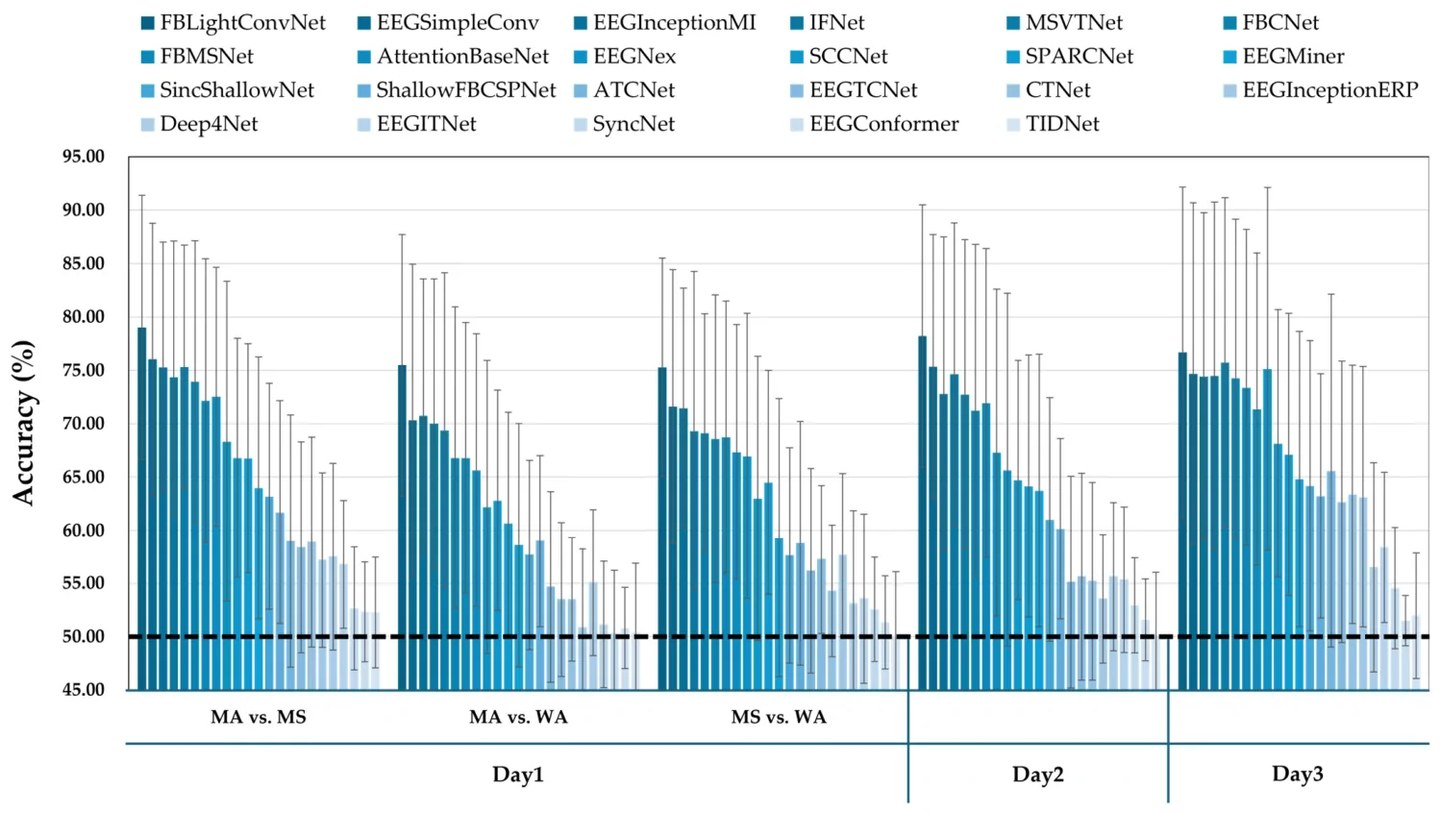
Researchers Ji-Seung Kim, Soo-In Choi, Han-Jeong Hwang, and Chang-Hee Han retrospectively analyzed an ear-EEG dataset from a previous real-time endogenous BCI study, benchmarking 23 deep neural network architectures originally developed for scalp-EEG. To the authors’ knowledge, this represents the first systematic comparison of this breadth for ear-EEG-based mental-task classification.
FBLightConvNet achieved the highest classification accuracy among all evaluated models, outperforming the widely adopted CSP-LDA baseline on all three recording days, with differences reaching statistical significance on Days 2 and 3. Notably, many state-of-the-art scalp-EEG models failed to generalize effectively to ear-EEG, underscoring the importance of architecture selection in this domain. The study offers practical design insights and a reproducible benchmarking framework for developing lightweight, high-performance deep learning models for real-world ear-EEG-based BCI systems.