

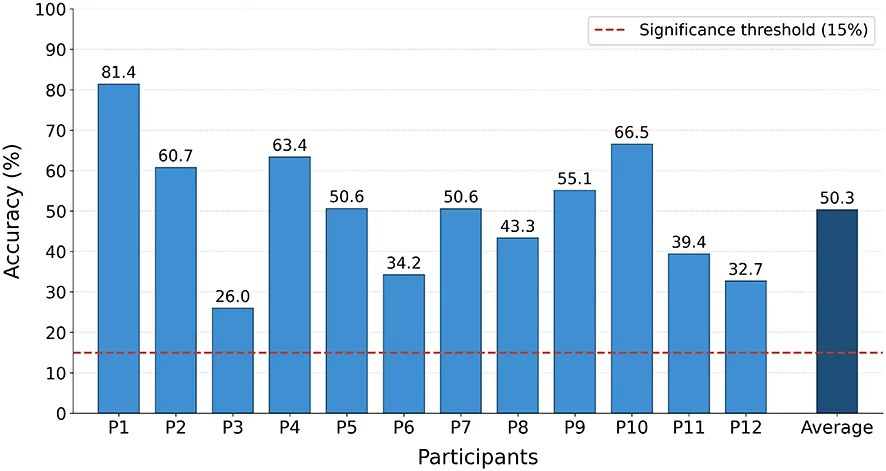
BCIwiki (bciwiki.com) — Imagining singing while also imagining moving a hand or the feet let an EEG-based brain-computer interface (BCI) tell apart up to 8 mental states, with average 8-class accuracy of about 50% against a 12.5% chance level, researchers at Memorial University of Newfoundland reported in Frontiers in Human Neuroscience on September 11, 2026 (PMID 42798362, DOI 10.3389/fnhum.2026.1912998).
Active BCIs detect brain activity patterns tied to intentionally generated mental tasks and translate them into commands for external devices. Motor imagery, the imagined movement of body parts, is the most common control paradigm, but it typically supports only a small number of commands. To add distinguishable states, the team introduced dual imagery tasks, in which singing imagery is performed simultaneously with motor imagery of one hand or both feet.
EEG was recorded from 14 healthy participants. After pre-processing, the researchers used filter bank common spatial patterns for feature extraction and a regularized linear discriminant analysis classifier in 3-, 4-, 7- and 8-class scenarios. The 3-class analyses tested whether each dual imagery task could be separated from its constituent single tasks; the 4-class analyses added a rest state; and the 7- and 8-class scenarios explored raising the number of control states beyond 6.
Peak accuracies reached 64.1% in the 3-class scenario and 63.0% in the 4-class scenario. In the 7- and 8-class scenarios, average accuracies of about 55% and 50% substantially exceeded theoretical chance levels of 14.3% and 12.5%.
The authors said the accuracies are not yet sufficient for practical high-command active BCIs, but that the results show combinatorial imagery can be classified from EEG and support dual imagery as a way to expand control states.