

BCIwiki (bciwiki.com) — A collaboration involving Kocaeli University, Türkiye, reported a four-class fNIRS BCI study in Sensors on October 27, 2026. Leave-one-subject-out cross-validation on a public dataset of 29 participants distinguished left- and right-hand motor imagery, mental arithmetic and rest, achieving 95.6% mean accuracy.
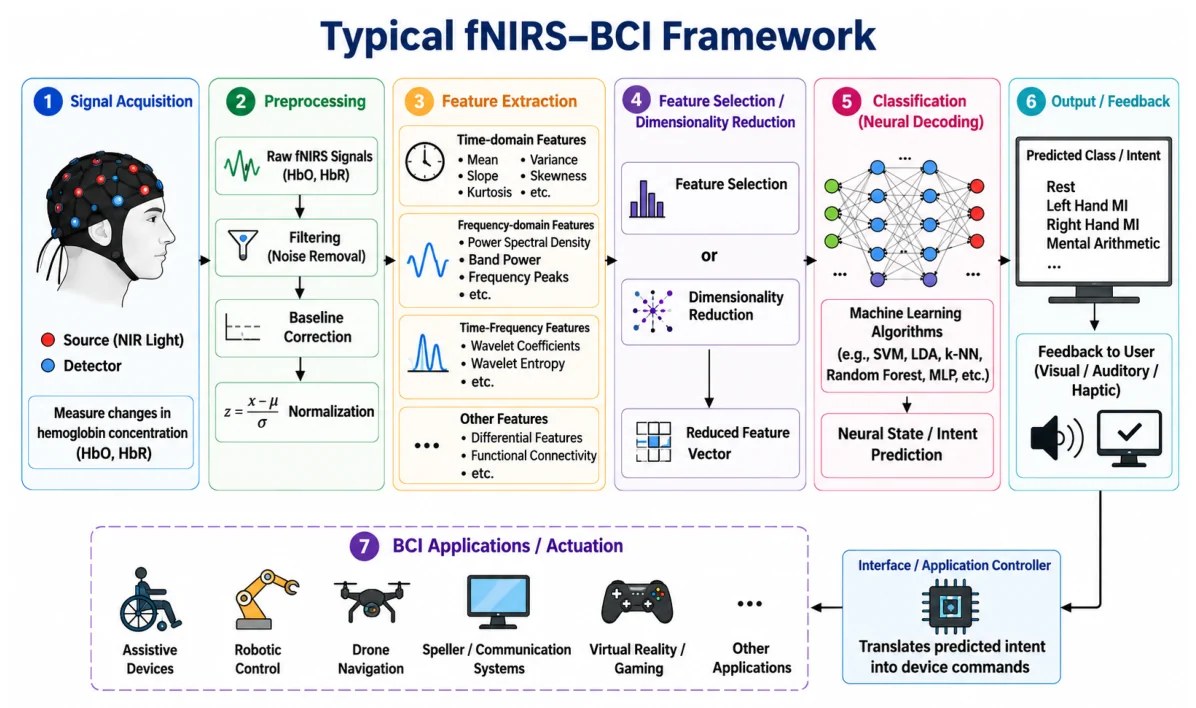
The framework combines six temporal hemodynamic descriptors with ten fNIRS-adapted Mel-frequency cepstral coefficients (MFCCs), capturing different aspects of the hemodynamic response. It learns sample-dependent weights for the two feature domains before classification with a multilayer perceptron, rather than simply concatenating the features.
Evaluation used an open-access dataset of 29 participants performing left-hand motor imagery, right-hand motor imagery, mental arithmetic and rest. Subject-independent leave-one-subject-out cross-validation held out each participant's data for testing in turn. AMFF achieved a mean accuracy of 95.6%, with precision, recall and F1-score of 94.6%, 95.9% and 95.3%, respectively.
Accuracy was 90.7% for temporal-only features, 95.0% for cepstral-only features and 95.2% for direct concatenation. Friedman and Holm-corrected Wilcoxon signed-rank tests confirmed significant differences for all four metrics. AMFF exceeded static concatenation for every participant, although accuracy gains were small, ranging from 0.2 to 0.7 percentage points.
The study notes that most of the improvement over temporal descriptors came from the cepstral domain, while adaptive weighting added a small but consistent refinement. MFCC parameter-sensitivity, coefficient-ablation and descriptor-ablation analyses further examined each domain's contribution. These findings come from cross-validation on a public dataset and do not establish performance in real-time BCI deployment.