

BCIwiki (bciwiki.com) — A single-subject feasibility study used an 8-channel OpenBCI Cyton board, an EEG cap placed on the international 10-20 system and a Meta Quest 2 headset to capture motor imagery and concentration signals, reaching up to 90% subject-specific online classification accuracy with the EEGNet deep learning model under stable signal conditions. The work was reported in Sensors on September 15, 2026.
The target setting is cognitive control training for attention-deficit/hyperactivity disorder (ADHD). The paper notes that integrating EEG sensors into virtual reality serious games for cognitive therapy remains relatively underexplored, and that existing solutions rely on multi-channel systems that are hardware-heavy and do not combine motor imagery with concentration levels.
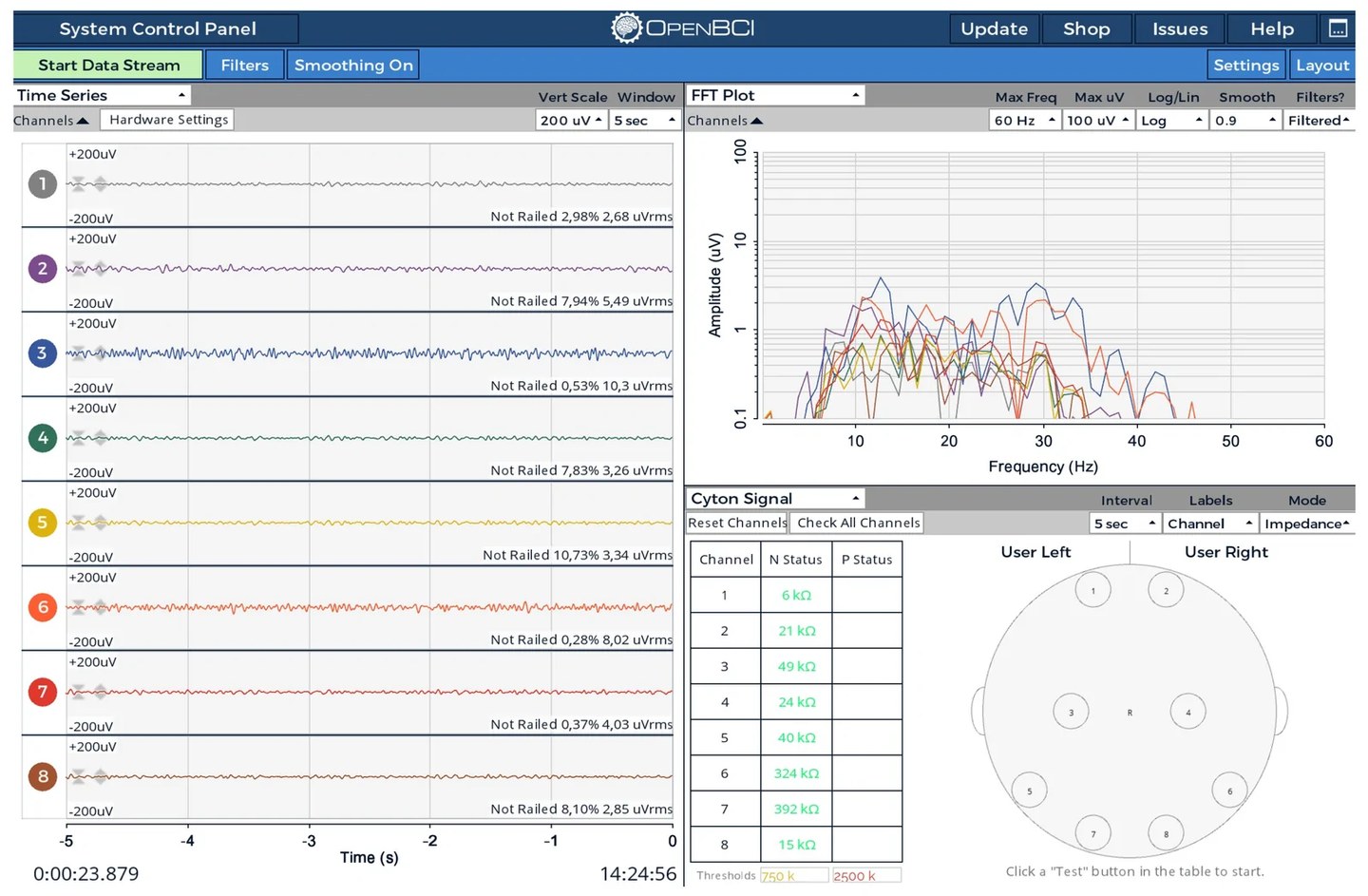
Signal acquisition was not smooth. High impedance and channel railing required mitigation with conductive gel, while mechanical tension from the VR headset strap introduced motion artifacts and noise, the paper reports. The authors conclude that the technical feasibility of a low-cost eight-channel setup in an interactive VR-BCI serious gaming application holds, provided skin-electrode impedance and mechanical sensor interference are managed.
The team is from the Research Group for Industrial Software (INSO) at TU Wien, RISE in Austria, and RISE Institute of Technology in India. The authors state the results are a basis for future investigation in cognitive-training applications, and that further studies, including clinical evaluations, are needed to assess applicability in therapeutic contexts.