

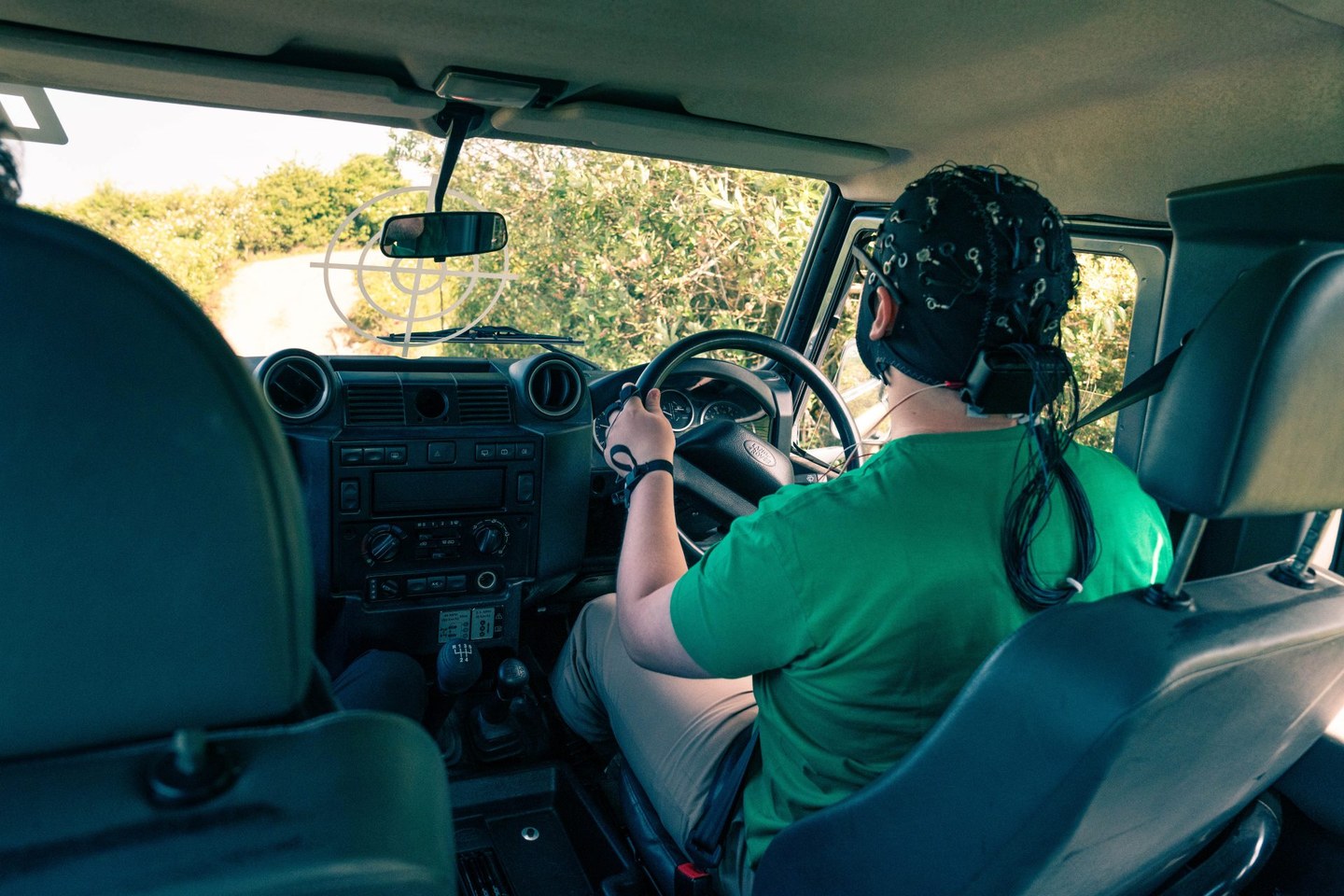
BCIwiki (bciwiki.com) — The thrill of driving is tied to focused engagement and a sense of control rather than to speed, according to a mobile EEG study that Brainbox ran at a closed test facility as part of Castrol EDGE's "Thrill of driving" project. Ten participants completed 6 driving conditions, ranging from low-speed off-road driving in a Land Rover Defender to track driving in a McLaren Artura GT4, with karting and a high-speed passenger ride also included, MBrainTrain reported.
Four modalities were recorded simultaneously in every condition: EEG, heart rate variability, galvanic skin response and eye tracking. EEG was acquired with mbt's Smarting PRO 32-channel system, and the primary measure was frontal-midline theta, an established marker of focused cognitive engagement. Extracting that measure reliably while a car is moving is considerably harder than in a typical stationary study.
The McLaren track condition produced the most pronounced flow-state signature of the 6: elevated frontal-midline theta alongside preserved alpha activity, a pattern consistent with sustained focus without cognitive overload. The passenger condition looked different. Theta and alpha power both fell while beta activity, associated with stress, rose — a profile the team read as anxiety rather than thrill. Karting supported that reading: despite comparatively modest speeds, it produced clearer signs of engaged, positive arousal than the high-speed passenger ride. Eye tracking agreed with the EEG. Drivers in the flow-state condition fixated longer on the racing line and blinked less; the passenger condition was marked by rapid, fragmented eye movements. Galvanic skin response tracked general physiological arousal but cannot by itself separate excitement from anxiety, which is why the study used a multimodal design.
Recording EEG in a moving vehicle adds noise sources that are largely absent when recordings are made in a fixed, controlled setting. Participants wore helmets, were exposed to lateral forces in corners and switched vehicles repeatedly during the day, each of which raises the risk of motion artifacts and electrode displacement. The team identified helmet removal between sessions as the period of greatest risk to signal quality. A pilot day before the main collection confirmed the cap could be worn under a helmet without compromising electrode contact, and a re-check protocol was applied after every helmet removal. Electrode impedances were checked across an extended field day rather than a single lab session, using a lightweight wireless amplifier built for recording during movement.
The results indicate that EEG of sufficient quality to distinguish engagement from stress can be obtained under real-world driving conditions, an approach the team says applies to conventional laboratory research as well as to clinical trials and field settings.