
/ EN
2026-08-20 00:00 Germany Papers Foundations & Methods Translated from EN

Motion-Based Visual BCI Reaches 85.67% Accuracy Without Flicker

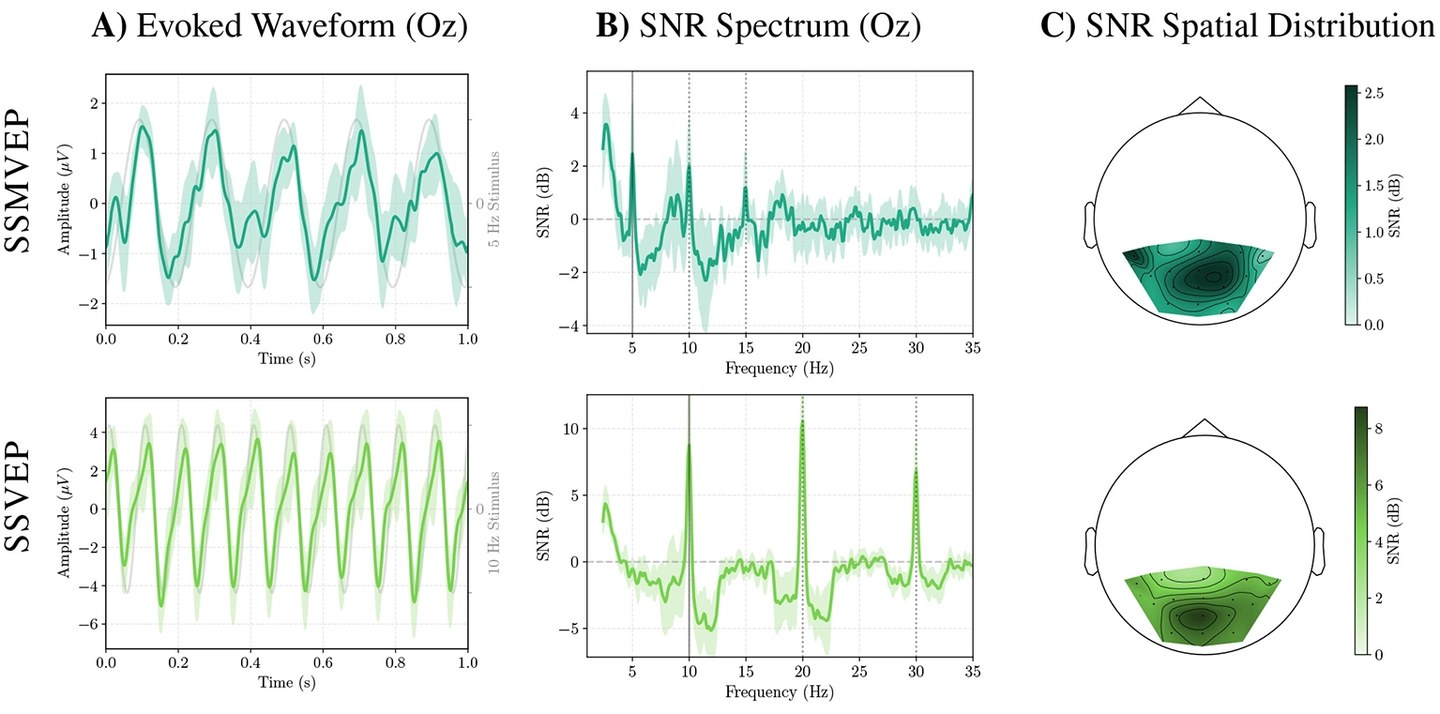
Summary A code-modulated motion visual-evoked-potential paradigm replaced flickering targets with pseudo-random motion sequences. In a four-target online BCI, it achieved 85.67% mean accuracy with a 2.61-second selection time—below c-VEP and SSVEP, but above steady-state motion VEP—while participants reported no clear comfort preference between motion and flicker.
Why it matters The head-to-head results show that motion can reduce reliance on flicker while retaining usable performance, although it does not yet match the strongest visual-evoked-potential paradigms.

运动代替闪烁刺激,新型脑机接口四目标准确率85.67%
Image: Frontiers in Neuroergonomics, CC BY 4.0

BCIwiki (bciwiki.com) — A new brain-computer interfacing paradigm that stimulates with motion instead of flicker reached a mean accuracy of 85.67% in an online four-target experiment. The study was published in Frontiers in Neuroergonomics on August 20, 2026.

The authors say the code-modulated motion visual evoked potential (c-MVEP) paradigm uses pseudo-random sequences to stimulate objects with motion, avoiding the visual discomfort and fatigue linked to flickering stimuli. In the online experiment, it reached 85.67% mean accuracy with an average selection time of 2.61 s, lower than c-VEP (97.81%; 1.15 s) and SSVEP (93.42%; 1.94 s) but higher than SSMVEP (64.91%; 4.18 s); subjective ratings showed no clear preference between motion- and flicker-based paradigms, indicating comparable user comfort.

Compiled by BCIwiki from public sources

Sources · 1
doi.org 2026-08-20
Read original ↗
Suggest a correction Revisions · none / EN
© 2026 BCIwiki.com Digest Topics Tips Subscribe Revisions About