

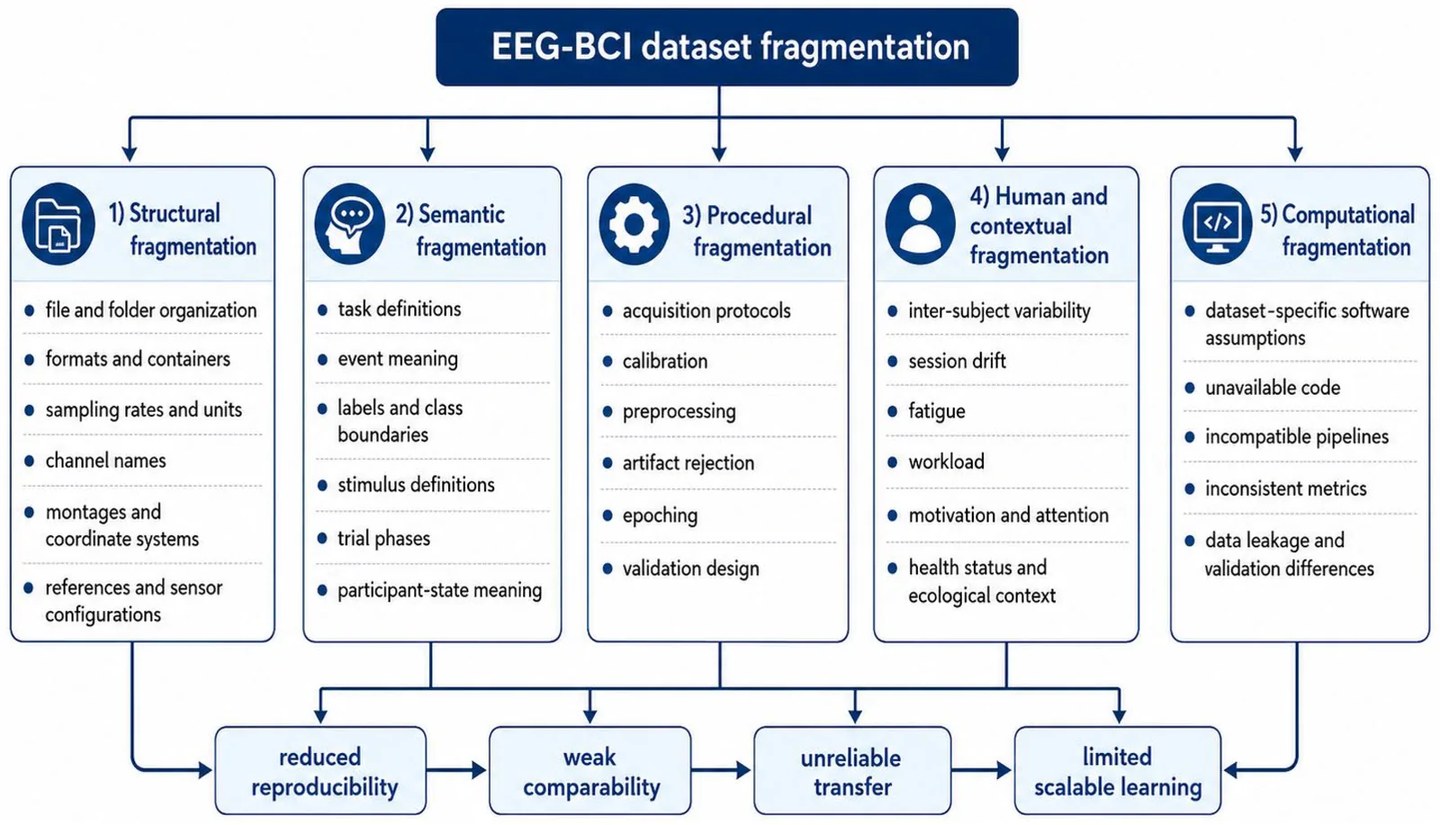
BCIwiki (bciwiki.com) — Public EEG brain-computer interface datasets are expanding quickly, but differences in sensors, experimental protocols, task and event semantics, preprocessing, participant context and evaluation design limit reproducibility and cross-dataset learning. Researchers at the Information Technology Faculty of Turiba University and the Institute of Information Technology at Riga Technical University mapped those differences in a systematic review reported in Sensors on September 15, 2026. The PRISMA-based mapping review searched Scopus, Web of Science Core Collection, IEEE Xplore, PubMed and the ACM Digital Library for literature published from 2014 to June 2026, yielding 16,920 records. After screening and evidence-focused curation, 129 publications were retained and confirmed by full-text review.
The review codes fragmentation across structural, semantic, procedural, human/contextual and computational layers, covering acquisition, channel layouts, task and event definitions, preprocessing, participant and session context, and evaluation design. Reporting transparency was assessed with 10 criteria; the median score in the retained corpus was 9 out of 10. Data availability was stated in 61.2% of publications and code or pipeline availability in 20.9%. The authors note that these frequencies describe the curated corpus rather than the field as a whole.
Existing standards, ontologies, software platforms, benchmark frameworks and transfer-learning methods address complementary layers but do not deliver complete semantic interoperability, according to the review. The authors argue that scalable cross-dataset analysis requires analysis-dependent compatibility rules, explicit provenance, contextual metadata and auditable transformations that preserve dataset identity, uncertainty and information loss.