

September 2026
Tsinghua Team Launches TrustBCI to Share BCI Data Without Moving It
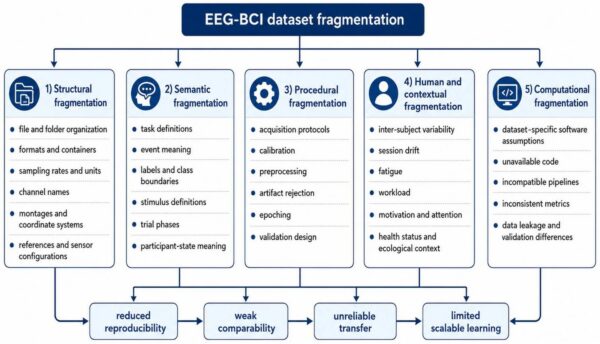
Training accurate BCI models depends on large, diverse EEG datasets, but that data is usually locked inside individual hospitals and labs, stored in inconsistent formats and restricted by privacy rules, which makes it hard to share. TrustBCI brings three functions into one platform: turning raw BCI datasets into assets that can be exchanged, using incentives to keep institutions contributing data, and letting users run computations without access to the raw records. The platform demonstrates two workflows, controllable data synthesis, which generates new datasets, and privacy-preserving query, which returns only query results. That suggests BCI models could be trained jointly across institutions without first pooling the data in one place.
August 2026
Chinese Academy of Sciences Team Releases BCIJelly Toolchain Unifying 18 BCI Datasets
BCI research has long been slowed by inconsistent data formats, divergent decoder implementations and incompatible deployment toolchains. BCIJelly standardizes 18 BCI datasets into inputs ready for AI training and integrates 15 benchmark decoders and 80 reusable modules. Its automated architecture search generates task-specific decoders without manual design and can extend into a large language model-driven closed-loop mode that supports single-task, multitask and cross-species decoder design; the system also offers interactive visualization software that requires no coding. A single-command pipeline compiles trained decoders onto neuromorphic hardware, cutting power consumption 30- to 50-fold while maintaining decoding performance. The work has been validated in humans, macaques and mice across five paradigms: motor, visual, speech, emotion and auditory. It is a preprint that has not been peer reviewed.
China's First National Standards for Brain-Computer Interfaces Take Effect
Two national standards for brain-computer interfaces took effect in China on 1 August 2026, the first foundational standards the field has had there. GB/T 47023 defines a reference architecture for BCI systems; GB/T 47127 sets a common format for multimodal data, down to directory structure and file naming. Both carry the GB/T prefix, marking them as recommended rather than mandatory, so they bind no one by law and work only as far as industry and procurement choose to adopt them.