
中 / EN

Singapore Institute of Technology

2 entries
October 2026

Singapore Institute of Technology Decodes Same-Hand Direction From EEG at 58.7%

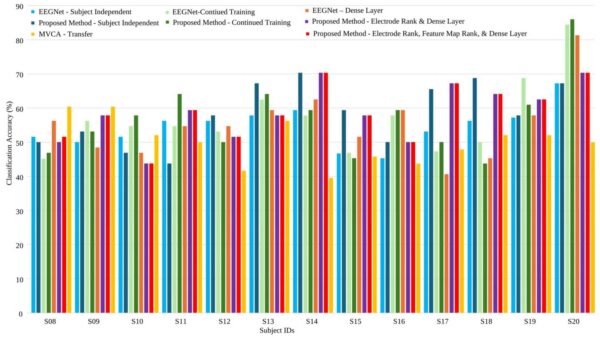
Researchers at the Singapore Institute of Technology decoded online whether 20 healthy subjects were imagining moving their dominant hand left or right, without actually moving, reaching an average accuracy of 58.7±8%, which they say beats existing deep learning models. The difficulty is that neural activity for different directions of the same hand overlaps heavily in space. The model uses EEGNet convolutional filters to extract temporal and spatial features, is trained first as a general model on pooled multi-subject calibration data and then fine-tuned per person, and its squeeze-and-excitation layers rank each electrode's contribution, offering a basis for personalized electrode layouts. Earlier studies mostly compared left versus right hand, largely offline. The work targets stroke rehabilitation but has been tested only in healthy people.
August 2026

Graph Convolutional Network-Based Harmonization of EEG for Cross-Dataset Transfer in MI-BCI

The study presents a spatial harmonization framework built on a two-layer graph convolutional network (GCN) that maps heterogeneous EEG recordings onto a unified physical electrode layout while preserving motor imagery information, addressing electrode-configuration mismatches across MI-BCI datasets. Each trial is modeled as a graph so the GCN captures spatio-temporal relations, and harmonized EEG showed lower error than spherical spline interpolation while retaining the key temporal-spectral-spatial features. Combining real and harmonized EEG lifted EEGNet accuracy from 56.57% to 66.20% and FBCNet from 61.96% to 72.54% in within-session classification on Dataset A, and supported source-only cross-dataset transfer and target-domain fine-tuning.
© 2026 BCIwiki.com Digest Topics Tips Subscribe Revisions About