
中 / EN
2026-10-01 00:00 Singapore Papers Foundations & Methods Source language EN

Singapore Institute of Technology Decodes Same-Hand Direction From EEG at 58.7%

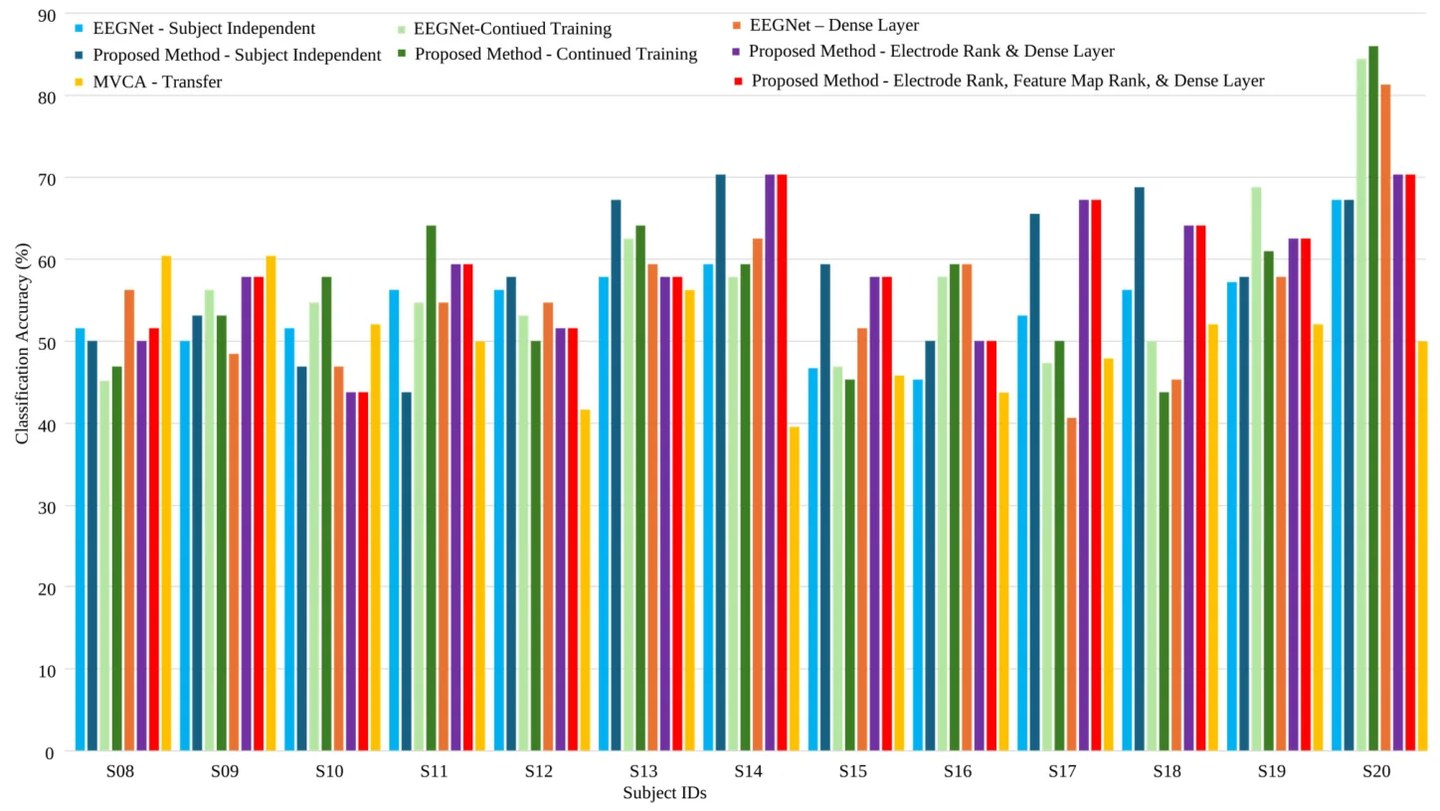
Summary Researchers at the Singapore Institute of Technology decoded online whether 20 healthy subjects were imagining moving their dominant hand left or right, without actually moving, reaching an average accuracy of 58.7±8%, which they say beats existing deep learning models. The difficulty is that neural activity for different directions of the same hand overlaps heavily in space. The model uses EEGNet convolutional filters to extract temporal and spatial features, is trained first as a general model on pooled multi-subject calibration data and then fine-tuned per person, and its squeeze-and-excitation layers rank each electrode's contribution, offering a basis for personalized electrode layouts. Earlier studies mostly compared left versus right hand, largely offline. The work targets stroke rehabilitation but has been tested only in healthy people.
Why it matters Reading direction within one hand would give motor-imagery BCIs a finer command set than the usual left-hand/right-hand split, and the test was run online rather than on replayed data. But 58.7% sits close to the 50% chance level of a two-class task, and stroke patients have not yet been tested.

新加坡团队用深度学习在线解码单手运动想象方向,平均准确率58.7%
Image: Sensors (Basel, Switzerland), CC BY 4.0

BCIwiki (bciwiki.com) — A deep learning framework decoded whether healthy subjects were imagining left or right movements of the same hand, reaching an average online accuracy of 58.7±8% across 20 people, researchers at the Singapore Institute of Technology reported in Sensors (Basel, Switzerland) on October 1, 2026 (PMID 42817507, DOI 10.3390/s26185951). The authors say the result outperforms existing deep learning models.

The work is aimed at stroke rehabilitation. Hemispheric strokes impair motor control on the opposite side of the body, and motor imagery-based brain-computer interfaces (BCIs) are thought to promote neuroplasticity. According to the paper, most deep learning studies decode bilateral imagery, such as left hand versus right hand, and evaluate offline. Decoding direction within a single hand would offer a more natural control interface with more degrees of freedom, but the underlying neural activity overlaps spatially.

The model uses EEGNet-based convolutional filters to extract temporal and spatial features, with squeeze-and-excitation (SE) layers that rank electrode importance and feature maps. A subject-independent model was trained on calibration data from multiple subjects, then fine-tuned for each individual and evaluated on that person's online session data.

The authors say the SE-layer ranking reveals each electrode's contribution and could support subject-specific BCI optimization. All subjects were healthy; the 58.7% average accuracy should be read against a 50% chance level for this binary task, and performance in stroke patients has not been tested.

Compiled by BCIwiki from public sources

Sources · 1

Singapore Institute of Technology timeline

2026-08 Graph Convolutional Network-Based Harmonization of EEG for Cross-Dataset Transfer in MI-BCI All entries →
Read original ↗
Suggest a correction Revisions · none 中 / EN
© 2026 BCIwiki.com Digest Topics Tips Subscribe Revisions About