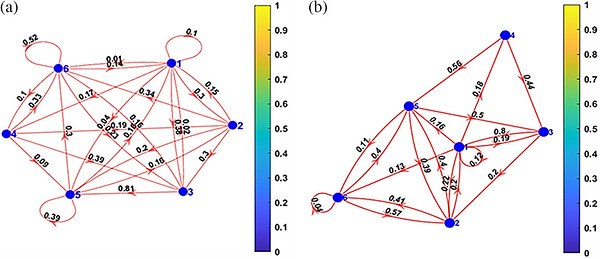
A new study proposes a hybrid Markov chain-spatial statistical (MCSS) machine learning framework for classifying motor imagery EEG, reporting classification accuracy above 98% for every subject on BCI Competition III datasets IVa and IVb when paired with a support vector machine. Because the method discretizes signals into symbolic states and works from transition probability matrices rather than raw traces, the original neural waveforms are hard to reconstruct; the authors report that membership inference attacks stayed near chance level and that feature inversion attacks produced low reconstruction similarity.
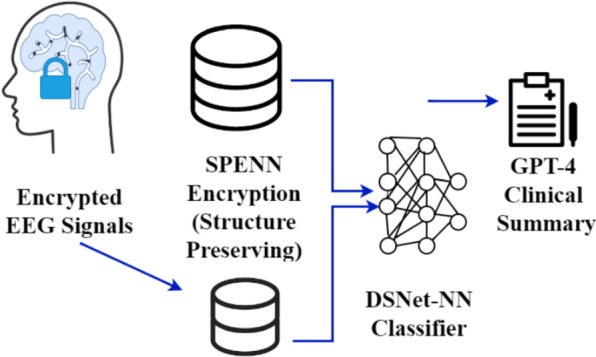
The study presents DSNet, a deep denoising structure-preserving neural encoding network that classifies privacy-preserving encoded EEG without decryption. Common spatial pattern (CSP) features are converted to irreversible neural codes — an irreversible neural transformation designed for privacy rather than a formal cryptographic guarantee — and two deep-learning architectures (a feedforward network and a recurrent RNN) classify in the encoded feature space. On public datasets, DSNet-NN exceeded 87% accuracy for every subject, outperforming the RNN variant and baselines while staying resilient to simulated privacy attacks; the study also integrated GPT-4 to generate clinical-style summaries from model outputs.