
/ EN
2026-07-22 00:00 Australia Papers Foundations & Methods Translated from EN

MCSS Framework Tops 98% Motor Imagery Accuracy While Resisting EEG Reconstruction

Summary A new study proposes a hybrid Markov chain-spatial statistical (MCSS) machine learning framework for classifying motor imagery EEG, reporting classification accuracy above 98% for every subject on BCI Competition III datasets IVa and IVb when paired with a support vector machine. Because the method discretizes signals into symbolic states and works from transition probability matrices rather than raw traces, the original neural waveforms are hard to reconstruct; the authors report that membership inference attacks stayed near chance level and that feature inversion attacks produced low reconstruction similarity.
Why it matters Neural data privacy has so far been argued in policy papers rather than built into pipelines; a representation that is hard to invert but still classifiable moves the question from regulation to engineering — read with the usual caveat that benchmark datasets are not deployment.

新算法在脑机接口运动想象分类中兼顾高准确率与隐私保护
Image: Healthcare Technology Letters, CC BY 4.0

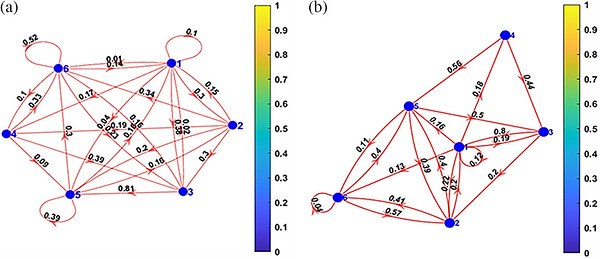
BCIwiki (bciwiki.com) — A new machine learning framework achieves both high accuracy and privacy protection in motor imagery EEG classification, according to a study published in Healthcare Technology Letters on July 22, 2026. The framework, proposed by researchers at Victoria University in Australia, discretizes spatially filtered EEG signals into six symbolic amplitude states and constructs transition probability matrices as the primary feature representation, making it difficult to reconstruct the original neural waveform.

The framework was evaluated on BCI Competition III datasets IVa and IVb using three machine learning algorithms. The MCSS combined with a support vector machine achieved consistently high classification accuracy (>98%) across all subjects, demonstrating strong robustness and cross-subject stability. Privacy evaluation showed that membership inference attacks remained close to chance level, and feature inversion attacks exhibited low reconstruction similarity. The research team stated that the framework provides an accurate, computationally efficient, and privacy-preserving solution for scalable BCI development.

Compiled by BCIwiki from public sources

Sources · 1
doi.org 2026-07-22

Victoria University timeline

2026-07 A Novel Deep Learning Approach for Privacy-Preserving Encoded EEG-Based BCIs with Clinical LLM Applications All entries →
Read original ↗
Suggest a correction Revisions · none / EN
© 2026 BCIwiki.com Digest Topics Tips Subscribe Revisions About