/ EN

Australia

7 entries
September 2026

Synchron Stent Electrode Beats Scalp EEG per Channel in One ALS Patient

A participant with severe upper-limb paralysis caused by amyotrophic lateral sclerosis (ALS) wore an endovascular stent-electrode array and a scalp EEG cap at the same time, in the same session, while attempting ankle flexion and extension. Both recordings changed markedly during attempted movement, but the stent array showed stronger per-channel motor modulation and was unaffected by skull attenuation. Scalp EEG was more susceptible to eye blinks and jaw-muscle activity, while the stent array picked up prominent cardiac signals. Neither method reliably distinguished left from right ankle movement, leaving spatial localization an open problem.
Carnegie Mellon Team Strips ECG Noise From Stentrode, Keeps Motor Signals

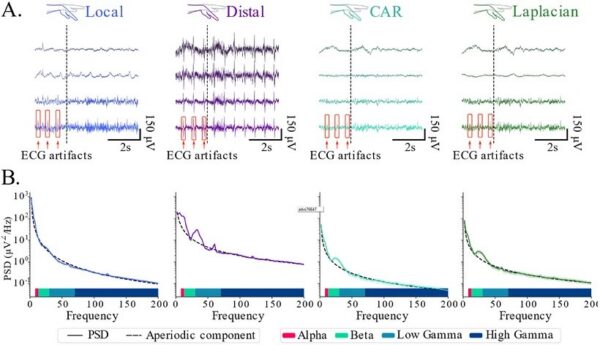
Stentrode, an endovascular brain-computer interface, often picks up electrocardiogram (ECG) artifacts. Researchers at Carnegie Mellon University and colleagues found that conventional re-referencing schemes reduce ECG artifacts but also diminish beta-band activity linked to movement. They applied band-limited independent component analysis (BL-ICA) as a spatial filter to remove ECG artifacts while preserving motor features. The study appeared in Advanced Science.
August 2026

Endovascular Electrodes Evoke Cortical Responses

The study was published in Journal of neural engineering on August 13, 2026, presenting the first strength-duration characterization of cortical evoked potentials elicited by endovascular stimulation adjacent to the cerebellum. The authors note that electrical stimulation and neural recording underpin neural prostheses for restoring function and treating neurological disorders, but that clinical adoption is limited by the invasiveness of implantation, while the Endovascular Neural Interface offers an alternative by accessing intracranial targets through the cerebral vasculature. A polymer-based stent-electrode array was deployed into the left transverse sinus of an ovine model, and biphasic current pulses targeting the cerebellum were delivered via the stent electrodes while a subdural electrocorticography grid recorded cortical responses. Endovascular stimulation consistently evoked time-locked cortical potentials with early and late components at approximately 40 ms and 100 ms post-stimulation, and impedance monitoring confirmed electrode functionality and stability throughout. Strength-duration analysis revealed rheobase and chronaxie values, providing a quantitative basis for parameter selection and comparison with established intracranial stimulation modalities.
July 2026

MCSS Framework Tops 98% Motor Imagery Accuracy While Resisting EEG Reconstruction

A new study proposes a hybrid Markov chain-spatial statistical (MCSS) machine learning framework for classifying motor imagery EEG, reporting classification accuracy above 98% for every subject on BCI Competition III datasets IVa and IVb when paired with a support vector machine. Because the method discretizes signals into symbolic states and works from transition probability matrices rather than raw traces, the original neural waveforms are hard to reconstruct; the authors report that membership inference attacks stayed near chance level and that feature inversion attacks produced low reconstruction similarity.

A Novel Deep Learning Approach for Privacy-Preserving Encoded EEG-Based BCIs with Clinical LLM Applications

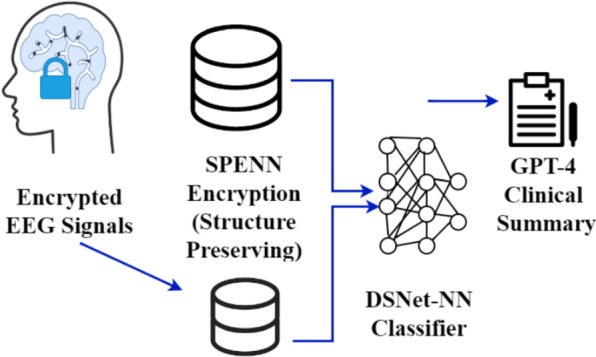
The study presents DSNet, a deep denoising structure-preserving neural encoding network that classifies privacy-preserving encoded EEG without decryption. Common spatial pattern (CSP) features are converted to irreversible neural codes — an irreversible neural transformation designed for privacy rather than a formal cryptographic guarantee — and two deep-learning architectures (a feedforward network and a recurrent RNN) classify in the encoded feature space. On public datasets, DSNet-NN exceeded 87% accuracy for every subject, outperforming the RNN variant and baselines while staying resilient to simulated privacy attacks; the study also integrated GPT-4 to generate clinical-style summaries from model outputs.
June 2026

FDA Approves Label Changes for Saluda Medical's Spinal Cord Stimulators

The FDA approved a premarket approval (PMA) supplement, S039, from Saluda Medical Pty, Ltd. on June 29, 2026, covering the CAP24 Paddle Lead, Passing Elevator, Evoke CLS (REF 3042), Clarity Programming Application (CPA) and RECAP Viewer. The supplement is a labeling change touching indications, instructions for use, shelf life and trade name rather than an original approval of a new device; the products carry the generic name 'stimulator, spinal-cord, totally implanted for pain relief.' Saluda Medical is an Australian company whose Evoke system is one of the few closed-loop spinal cord stimulators on the market.
November 2025

Synchron Raises $200 Million Series D, Bringing Total Funding to $345 Million

Synchron raised a $200 million Series D led by Double Point Ventures, taking its total funding to $345 million. The company plans to use the capital to commercialize its Stentrode endovascular BCI, prepare pivotal trials and expand its AI and engineering teams. Synchron said 10 people with paralysis had received the implant in U.S. and Australian trials at the time of the announcement.
© 2026 BCIwiki.com Digest Topics Tips Subscribe Revisions About