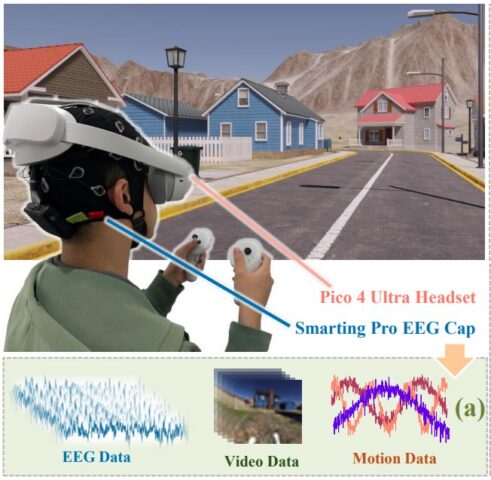
Researchers at Beihang University and Tsinghua University in Beijing built a multimodal contrastive learning framework that pairs EEG with synchronized video and motion data to detect cybersickness in virtual reality, representing the EEG as a connectivity graph and using an attention-based encoder to map the video and motion streams onto the same structure. Fusing all three signals separated cybersick from non-cybersick states more cleanly than any single modality or pair, and the model automatically pruned prefrontal connections unrelated to cybersickness. The setup used mBrainTrain's Smarting PRO 32-channel wireless EEG system and a Pico 4 Ultra headset, with 29 healthy adults navigating a VR scene under their own control.