
/ EN
2026-07-02 00:00 France Papers Foundations & Methods Translated from EN

BIOSerenity's E1 Foundation Model Posts Strong Results on Four Clinical EEG Tasks

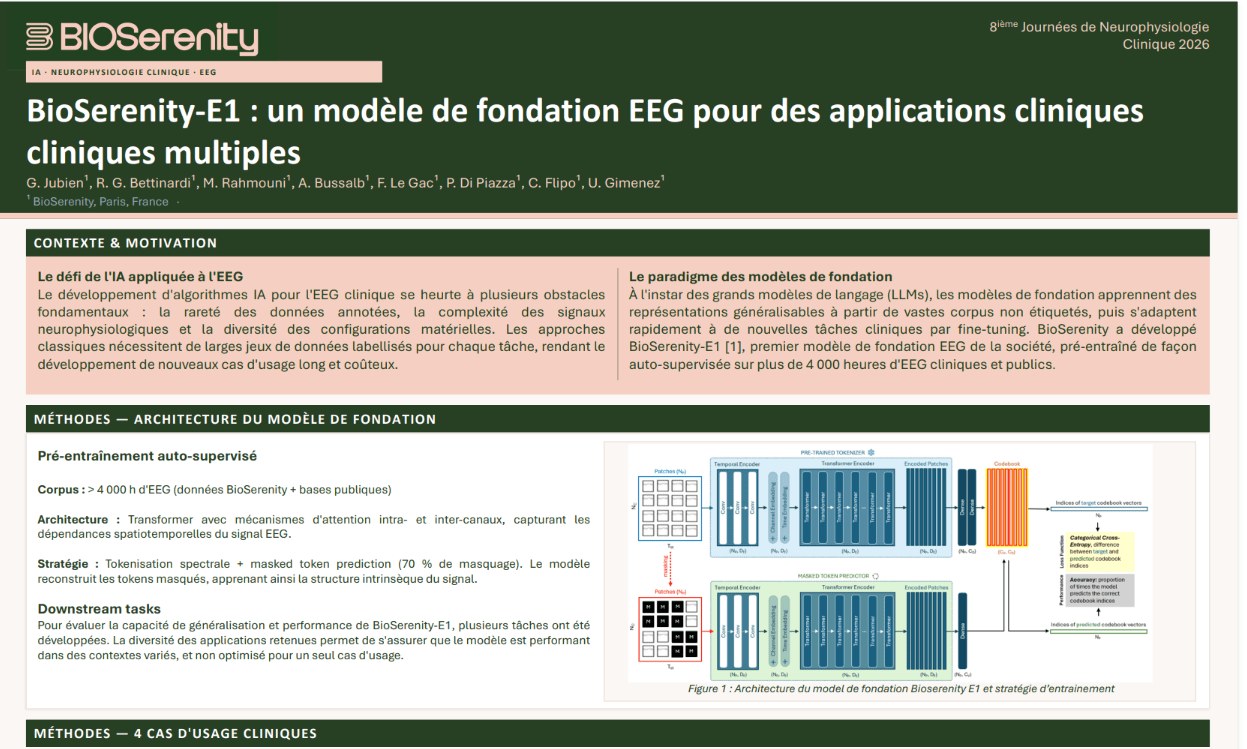
Summary French medtech company BIOSerenity has built an EEG foundation model, BIOSerenity-E1, pre-trained self-supervised on more than 4,000 hours of recordings, and reports strong results on four clinical tasks: normal/abnormal classification, Alzheimer's disease detection, pediatric sleep staging and seizure detection. The normal/abnormal algorithm is already built into a CE-marked medical device, and the seizure-detection algorithm is in clinical evaluation. The work will be shown as a poster at the 8th Journées de Neurophysiologie Clinique in Grenoble, France.
Why it matters The four benchmarks matter less than the regulatory position: one head of this pretrained model already sits inside a CE-marked device, which puts foundation-model EEG on the clinical side of the line and, if it holds, cuts how much labelled data each new indication needs.

BIOSerenity发布EEG基础模型,在四项临床任务上表现强劲
Image: BIOSerenity

BCIwiki (bciwiki.com) — BIOSerenity, a French medtech company, has developed an EEG foundation model, BIOSerenity-E1, pre-trained in a self-supervised manner on more than 4,000 hours of EEG data, and demonstrated strong performance across four clinical tasks, according to a blog post published by BIOSerenity on July 2. The work will be presented as a poster at the 8th Journées de Neurophysiologie Clinique in Grenoble, France.

BIOSerenity said that a major challenge in developing AI algorithms for clinical EEG is the scarcity of annotated data. Traditional approaches require large labeled datasets for each new task, making development time-consuming and costly. The model was evaluated on four tasks: normal/abnormal classification, Alzheimer's disease detection, pediatric sleep staging, and seizure detection. Results showed strong performance across all tasks, with high generalizability confirmed on independent external cohorts across heterogeneous populations and modalities. The normal/abnormal algorithm is already integrated into a CE-marked medical device, and the seizure detection algorithm is currently undergoing clinical evaluation. BIOSerenity described these as first concrete steps toward clinical deployment of BIOSerenity-E1.

The abstract, titled "BIOSerenity-E1: a foundation EEG model for multiple clinical applications," has been accepted for poster presentation at the conference.

Compiled by BCIwiki from public sources

Sources · 2
bioserenity.ai 2026-07-02

BIOSerenity timeline

2026-07 BIOSerenity Trains EEG Models on Jean Zay, Finds Scaling Diverges From Language AI All entries →
Read original ↗
Suggest a correction Revisions · none / EN
© 2026 BCIwiki.com Digest Topics Tips Subscribe Revisions About