
/ EN

Clinical Translation

64 entries

Clinical translation is the critical phase bridging BCI research and patient care, involving regulatory approvals, trial design, long-term safety assessment, and commercialization. This topic covers FDA and NMPA regulatory updates, Breakthrough Device designations, and the journey from first-in-human trials to market.

September 2026

Singapore Trial Tests EEG-Headband Games for Rehab in Children With Brain Injury

KK Women's and Children's Hospital in Singapore has registered a clinical trial of brain-computer interface neurofeedback training (BCI-NFT) for children and adolescents aged 7 to 21 with acquired brain injury from causes including traumatic brain injury, stroke, encephalitis, brain tumors and epilepsy. The intervention group will complete 12 sessions of about 60 minutes each over 10 weeks, wearing a wireless EEG headband while interacting with neurofeedback computer games; the control group receives standard care first and then crosses over to training. A cohort of peers with no history of brain injury will provide normative EEG data. The trial plans to enroll 70 participants, with primary endpoint results expected in February 2028.
Anhui Pushes BCI Milestones to 2028, Hands Research Lead to USTC

Anhui issued a 2026-2030 BCI action plan on June 15, 2026 that sets its near-term milestones in 2028 rather than 2027 and frames every target as a minimum, including at least three approved invasive BCI clinical trials. Research leadership goes to the University of Science and Technology of China, with Hefei as the hub, Bengbu handling key components and Wuhu clinical translation.

Beijing's BCI Plan Sets No Output Targets, Bets on Companies Instead

Beijing issued China's first provincial-level brain-computer interface (BCI) action plan on January 7, 2025, setting every 2027 and 2030 target in terms of companies and platforms rather than output or revenue. The plan calls for three to five unicorns or would-be unicorns by 2027 and around 100 innovative small and medium-sized firms by 2030. On the payment side, Beijing prices invasive BCI implantation at RMB 7,980 per procedure and covers all three BCI service fees under Category A of basic medical insurance, limited to four hospitals.

Shanghai Aims to Partially Restore Sight With BCIs by 2030

Shanghai's science and technology commission issued a BCI action plan on January 10, 2025, pledging to help blind patients partially regain sight by 2030 and to have more than five invasive or semi-invasive products complete medical device type testing by 2027. The city's healthcare security bureau created three BCI service fee items in August 2025 but left prices to hospitals and explicitly excluded them from basic medical insurance payment.

Sichuan Targets 3,000 Invasive BCI Operations a Year by 2030

Sichuan's industry department and seven other agencies issued a BCI and human-machine interaction plan on May 12, 2025, targeting 3,000 invasive BCI operations a year by 2030 and the registration of three invasive and five non-invasive products by 2027. The province prices BCI services in five tiers by hospital grade, with implantation ranging from RMB 6,583 to RMB 4,389, all paid out of pocket.

Shandong Health Commission Leads 16-Agency Push on BCI Clinical Validation

Shandong's health commission and 15 other agencies issued a BCI clinical translation plan on July 7, 2026, following a 2025 industry plan led by the provincial science department. The 14-measure plan sets up a clinical research alliance and a provincial clinical database, cuts review time for Class II devices to 90 working days, and targets more than 30 multicenter validation projects and a RMB 2 billion industry by 2028.

Jiangxi Sets 10-Day Clock for Mutual Recognition of BCI Ethics Reviews

Jiangxi issued BCI support measures on November 26, 2025 that set no numeric targets but called for mutual recognition of clinical research ethics reviews, and its health commission followed on May 26, 2026 with guidance requiring participating sites to finish recognition reviews within 10 working days. Invasive projects for neurological or psychiatric treatment also need provincial expert review within 20 working days.

Jiangsu Opens BCI Trials to Nuclear, Mining and Power Industries

Jiangsu's industry department and eight other agencies issued a BCI action plan in March 2026 that invites companies in hazardous chemicals, nuclear power, mining and electric power to pilot the technology first. Nearly all its numeric targets, including at least 20 registered medical products, fall in 2030, and a widely cited RMB 6,600 implant price appears only in a 2025 draft, not in the province's final pricing notice.

Tianjin Stakes BCI Product Targets on Non-Invasive Devices

Tianjin's municipal government issued a 2026-2030 BCI action plan on May 26, 2026 that limits every numeric product target to non-invasive devices, aiming for more than ten in large-scale clinical use by 2030, while invasive products get a single unquantified approval goal. The plan also targets an industry fund cluster of more than RMB 10 billion by 2030.

Guangdong Plans 200 BCI Wards and Splits Roles Between Shenzhen and Guangzhou

Guangdong's provincial Party science and technology committee office issued a 2026-2030 BCI plan on June 5, 2026 that calls for 200 BCI hospital wards serving more than 500,000 patients cumulatively by 2030. The plan assigns invasive devices and signal decoding to Shenzhen and non-invasive systems to Guangzhou, and follows provincial BCI prices set nine months earlier, with implantation capped at RMB 6,600.

Zhejiang, First to Reimburse BCI Fees, Cuts Device Review to 40 Days

Zhejiang became the first Chinese province to reimburse a BCI service when it covered non-invasive fitting fees under Category B insurance from September 1, 2025, limited to smart bionic prosthesis fittings. Its 18 industry-academia-research measures, dated July 16, 2026, cut review of qualifying Class II BCI devices to 40 working days and offer research hospitals up to RMB 8 million per project.

Tsinghua Team Launches TrustBCI to Share BCI Data Without Moving It

Training accurate BCI models depends on large, diverse EEG datasets, but that data is usually locked inside individual hospitals and labs, stored in inconsistent formats and restricted by privacy rules, which makes it hard to share. TrustBCI brings three functions into one platform: turning raw BCI datasets into assets that can be exchanged, using incentives to keep institutions contributing data, and letting users run computations without access to the raw records. The platform demonstrates two workflows, controllable data synthesis, which generates new datasets, and privacy-preserving query, which returns only query results. That suggests BCI models could be trained jointly across institutions without first pooling the data in one place.

Generative AI Lowers the Bar for BCI Attacks, Putting Cognitive Autonomy at Risk

Researchers have mapped the brain-computer interface (BCI) attack surface along five dimensions (forged neural signals, desynchronization-based evasion, replay hijacking, "Vein Tapping" eavesdropping and embedded backdoors), which they group as "NERVE Attacks" and describe as orthogonal and together spanning the full BCI stack. Their EEGle framework, which the team is releasing to the community for building and verifying device security, surfaced 17 new neuro-specific attack instances and a stealth-versus-effectiveness trade-off in backdoor design. The authors warn that generative AI is lowering the barrier for non-expert attackers, with risks to cognitive autonomy, mental privacy and physical safety, from neural data exfiltration to malicious control of BCI-connected devices. The preprint, by Zahra Tarkhani, Georgios Akkogiounoglou, Lorena Qendro, Isabel Tscherniak and Anil Madhavapeddy, has not been peer reviewed.

KU Leuven Team Finds EEG Tracking of Moving Objects Weakens Farther From the Gaze Point

Even when the eyes stay fixed on one point, the brain tracks moving objects in a video, and that tracking grows stronger with attention. But researchers at KU Leuven found that EEG tracking of an object's motion weakens the farther the object sits from the fixation point, meaning decoding methods that read attention from tracking strength may mistake where an object is for where attention is.

Implant-Grade BCI Preserves Epilepsy HFO Biomarkers, Maps Onset Zone at 84% Sensitivity

A wireless implantable neural interface, the Brain Interchange (BIC), paired with artifact-removal algorithms captured about 82% of the high-frequency oscillations (HFOs) that a clinical-grade amplifier detected across 24-hour intracranial EEG recordings in 10 patients with drug-resistant epilepsy, according to a preprint. Using those HFOs, the system localized the seizure onset zone with 84% sensitivity and 90% specificity, comparable to clinical equipment. The authors present the work as a translational framework for chronic tracking of epileptogenic networks and for future biomarker-guided adaptive neuromodulation.
August 2026

Roadmap Counts More Than 150 Children Worldwide With Implanted BCIs

Researchers report that more than 150 children worldwide have received implanted brain-computer interfaces, a number expected to grow quickly as the devices reach the market. A 2026 paper in Neurorehabilitation and Neural Repair spells out a roadmap for pediatric iBCI development, including work from the first International Virtual Summit on Implanted BCIs for Children with Complex Needs and workshops at the 11th International BCI Society Meeting. It highlights unresolved questions about early-life implantation and pediatric indications that must be answered before the technology is deployed widely in children.

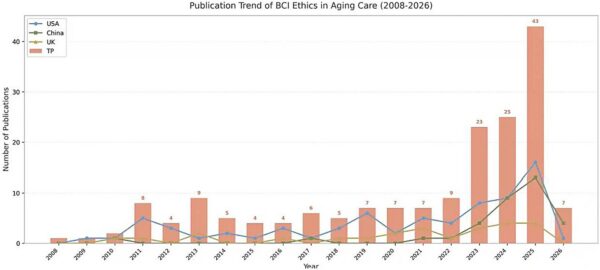
BCIs in Elderly Care: Review of 177 Studies Maps Six Ethical Themes

A systematic review in Frontiers in Digital Health screened 12,423 records and analyzed 177 studies of brain-computer interfaces in elderly care, identifying six recurring ethical themes: privacy and data security, informed consent and autonomy, personhood and identity, technical risk and safety, equity and access, and risk-benefit trade-offs. The authors argue those risks are built into the technology's interaction logic rather than sitting at its margins: decoding uncertainty can turn into care misjudgment, the inferability of neural data extends privacy exposure into psychological territory and power asymmetry, and technology-mediated communication strains trust and accountability. Responsible deployment, they conclude, requires embedding ethical principles systematically into care processes.

BCI Society Workshop Tackles Outcome Measures for Pivotal Trials

A workshop at the BCI Society Meeting 2025, run with the Implantable BCI Collaborative Community (iBCI-CC), took up how clinical outcome assessments (COAs) for pivotal BCI trials should be selected, developed and validated. Participants pointed to patient heterogeneity, the absence of widely validated COAs, and the difficulty of capturing outcomes that matter in home and daily-life settings. The discussion lays groundwork for the iBCI-CC Clinical Study Endpoints Workgroup to build a transparent process for identifying meaningful aspects of health and concepts of interest, in support of regulatory approval and reimbursement.

Review Outlines Three BCI Paradigms for Post-Stroke Hand Rehabilitation

A review in Topics in Stroke Rehabilitation maps the neurophysiological basis of non-invasive EEG-based brain-computer interfaces for post-stroke hand recovery and sorts the field into three paradigms: motor imagery with physical feedback, motor imagery with virtual or multisensory feedback, and steady-state visual evoked potential (SSVEP)-driven training. These systems decode sensorimotor-cortex rhythms during imagined hand movement in real time to drive exoskeletons, functional electrical stimulation or virtual reality, closing a Hebbian feedback loop meant to strengthen or remodel damaged pathways in patients whom conventional rehabilitation, which depends on active movement, often cannot reach. Studies confirm the approaches can improve upper-limb function, the review says, but clinical adoption still faces low signal-to-noise ratios, wide individual variability and 'BCI blindness.'

LibriBrain100 Releases Over 100 Hours of MEG Data, Some 80 From One Subject

LibriBrain100, a magnetoencephalography (MEG) dataset released on August 25, 2026, contains more than 100 hours of high-quality recordings, about 80 of them from a single subject, the deepest within-subject collection of its kind. It is meant as a standardized benchmark for neural speech decoding and ships with open-source tooling and an online competition; a further 32 subjects contribute roughly 40 minutes each to offset thin per-subject data. Using an existing decoding model, the team reported state-of-the-art results on a word-classification benchmark, which it takes as evidence of both data quality and the value of deep within-subject recording.

Children Designing Their Own P300 BCI Interface Choose Animation, Color and Sound

Thirty-eight typically developing children aged 8 to 12 used a design application to build their own picture-based interface for a P300 brain-computer interface augmentative and alternative communication (P300-BCI-AAC) system, in a study of what children themselves want from such interfaces. They consistently chose preferred colors, animation — zooming most of all — and sound cues: animation aided visual accessibility and target location, background color changes carried preferred colors into the display, and video GIFs and picture overlays added personal relevance. The authors call motion, color, personalization and visual clarity preliminary priorities for pediatric BCI-AAC design, and point to follow-up work with children who use AAC daily and with people who have motor difficulties.

Stanford Team Records Psychiatric Brain Circuits at Millisecond Precision

A Stanford program is recording brain activity in psychiatric inpatients at millisecond precision, combining noninvasive electrode arrays with deep brain recording electrodes to trace the circuits behind schizoaffective disorder, borderline personality disorder, autism and cancer-induced depression. The Human Neural Circuitry program, led by neuroscientist Karl Deisseroth at the Wu Tsai Neurosciences Institute, has run for three years and moves data over fiber-optic and copper links fast enough for round trips of under half a millisecond, allowing the system to sense and respond in a closed loop. Deisseroth said the key innovation is getting results at millisecond precision, which he called a crucial step toward understanding complex psychiatric symptoms.

Chinese Insurers Begin Covering BCI Procedures and Surgical Risk

Chinese insurers have begun introducing BCI-related coverage. Shanghai's 2026 Hu-huibao plan added up to 150,000 yuan for out-of-pocket materials used in inpatient BCI surgery, PICC Property and Casualty underwrote an invasive-BCI surgical accident policy for the Second Affiliated Hospital of Zhejiang University School of Medicine, and China Pacific Property Insurance covered patients receiving Neuracle's NEO implant at Huashan Hospital.

Implantable Motor BCIs Need a Unified Clinical Outcomes Framework

A paper in *Neurorehabilitation and Neural Repair* examines the outcome measures needed as implantable motor BCIs move from safety and feasibility studies toward regulatory approval, reimbursement and sustained clinical use. It calls for valid and reliable assessments that satisfy regulators and payers while reflecting activities that matter to people with severe motor impairment.

Zhejiang Cuts BCI Device Review to 40 Days

The General Office of China's Zhejiang Provincial People's Government issued Several Measures for Promoting Industry-University-Research Coordination in Brain-Computer Interfaces, document number Zhe Zheng Ban Fa [2026] No. 33, dated July 16, 2026 and released on August 12, comprising 18 measures in five areas. Class II BCI devices of clear clinical value may enter a special review procedure with the timeline cut to within 40 working days, while medical consumables are listed through a green channel within 10 working days. Funding comes in four tiers: up to 10 million yuan for a provincial major science and technology project, up to 8 million yuan for research hospitals deeply involved in preclinical work and product launch, up to 3 million yuan for applied basic research, and 1 million, 500,000 and 100,000 yuan for leading international, national and local standards. Beds used solely for clinical research are exempt from efficiency and DRG performance assessment.

Air Force Medical University Releases Multi-Day fNIRS Stroop Dataset from 55 Adults

Researchers at Air Force Medical University have published a functional near-infrared spectroscopy (fNIRS) dataset in Scientific Data: frontal hemoglobin responses from 55 young adults, each recorded across three color-word Stroop sessions spread over about two weeks, with more than 30 trials per condition. The authors offer it for work on conflict inhibition, for building decoders for neurofeedback training, and for training large-scale cross-subject fNIRS models.
© 2026 BCIwiki.com Digest Topics Tips Subscribe Revisions About