

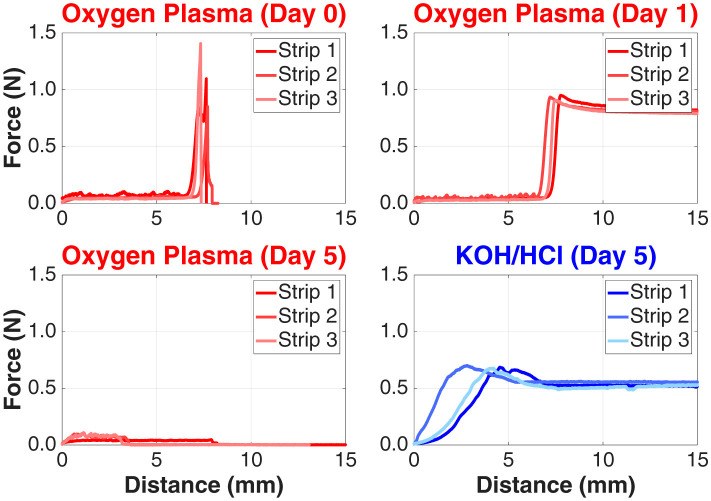
BCIwiki (bciwiki.com) — The study was published in Frontiers in Neuroscience on August 18, 2026. Using reactive-accelerated-aging (RAA) soak testing at 87°C, the authors compared oxygen plasma and KOH/HCl soak surface treatments for enhancing polyimide-to-polyimide adhesion. The researchers are from the University of Florida.Oxygen plasma-treated samples exhibited high initial adhesion of about 262 mN/mm but degraded rapidly under RAA, with bond strength decreasing linearly and failing within 3 to 6 days depending on strip width; the width dependence indicates edge-driven degradation. In contrast, KOH/HCl-treated samples showed lower initial adhesion of about 150 mN/mm but minimal degradation over the test duration, corresponding to an estimated minimum 40-fold improvement in bond lifetime.The authors conclude that plasma-based bonding of polyimide films is highly susceptible to oxidative degradation, while chemically reconstituted interfaces provide significantly improved stability that could be beneficial for chronic neural-implant applications. Reliable bonding between polyimide layers is critical for the long-term performance of thin-film neural interfaces.