

BCIwiki (bciwiki.com) — Researchers at Chiba University in Japan have proposed a signal processing method called Diffusion Inverse Filtering (DIF) to counteract spatial smoothing in electroencephalography (EEG) caused by volume conduction, aiming to enhance functional connectivity-based pattern recognition in brain-computer interfaces (BCIs). The study was published in Brain Sciences on August 27, 2026, authored by Xu Y, Otsuka S, and Nakagawa S.
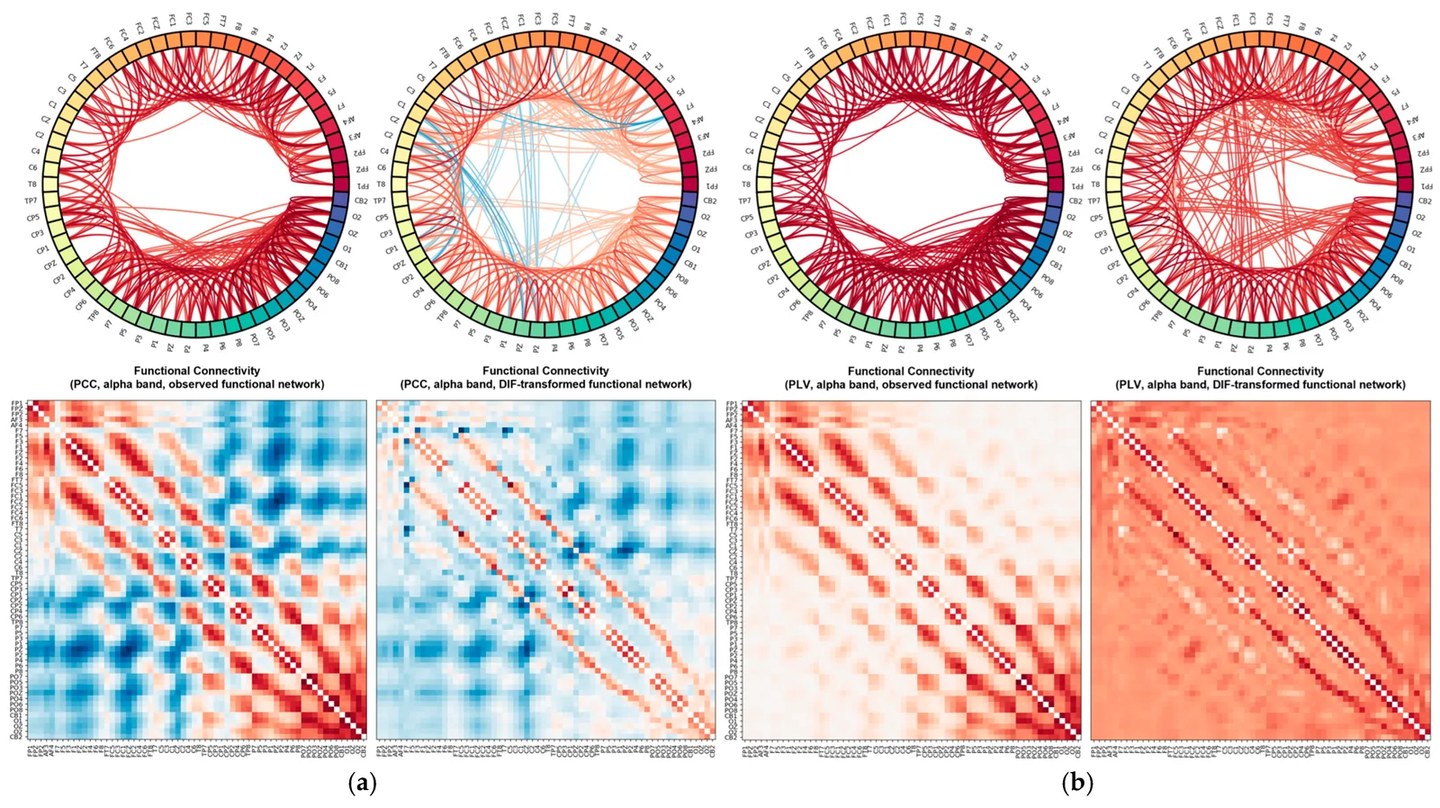
Volume conduction smears EEG signals across nearby electrodes, introducing spurious connections that distort functional network patterns. DIF approximates this spatial smoothing as a diffusion-like process and applies a regularized inverse operation to transform observed functional networks into representations with enhanced discriminative power. The method was evaluated using emotion recognition as the paradigm task, a critical component of BCI systems. Results showed that DIF generally improved emotion-recognition performance under electrode-sparsification conditions, with the most consistent improvements observed for Pearson correlation coefficient (PCC) estimation.
The study compared DIF with signal-level processing, which operates on EEG before connectivity estimation, and functional-connectivity-level transformations such as graph signal processing (GSP)-based filtering. DIF belongs to the latter category but does not rely on a GSP framework. The findings suggest that DIF, as a functional-connectivity-level transformation, could complement or serve as an alternative to signal-level processing, and is compatible with modern functional-connectivity-based BCI pipelines.