
/ EN

Japan

7 entries
September 2026

Imagining Jogging Strengthens Sense of Owning a BCI-Controlled Avatar, Keio Team Finds

Participants steering a virtual avatar with a brain-computer interface reported a stronger sense that the avatar's body was their own when they imagined jogging than when they imagined opening their right hand, even though jogging imagery produced weaker EEG signals. Forward movement was driven by motor imagery-related sensorimotor rhythm event-related desynchronization from scalp EEG and direction by eye gaze, as participants guided a jogging avatar along a curved course before rating their embodiment in questionnaires. The researchers say neural signal strength and embodied experience can diverge, so the congruence between imagery and action should be weighed alongside standard decoding metrics.
Endovascular EEG Records 3.7 Times the Power of Scalp EEG in 5 Patients

Endovascular EEG recorded approximately 3.7 times the power of concurrent scalp EEG in 5 patients undergoing an intracarotid amobarbital injection, known as the Wada test, and the nearest endovascular-scalp electrode pairs showed consistently higher coupling in every participant, a mean difference of 4.9 percentage points ranging from 1.8% to 7.6% across individuals and most pronounced at separations under 30 mm. Endovascular EEG has emerged as a brain monitoring technique that balances signal fidelity against invasiveness, the authors write, matching subdural recordings in bandwidth and signal-to-noise ratio in animal studies, but its signal properties have been sparsely quantified in people. All signals were preprocessed with artifact rejection and independent component analysis, then assessed with power spectral density, imaginary coherence, phase-locking value and amplitude envelope correlation.
August 2026

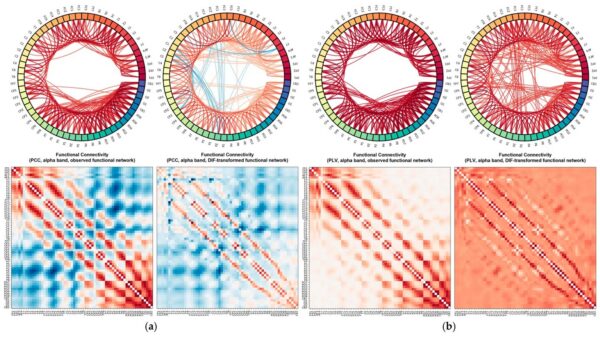
Diffusion Inverse Filtering Lifts BCI Emotion Recognition With Fewer Electrodes

A team at Chiba University in Japan has proposed Diffusion Inverse Filtering (DIF), a signal-processing method that undoes the spatial smearing volume conduction introduces into EEG, sharpening the functional-connectivity features that brain-computer interfaces (BCIs) rely on. Tested on an emotion-recognition task, DIF generally improved performance as electrodes were thinned out, and it is compatible with existing BCI pipelines. The work appeared in Brain Sciences on August 27, 2026.

AutoMI: Hands-Free Motor Imagery EEG Classification via LLM Multi-Agents

The study presents AutoMI, a framework that uses LLM multi-agents to automatically and rapidly iterate on motor imagery EEG classification models, combining a Q-learning policy with deterministic rules and integrating planning, execution and output agents with predefined tools, plus experience tracking and rollback. Models built by AutoMI reached 77.62%, 78.08% and 83.02% accuracy on the IV2a, OpenBMI and ECUST-MI datasets — up 18.42%, 9.27% and 19.25% over automated optimization algorithms.
July 2026
January 2026

Researchers Say BCIs Should Decode User Goals, Not Motor Cortex Signals

Researchers in Germany, the Netherlands and Japan argue in an opinion piece that brain-computer interface design should be rebuilt around ideomotor theory, which treats voluntary action as driven by internally represented sensory outcomes. BCI research has made remarkable technical progress but remains limited in scope, the authors write, typically relying on motor and visual cortex signals in a narrow range of patient populations, and they describe this underused framework as a principled basis for next-generation interfaces that align more closely with the brain's own intentional and action-planning architecture. Reorganizing BCIs around the purpose of an action, meaning the user's goals and anticipated effects, would be a more intuitive, generalizable and scalable path, they suggest, and advances in neural recording and artificial intelligence-based decoding of sensory representations make the shift feasible and timely, potentially easing persistent usability and generalizability problems in BCI design.
October 2025

Nihon Kohden's EEG-1260A Neurofax System Clears FDA 510(k)

Nihon Kohden's EEG-1260A Neurofax system, along with its amplifier unit and photic stimulator, received FDA 510(k) clearance on October 9, 2025. The device is a Class II medical device in the neurology specialty, with software for quantitative EEG analysis. The traditional 510(k) clearance indicates substantial equivalence to a legally marketed device.
© 2026 BCIwiki.com Digest Topics Tips Subscribe Revisions About