

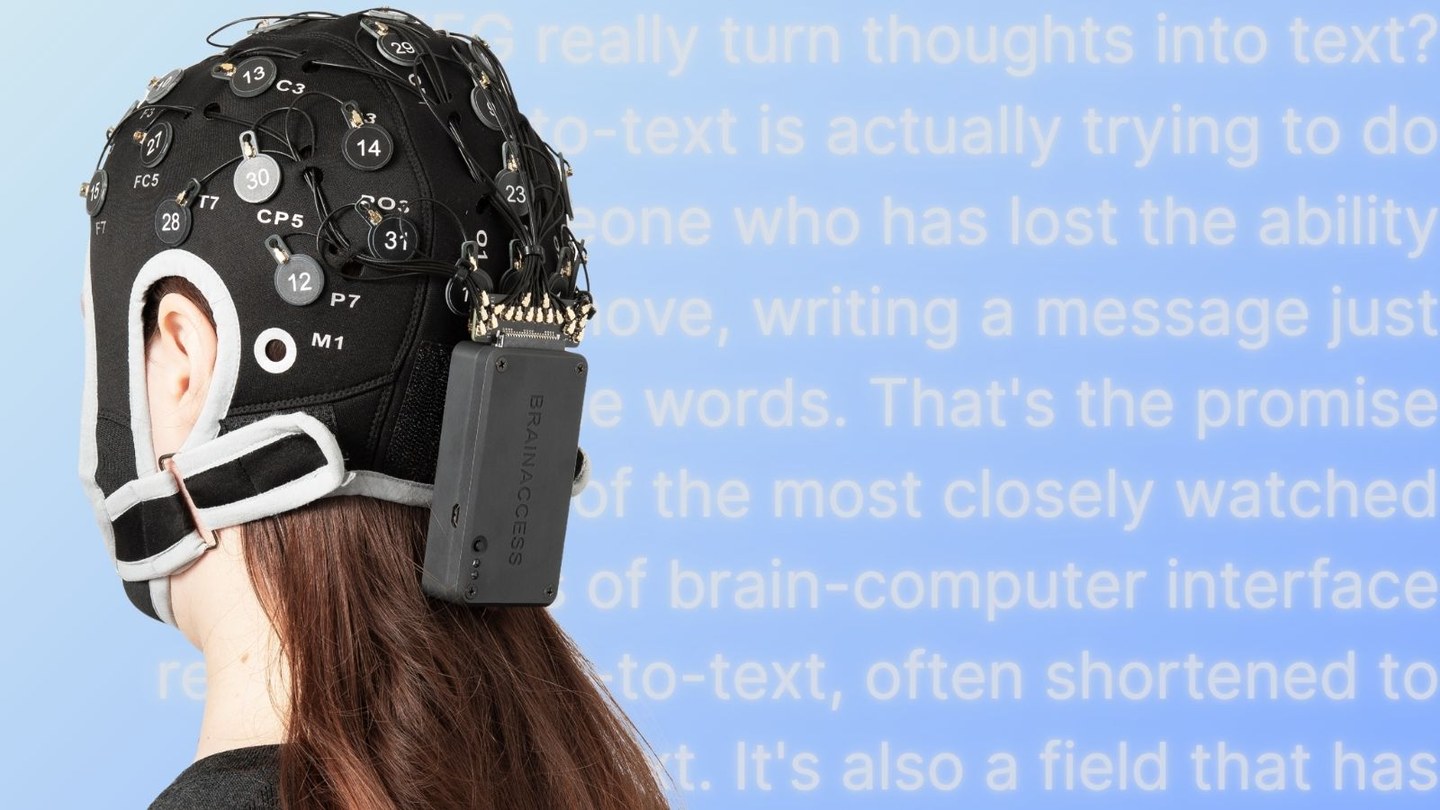
BCIwiki (bciwiki.com) — Translating scalp EEG directly into freely composed text is one of the most closely watched goals in non-invasive brain-computer interfaces, but a test of several published decoders delivered a sobering result: swap in random noise, and some models still produced fluent, plausible sentences at scores comparable to real brain data, suggesting the language model was doing most of the decoding. That finding comes from a 2025 study in Scientific Reports, reviewed by EEG hardware maker Neurotechnology (BrainAccess) on September 16, 2026.
The review flags a second long-overlooked problem: many earlier evaluations relied on teacher forcing, feeding the model the correct previous word at each step instead of letting it build a sentence unaided. One widely cited analysis found that switching to fully autonomous decoding could shrink reported translation-quality scores to roughly a third of their teacher-forced values. None of this makes EEG-to-text a dead end; it is pushing the field to make noise-baseline testing and autonomous decoding the default checks for new models.
Among the work that is genuinely advancing, the 2024 academic project EEG2TEXT tackled open-vocabulary decoding head-on, combining EEG-specific pre-training with a multi-view transformer that treats signals from different scalp regions as separate perspectives on the same sentence and aligns them with a language model's sense of meaning. On standard benchmarks it improved translation-quality scores by as much as 5 percentage points. Meta AI's Brain2Qwerty took a different angle: rather than decoding imagined or spoken words, it decodes what someone is typing on a physical keyboard from brain activity recorded during typing. Published in Nature Neuroscience, the study tested 35 volunteers using both EEG and magnetoencephalography (MEG).
MEG reads magnetic rather than electrical brain activity, needs a room-sized scanner, and returns a considerably cleaner signal, which makes it the field's honesty check. In one direct head-to-head comparison, the best individual MEG participants reached a character error rate of 18%, accurate enough to perfectly decode some sentences the model had never seen in training. A newer version, Brain2Qwerty v2, trained on 22,000 typed sentences collected across 9 participants, brought the average word error rate down to 39% using MEG alone, decoded in real time; for the best participant, half of all sentences were reconstructed with at most one word wrong. The team also found decoding accuracy kept improving log-linearly as more training data was added, with no plateau in sight, hinting that some of the remaining gap might close through more data rather than cleverer architectures alone.
Taken together, the picture is fairly clear: non-invasive EEG-to-text is real, it is improving, and it remains meaningfully behind cleaner signals such as MEG, and further still behind invasive implants placed on or in the brain. The gap is narrowing through better architectures, larger datasets, and, just as importantly, through the field holding itself to tougher standards after the memorization findings. Neurotechnology said it builds affordable, wireless, dry-electrode EEG systems to put research-grade tools into more hands, from university labs to independent BCI developers, so the next dataset and the next round of tougher validation do not have to wait on a handful of institutions.