

Speech decoding translates brain language signals directly into text or synthesized speech, restoring communication for patients who have lost the ability to speak. This topic tracks breakthroughs in vocabulary decoding and continuous sentence generation via cortical electrodes and non-invasive methods.
September 2026
Paradromics Implant Lets First Participant Speak Her Own Words in Real Time
LLMs Cut P300 Speller Keystrokes by More Than 62%, Review Finds
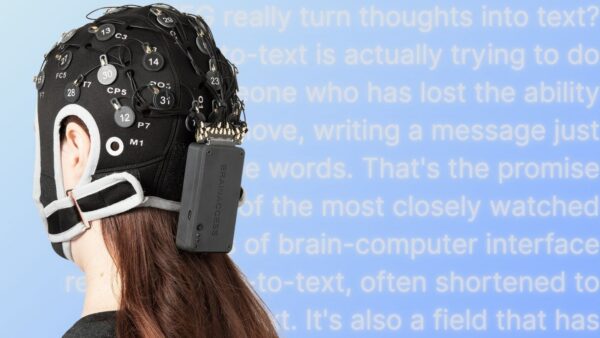
This review traces the evolution of P300 brain-computer interfaces from classic spellers to AI agents. The P300 is a positive brain potential that appears about 300 milliseconds after a rare stimulus, and systems use it to determine which character a user wants to select. According to the review, recent systems such as ChatBCI and MindChat, which pair P300 spellers with large language models, cut keystrokes by more than 62% and nearly triple communication speed. The author also proposes an end-to-end architecture: an EEG headset and a real-time CNN detector, topped by an AI-agent layer made up of an LLM planner and IoT control interfaces.
StairMed Plans 4-Patient Trial of Wireless Implant for Mandarin Speech
Shanghai-based StairMed has taken its wireless implantable brain-computer interface system into human evaluation for people with speech impairments. The prospective, single-arm trial (NCT07647315) actually began on September 1, 2026, is now recruiting, and plans to enroll 4 participants. Subjects will undergo surgical implantation and brain-control training, followed by an expected 12 months of follow-up recording adverse events, serious adverse events and device deficiencies, along with efficacy data on brain-controlled interaction and communication. Primary completion is expected on August 30, 2028, and the study as a whole on December 30, 2028. The registry record does not disclose the implant site, decoding method or detailed eligibility criteria, and no interim results have been posted, so conclusions on safety and efficacy will have to wait for follow-up data.
More Components Can Hurt P300 Spellers, Full-Factorial Study Finds
P300 BCI spellers are often built by switching on every component that works on its own, on the assumption that more is better. A preprint study tested that assumption with a four-component full-factorial experiment and found that a component's value is conditional, not additive. Subject calibration was the strongest single contributor; Euclidean Alignment made up for the lack of calibration in zero-calibration settings; and stacking components that are each useful on their own could lower performance, an effect the authors call component anti-synergy. Language model support was not universally beneficial either: its effect depended strongly on how strong the underlying EEG pipeline was.
OPM-MEG Beats EEG by 3.6 Points in Non-Invasive Speech Decoding
Ten native Mandarin speakers read aloud six single-vowel rhymes while optically pumped magnetometer magnetoencephalography (OPM-MEG) and EEG recorded the same task. In the 150-500 ms window after stimulus onset, OPM-MEG decoded significantly more accurately than EEG with all five classifiers tested. The best-performing combination, common spatial pattern features with a linear support vector machine, reached a mean accuracy of 60.3% for OPM-MEG versus 56.7% for EEG. That suggests speech BCIs that need no implanted electrodes and do not restrict head movement may have a clearer signal path than EEG.
PNPL 2026 Challenges Teams to Adapt Speech Decoders on 10 Minutes of Data
A preprint posted to arXiv on September 3, 2026, sets out the 2026 PNPL competition, built on an extended LibriBrain100 dataset that adds 32 subjects at about 40 minutes each and roughly 80 more hours of within-subject data. The competition runs two tracks: a Deep track for within-subject word classification at scale, and a Broad track for cross-subject generalization that steps subject-specific fine-tuning data down from about 40 minutes to 20 and then 10, a clinically feasible range. Winning 2025 submissions reached F1-macro scores of 95.6% on speech detection and 73.6% on phoneme classification.
OVMI Metric Puts Speech BCI Results on a Common Scale
Researchers have proposed Open-Vocabulary Mutual Information (OVMI), an information-theoretic metric that scores speech brain-computer interfaces on a common scale, and used it to show that accuracy figures computed only over a system's supported vocabulary can overstate how much of a user's intended speech actually gets through. Speech BCIs translate neural activity into language and offer a path to restoring communication for people with paralysis, but systems differ in datasets, recording methods and vocabularies, leaving their reported scores hard to compare. Choosing a vocabulary that maximizes OVMI yielded up to 16.3% relative accuracy improvement across three speech domains; the preprint has not been peer reviewed.
NVOL: Mid-Layer CLIP Alignment Lifts EEG Image Retrieval to 86.4%
A preprint from Minyi Wang, Zhenqin Wu and Rihui Li reports that aligning EEG signals to an intermediate CLIP layer rather than the final one raised 200-way image retrieval on the THINGS-EEG dataset to 78.1% mean Top-1 accuracy, and to 86.4% with CSLS. Layer-wise contrastive learning selects that layer, which the authors call the Neural Visibility Optimal Layer (NVOL); the same representation then drives generation, with a conditional diffusion prior reconstructing subject-specific NVOL features and mapping them into CLIP space for Stable Diffusion XL, which the authors say beats single-stage final-layer diffusion on semantic and structural metrics. The paper was posted to arXiv on September 2, 2026, and has not been peer reviewed.
August 2026
LibriBrain100 Releases Over 100 Hours of MEG Data, Some 80 From One Subject
LibriBrain100, a magnetoencephalography (MEG) dataset released on August 25, 2026, contains more than 100 hours of high-quality recordings, about 80 of them from a single subject, the deepest within-subject collection of its kind. It is meant as a standardized benchmark for neural speech decoding and ships with open-source tooling and an online competition; a further 32 subjects contribute roughly 40 minutes each to offset thin per-subject data. Using an existing decoding model, the team reported state-of-the-art results on a word-classification benchmark, which it takes as evidence of both data quality and the value of deep within-subject recording.
Interpretable BCI Framework Pairs Emotion Recognition With Thought-to-Speech Decoding
A new study proposes an interpretable brain-computer interface framework that combines affective state recognition with EEG decoding to enable emotion-aware thought-to-speech. Tested on public imagined-speech EEG datasets in subject-independent settings and scored on accuracy, precision, recall, F1-score, inference speed and interpretability, the framework improved decoding reliability over conventional opaque models and produced clinically meaningful explanations, the authors report. They present it as a practical basis for assistive communication tools for people with paralysis, amyotrophic lateral sclerosis, locked-in syndrome and other conditions that disrupt natural speech.
Children Designing Their Own P300 BCI Interface Choose Animation, Color and Sound
Thirty-eight typically developing children aged 8 to 12 used a design application to build their own picture-based interface for a P300 brain-computer interface augmentative and alternative communication (P300-BCI-AAC) system, in a study of what children themselves want from such interfaces. They consistently chose preferred colors, animation — zooming most of all — and sound cues: animation aided visual accessibility and target location, background color changes carried preferred colors into the display, and video GIFs and picture overlays added personal relevance. The authors call motion, color, personalization and visual clarity preliminary priorities for pediatric BCI-AAC design, and point to follow-up work with children who use AAC daily and with people who have motor difficulties.
Review Identifies Three Shared Bottlenecks Across DBS and BCIs
EEG-guided extraction switches speakers in 2.04 s
Researchers report SAGE, a switch-aware EEG-guided soft gating framework for target speaker extraction, posted to arXiv as a preprint on August 3, 2026 and not yet peer reviewed. Under in-trial auditory attention switching, neural noise and intrinsic latency can delay or destabilize attention tracking, and conventional methods often cause discontinuities at switching points. SAGE treats in-trial switching as dynamic selection, generating two candidate speech streams with a robust separator and using an EEG-guided switch-aware gating module to produce smooth fusion weights and suppress transition artifacts. It integrates latency-compensated alignment and an uncertainty-driven conservative strategy, outperforms baselines, achieves 8.67 dB SI-SDR and 88.24% STOI, and reduces average switching latency to 2.04 s.
July 2026
Paradromics Implants Connexus BCI in Patient With Motor Neuron Disease
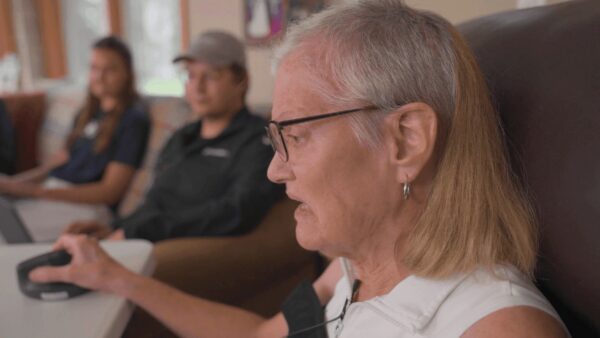
Surgeons in Michigan have implanted Paradromics' Connexus brain-computer interface in a patient with motor neuron disease who had lost most of her ability to speak. Connexus records from individual neurons through 421 microelectrodes seated 1.5 millimeters into the motor cortex; the signals pass to a transceiver in the patient's chest, where AI converts them into text on a screen. Austin, Texas-based Paradromics received FDA approval in the fall of 2025 to begin the clinical trial.
Multi-User Speech BCI Model Needs Fewer Than 200 Sentences for a New User
UC Davis researchers trained a transformer-based speech decoder across six people with intracortical BCIs. The pooled model cut relative word error rates by more than 50% on average compared with subject-only models and, after fine-tuning on fewer than 200 sentences from an unseen user, achieved a word error rate below 7%. The bioRxiv preprint has not been peer reviewed.
N400 Window Shapes Semantic Decoding
Aalto University researchers connected the classic N400 evoked response with semantic-vector decoding in a controlled MEG word-priming experiment. The study involved 25 native Finnish speakers who read word groups with different levels of semantic relatedness. Unrelated primes produced larger N400 responses and supplied the most useful training examples for a decoder mapping distributed MEG activity to semantic vectors. The researchers report that semantic information could be decoded from about 100 to 500 ms after stimulus onset. After the N400 peak, however, neural responses no longer mapped reliably to context-invariant semantic vectors. The result suggests that the end of the N400 window may mark a transition from word-specific representation toward broader contextual meaning. This bioRxiv preprint has not been peer reviewed.
Surprisal Adds Little to ECoG Language Encoding
A bioRxiv preprint finds that adding a surprisal predictor on top of GPT-2 contextual embeddings contributes almost nothing extra to predicting high-gamma ECoG responses during speech comprehension.
Diffusion Latents Boost Neural Speech Decoding
University of Toronto researchers use diffusion latent representations as an intermediate layer for neural speech decoding, with word error rate varying sharply by timestep.
University Hospital, Grenoble Registers Chronic BCI Study for Speech Rehabilitation in Locked-In Syndrome
Grenoble University Hospital has registered a clinical study (NCT07698496) assessing the feasibility and effectiveness of a chronic brain-computer interface for speech rehabilitation in people with locked-in syndrome (LIS), where non-invasive communication carries high cognitive load and existing invasive speech BCIs still rely on percutaneous connectors with infection risk. Using an intracranial epidural BCI paired with a speech synthesizer, the SpeechBCI protocol will test two complementary approaches in the same subject — a speech BCI (primary objective, the BCI_PAROLE device) and a cursor BCI (secondary), both running on the WIMAGINE intracranial epidural system. The trial is in the registration stage and has no clinical results yet.
Deep Learning Decodes Imagined Sounds and Images From MEG, Topping 70% for Visual Imagery
Researchers recorded magnetoencephalography (MEG) from 18 right-handed participants as they imagined sounds and pictures, then compared two decoders: a convolutional neural network (CNN) and a linear logistic regression model. The CNN decoded both tasks above chance and exceeded 70% accuracy for visual imagery. It still decoded significantly when trained only on cortical regions unrelated to the task, suggesting imagined content is spread across partially overlapping networks rather than confined to a single sensory area, an experimental basis for feeding auditory and visual information into BCI decoders together.
June 2026
Dynamic Wavelets Boost Imagined-Speech EEG
A study published in Computers in biology and medicine proposes dynamic wavelet-basis selection to improve non-invasive EEG imagined-speech classification. For each EEG epoch, the method minimizes wavelet entropy to select an informative basis and then injects Gaussian noise into the corresponding coefficients. A convolutional neural network with channel-wise excitation classifies the augmented signals. The dataset contains 32 channels, 8 stimuli, and recordings from 10 participants. The words-vowels combination reached a highest classification accuracy of 98% with a Cohen's kappa of 0.95, although performance was lower for the full class set. The researchers report that the method outperformed conventional augmentation strategies and static wavelet approaches, offering an adaptive way to address noise and non-stationarity in EEG decoding.
February 2026
Layer 7 Array Decodes Speech and Cursor Direction in Four Surgical Patients
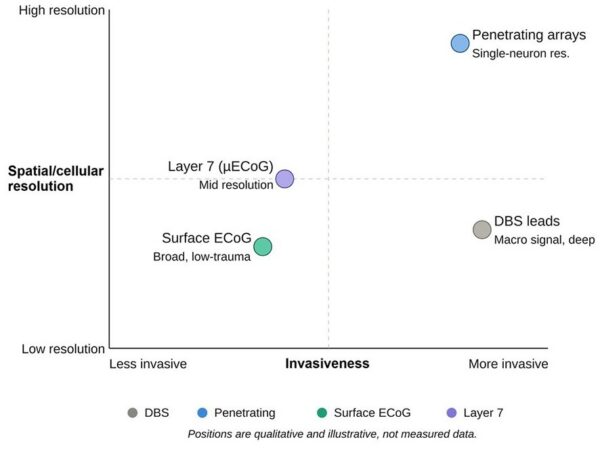
A Neurosurgical Focus paper tested Precision Neuroscience's 1,024-channel Layer 7 micro-ECoG array in four awake-craniotomy patients. Four-word speech classification reached 77.5% accuracy and four-direction cursor classification reached 78% to 84%, with no device-related adverse events reported during the procedures. The small, short intraoperative study was a feasibility test rather than a pivotal motor-restoration trial.