

BCIwiki (bciwiki.com) — A collaboration involving Huashan Hospital, Fudan University, China, published a descriptive feasibility study in Brain Sciences on October 27, 2026, examining EEG features of attempted urination and defecation. The full text reports 90 recruited participants: 30 healthy young adults, 31 healthy older adults and 29 people with spinal cord injury.
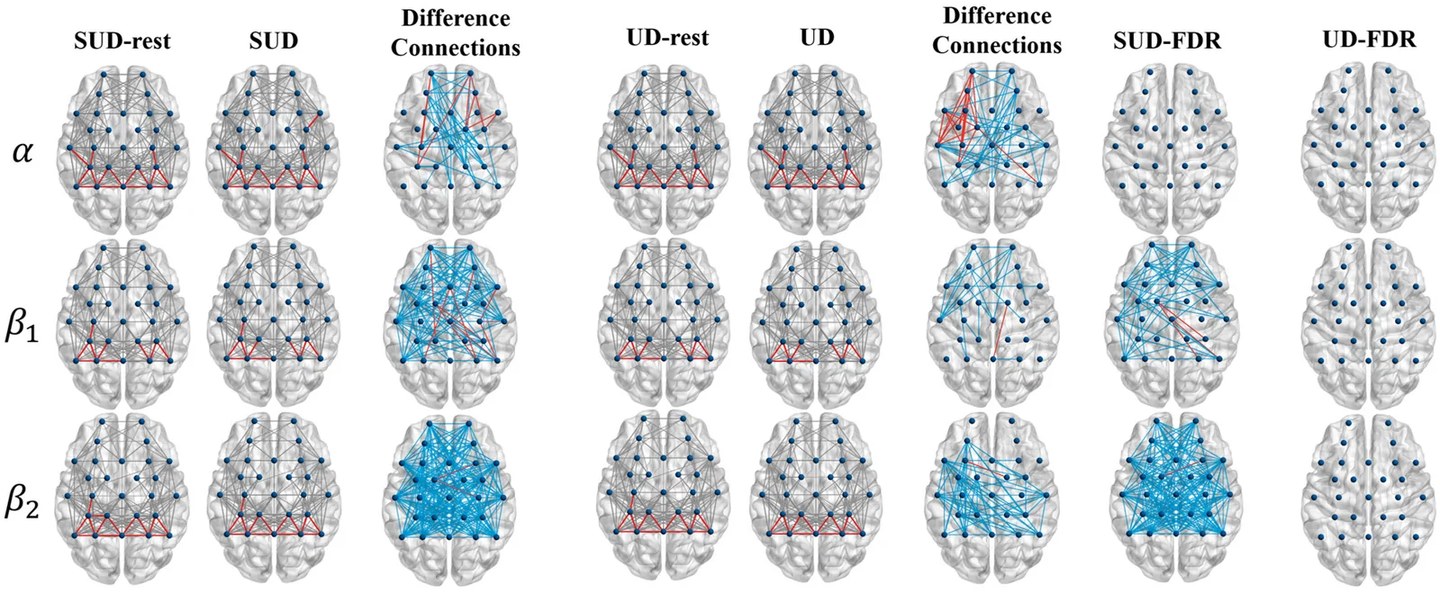
The researchers collected 32-channel EEG from healthy young adults, healthy older adults and patients with spinal cord injury during motor attempts involving suppressed urination and defecation (SUD) and active urination and defecation (UD). Event-related spectral perturbation (ERSP) and phase-locking value (PLV) analyses examined spectral changes and functional connectivity across alpha (8–13 Hz), beta1 (13–20 Hz) and beta2 (20–30 Hz) bands.
All groups exhibited generally consistent broadband event-related desynchronization (ERD), a reduction in rhythmic activity, in the sensorimotor cortex during visceral motor attempts. The frontal cortex showed marked frequency-band differentiation. During SUD, healthy older adults had significantly greater sensorimotor beta2 ERD than healthy young adults. Patients with spinal cord injury showed a similar trend, but it was not statistically significant.
Network analysis associated physiological aging and spinal cord injury with large-scale topological reconfiguration, including enhanced long-range frontal functional connectivity. The authors interpret this as a possible compensatory mechanism for sensory or peripheral deficits and conclude that the findings support preservation of higher-level cortical intentions for continence after spinal cord injury. Frontal beta2 findings remain preliminary and require caution because of potential residual artifacts.
The authors aim to use these spatiotemporal characteristics to inform targeted pelvic nerve modulation through brain-computer interfaces (BCIs). The study describes EEG activity and connectivity during motor attempts; it is not an efficacy trial demonstrating BCI-mediated restoration of bowel or bladder function.