/ EN

Neurorehabilitation

53 entries

Brain-computer interfaces are becoming key tools in neurorehabilitation, decoding motor intent in real time to drive exoskeletons and electrical stimulation devices, promoting neuroplasticity and functional recovery. This topic tracks BCI-assisted rehabilitation trials, efficacy outcomes, and product launches.

September 2026

Singapore Trial Tests EEG-Headband Games for Rehab in Children With Brain Injury

KK Women's and Children's Hospital in Singapore has registered a clinical trial of brain-computer interface neurofeedback training (BCI-NFT) for children and adolescents aged 7 to 21 with acquired brain injury from causes including traumatic brain injury, stroke, encephalitis, brain tumors and epilepsy. The intervention group will complete 12 sessions of about 60 minutes each over 10 weeks, wearing a wireless EEG headband while interacting with neurofeedback computer games; the control group receives standard care first and then crosses over to training. A cohort of peers with no history of brain injury will provide normative EEG data. The trial plans to enroll 70 participants, with primary endpoint results expected in February 2028.
AI Should Read Intent in BCI Exoskeletons While Controllers Enforce Limits, Review Says

A brain-computer interface can read neural activity tied to movement, while a powered exoskeleton supplies the force needed to carry it out. But EEG is noisy, muscle signals shift with fatigue and recovery, and the right level of assistance depends heavily on the user and the task, so AI's main value lies in handling several changing signals at once rather than relying on a single fixed input. The review surveys how EEG, EMG and mechanical sensing are combined for exoskeleton control and contrasts two applications with very different goals: stroke rehabilitation and healthy users. The author argues that higher classification accuracy alone is not enough, since latency, calibration, fatigue, uncertainty and physical safety also determine whether a system is truly usable.

Adding fNIRS to EEG Fails to Improve Brain-Controlled Stimulation in 16-Person Trial

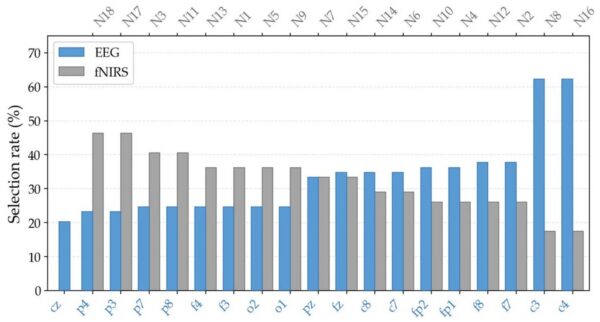
Combining EEG with functional near-infrared spectroscopy (fNIRS) did not make brain-controlled electrical stimulation more accurate in a blinded randomized trial of 16 healthy volunteers. The hybrid and EEG-only groups showed no statistically significant differences in real-time three-class recall, sense of agency, attention or physical comfort; median recall was 53.5% in the hybrid group and 57.3% with EEG alone. The researchers also released the full EEG-fNIRS dataset.

Peking University Third Hospital Joins Chinese Invasive BCI Trial for Spinal Cord Injury

Peking University Third Hospital, a top-tier (Grade 3A) general hospital in Beijing whose neurosurgery department is one of its key specialties, is taking part in a clinical trial of a Chinese-developed invasive brain-computer interface (BCI), neurosurgeons Yang Jun and Yu Tao wrote in the 16th issue of China Hospital CEO magazine. The trial enrolls patients with spinal cord injury and relies on a multidisciplinary team (MDT) to restore hand function after implantation. Invasive BCIs read neural signals through electrodes placed inside the skull or on the cortical surface, so surgery and rehabilitation depend on close coordination among neurosurgery, rehabilitation and imaging departments. The disclosure marks one step in Chinese hospitals' clinical validation of domestic systems. Public information has not named the system or disclosed enrollment, follow-up milestones or primary endpoints, and no efficacy or safety data have been released.

1,145-Patient Meta-Analysis Finds Stronger Evidence for Robotic Stroke Rehab Than BCI

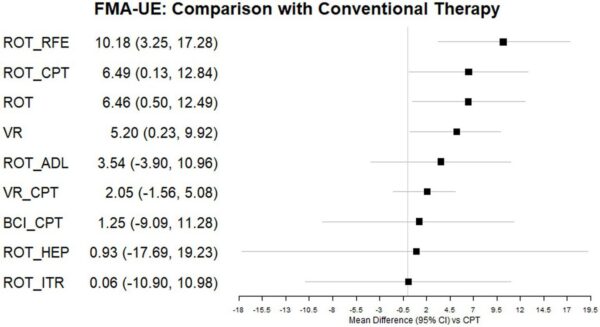
Which new technology does most for upper-limb recovery after stroke: virtual reality, robotics or a brain-computer interface (BCI)? A systematic review and network meta-analysis placed all three in a single evidence network, pooling 25 randomized controlled trials and 1,145 stroke survivors. The authors searched PubMed, Web of Science, the Cochrane Library and Embase from inception to October 2025, used conventional physical therapy as the common comparator in a star-shaped network, and applied a Bayesian random-effects model to estimate relative efficacy and calculate SUCRA rankings. Robot-assisted training produced the most robust findings, with two studies supporting robotics plus conventional physical therapy and three supporting robotics alone; only one BCI study yielded extractable data, too little to judge efficacy. The authors caution that the top-ranked intervention, robotics combined with rehabilitative functional electrical stimulation, rests on a single trial and should not be read as definitive evidence of superiority.

At-Home BCI Therapy Beats Home Exercise for Chronic Stroke Arm Deficits in Randomized Trial

Chronic stroke patients who used an at-home brain-computer interface (BCI) therapy system gained a mean 6.0 points on the Upper Extremity Fugl-Meyer Assessment after 12 weeks, versus 1.5 points for those on a home exercise program. Response rates were 55.5% and 9.6%, for a number needed to treat of 2.2. The trial also exposed the dropout problem in home-based studies: 17 of 42 control participants withdrew because they were dissatisfied with their group assignment.

Shandong Hospital Registers Retrospective Cohort Study of Closed-Loop BCI Exoskeleton in Stroke Recovery

The study asks whether adding closed-loop BCI exoskeleton training to conventional rehabilitation improves lower-limb recovery in stroke patients. The retrospective cohort plans to enroll 58 patients in a closed-loop training group and 57 in a conventional rehabilitation group, with the primary endpoint being change in FMA-LE score from baseline to week 6. Secondary outcomes include motor imagery-related EEG features, the 10-Meter Walk Test and the Berg Balance Scale, indicating the researchers want to track both walking function and the brain signals themselves. The trial is self-funded by the research team and has not yet begun recruiting.

Umbrella Review Ties Post-Stroke BCI Gains to Motor Attempt and 20-60 Minute Sessions

Motor attempt, meaning a patient's effort to move a paralyzed limb, was the intent-inducing modality most consistently tied to significant therapeutic effects in an umbrella review of 17 meta-analyses of brain-computer interface systems for stroke motor recovery, published in Symmetry on September 4, 2026 with a literature search cutoff of June 30, 2026. Electrical stimulation was a consistently effective feedback type, while robot-assisted and visual feedback gave inconsistent results, and higher weekly session frequency and moderate session durations of about 20 to 60 minutes were linked to consistent recovery. Combining motor attempt with electrical stimulation may yield greater benefits, the authors suggest.

One EEG Diffusion Model Decodes Motor Imagery, Hemiplegic Side and Recovery

Researchers have proposed a unified EEG-based framework that simultaneously performs motor imagery classification, hemiplegic side detection and functional recovery prediction, aimed at motor rehabilitation after stroke. Stroke remains one of the leading causes of long-term motor disability worldwide, the authors note, and motor imagery brain-computer interfaces are seen as a way to accelerate recovery. Current MI-BCI methods, however, generalize poorly across patients, lack an effective functional assessment step, and are limited by scarce patient data and a shortage of suitable augmentation approaches. The framework introduces a diffusion model tailored to the spatio-temporal characteristics of EEG, built on a decoupled neural architecture with rotary spatial encoding and autoregressive temporal fusion. To offset data scarcity, the team designed two augmentation strategies adapted to stroke EEG. Experiments across multiple MI-BCI tasks show superior performance and generalizability, the authors say, supporting the method's potential for personalized stroke rehabilitation.

Hybrid BCI Replaces Exoskeleton Crutch Controls at 95.06% SSVEP Accuracy

A hybrid brain-computer interface replaced crutch control for 10 participants walking with a custom lower-limb exoskeleton, classifying steady-state visual evoked potentials with 95.06% accuracy and reaching F1 scores of 99.80% and 99.22% for its wink- and clench-triggered asynchronous switches, researchers reported in IEEE TNSRE. Measured against crutch control, the system scored 78.25 versus 53.50 on the System Usability Scale and 3.15 versus 7.85 on NASA-TLX physical demand.
August 2026

Embodiment and Simulator Sickness Map to Distinct EEG Patterns in XR-BCI

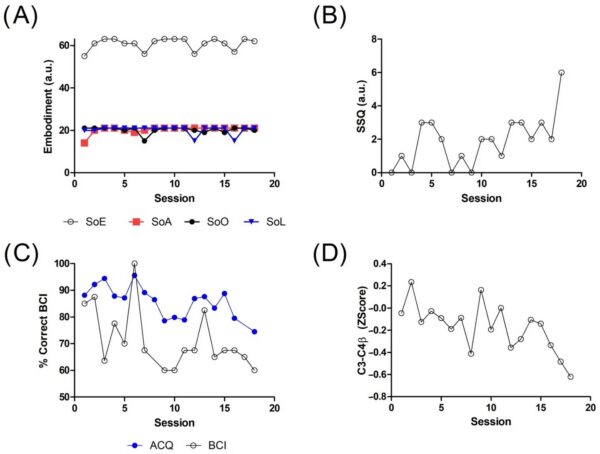
A single-case study of a participant with chronic spinal cord injury found that sense of embodiment was positively associated with frontal theta activity, while simulator sickness was negatively associated with sensorimotor beta activity, during extended reality brain-computer interface (XR-BCI) use. Analyzing 17 XR-BCI sessions with Bayesian correlation and multiple linear regression, researchers at Escola Superior de Saúde do Alcoitão, Universidade de Aveiro and Universidade Católica Portuguesa found simulator sickness to be the only variable independently associated with sensorimotor beta activity, a result they report as robust; the study appeared in Life on August 27, 2026. Different dimensions of subjective experience during XR-BCI operation therefore appear to have partly distinct neurophysiological correlates, a basis for reading user experience from EEG in real time and tuning BCI training and interaction design.

Review Outlines Three BCI Paradigms for Post-Stroke Hand Rehabilitation

A review in Topics in Stroke Rehabilitation maps the neurophysiological basis of non-invasive EEG-based brain-computer interfaces for post-stroke hand recovery and sorts the field into three paradigms: motor imagery with physical feedback, motor imagery with virtual or multisensory feedback, and steady-state visual evoked potential (SSVEP)-driven training. These systems decode sensorimotor-cortex rhythms during imagined hand movement in real time to drive exoskeletons, functional electrical stimulation or virtual reality, closing a Hebbian feedback loop meant to strengthen or remodel damaged pathways in patients whom conventional rehabilitation, which depends on active movement, often cannot reach. Studies confirm the approaches can improve upper-limb function, the review says, but clinical adoption still faces low signal-to-noise ratios, wide individual variability and 'BCI blindness.'

Brain-Spine Interfaces Remain Supported by Limited Clinical Evidence

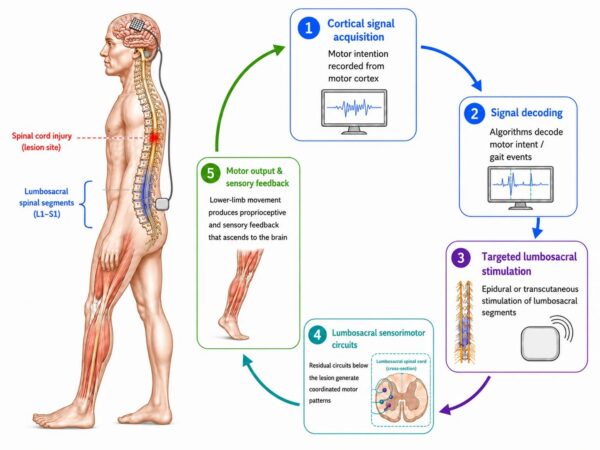
A review in *Neurosurgical Review* finds encouraging motor outcomes from early preclinical work and highly selected clinical studies of brain-spine interfaces, but concludes that the evidence remains preliminary. Safety, durability, patient selection, access, long-term functional benefit, technical complexity, ethics and specialist training all remain barriers to routine care.

Cochrane Review Finds Small, Low-Certainty Gains for BCI Stroke Rehabilitation

A Cochrane review of 43 randomized trials involving 1,628 participants found that BCI training may produce a small improvement in post-stroke upper-limb motor function compared with conventional rehabilitation, while effects on lower-limb function and activities of daily living were limited or uncertain. No clear advantage emerged over sham BCI, and certainty was low to very low because of bias risk, small samples, heterogeneity and possible publication bias.

BCI emerges as hotspot in post-stroke motor rehab

Published in Neural Regeneration Research on August 18, 2026, the study conducted a bibliometric analysis of 3173 articles from the Web of Science Core Collection on post-stroke limb motor dysfunction and functional recovery from 2016 to 2025, by authors from Beijing Rehabilitation Hospital, Capital Medical University. The field is in a period of rapid expansion, with technology-assisted rehabilitation as the dominant trend and robot-assisted training and virtual reality as the two major technological keywords. Burst literature analysis revealed three hotspot phases, with the recent phase (2020 to present) covering neuromodulation (brain-computer interface and non-invasive brain stimulation), global disease burden and public health policy. Highly cited studies focus on comparative efficacy, robot-assisted training, brain-computer interfaces, vagus nerve stimulation and prediction of rehabilitation outcomes.

Sixth-Finger BCI Neurofeedback Aids Stroke

Researchers report that a BCI-controlled sixth-finger neurofeedback intervention improved motor function in stroke: after 8 sessions (2 weeks) of motor-imagery BCI training, 14 patients gained an average of 7.9 points on FMA-UE and 7.1 on the Barthel Index, with 9 of 14 reaching the 6.6-point minimally clinically important difference. EEG tracking across the full intervention showed a two-phase ERD trend that strengthened in week one and narrowed to the contralateral sensorimotor area in week two, and resting-state functional connectivity rose afterward, correlating with motor gains. The authors say the work offers longitudinal evidence on neuroplasticity in stroke rehabilitation.

Implantable Motor BCIs Need a Unified Clinical Outcomes Framework

A paper in *Neurorehabilitation and Neural Repair* examines the outcome measures needed as implantable motor BCIs move from safety and feasibility studies toward regulatory approval, reimbursement and sustained clinical use. It calls for valid and reliable assessments that satisfy regulators and payers while reflecting activities that matter to people with severe motor impairment.

Wearable BCI Hits 79.38% Online Decoding Accuracy

The study was published in ITM Web of Conferences on August 14, 2026, addressing the demand for portable, real-time brain-computer interface systems in stroke rehabilitation by completing the physical integration and online experimental validation of a wearable system. The system uses a specialized EEG headset with miniaturized acquisition circuits secured via pogo pins, featuring 10 core recording channels positioned over the sensorimotor cortex. During the evaluation phase, the research team recruited 6 healthy subjects and 2 stroke-affected hemiplegic patients for closed-loop experiments based on motor imagery and motor attempts. Common Spatial Pattern was used for spatial feature extraction and Linear Discriminant Analysis for intention classification, with personalized sub-band optimization applied to further improve recognition. The authors report an average offline recognition rate of 84.91% and a classification accuracy of 79.38% in the more challenging online real-time testing. Analysis of spatiotemporal spectra and R² value distributions validated activation patterns in the sensorimotor areas during motor intention triggering, which the authors present as support for advancing the technology from laboratory settings toward community rehabilitation.
July 2026

A Multi-Paradigm Longitudinal EEG Dataset Including 'Sixth-Finger' and 'Affected-Hand' Motor Imagery of Stroke Patients

Researchers released a multi-paradigm longitudinal EEG dataset from 24 stroke patients, covering a novel 'sixth-finger' motor imagery paradigm and affected-hand motor imagery. The dataset spans the full pre-training, post-training and follow-up stages and includes raw EEG, preprocessed data and patient clinical information. Preliminary analysis with classical classifiers (CSP+SVM, CSP+LDA) kept average cross-paradigm classification accuracy at roughly 85%–86%.

Three Weeks of Motor Imagery BCI Improves Arm Function in Subacute Stroke

A study of 60 patients with subacute stroke hemiplegia found that adding motor imagery brain-computer interface training to conventional rehabilitation significantly improved upper limb motor function, simplified upper limb function scores, and daily living abilities. The experimental group of 30 received 3 weeks of additional BCI training, 5 days per week, while the control group received only conventional rehabilitation. The experimental group showed greater improvements in Fugl-Meyer upper limb scores, simplified upper limb function scores, and Barthel Index, with statistically significant differences.

Portugal's University of Aveiro Registers VR-Based BMI Trial in Spinal Cord Injury

The University of Aveiro in Portugal has registered a study (NCT07732868) testing a brain-machine interface protocol that pairs virtual reality with sensory feedback, visual, auditory and tactile, and/or an exoskeleton in people with spinal cord injury. Participants attend 12 monitored sessions, one a week, each lasting roughly one to two hours, moving a virtual avatar through motor imagery while non-invasive EEG records brain activity. The study focuses on changes in brain activity that track clinical improvement and on how information moves between brain regions, and it collects age, sex, injury level and type, time since injury, functional grade and neuropathic pain; it is at the registration stage with no results yet.

Preprint: Triad Interviews With Stroke Survivors Expose Three XAI Elicitation Biases

Researchers report a preprint, posted to arXiv on July 28, 2026 and not yet peer reviewed, on the methodological problem of eliciting explainable AI (XAI) requirements from stroke survivors. Existing protocols run dyadic interviews and overlook facilitation dynamics; this formative study moved to a survivor-caregiver triad, with three stroke survivors (two with moderate-to-severe aphasia) and three caregivers, and facilitators used four scaffolding techniques: analogical bridging, projective personas, binary forcing and extended response time. A reflexive analysis identified three systematic facilitation biases — normative bias, hypothesis confirmation bias and the presence effect — which the authors present as protocol risk guidelines for practitioners.

Hospices Civils de Lyon trial decodes motor imagery for stroke rehab

Hospices Civils de Lyon has registered a clinical study in France to decode motor imagery from non-invasive brain recordings as a prerequisite for innovative motor rehabilitation therapies. Combining MRI, MEG, and EEG, the study will design a subject-specific neurophysiological model, noting that standard BCI approaches neglect transient features such as beta bursts. The approach will first be validated in healthy subjects, then assessed for feasibility in stroke patients.

Can a BCI boost attention in older adults? UT Austin launches trial

The University of Texas at Austin has registered a study on ClinicalTrials.gov to explore whether an EEG-based brain-computer interface (BCI) decoding the P300 event-related potential in real time, combined with non-invasive interventions such as mindfulness relaxation or transcranial electrical stimulation, can enhance attention and memory neural markers—proxies for cognitive reserve—in healthy older adults and those with mild cognitive impairment (MCI). The trial is recruiting and aims to test whether targeted modulation of attention-related brain activity can support cognitive reserve.

Preprint: Cross-Subject Learning Cuts BCI Calibration for Children With Cerebral Palsy

A preprint reports that cross-subject cumulative learning and transfer learning can sharply cut the calibration burden of brain-computer interfaces based on movement-related cortical potentials (MRCP) in children with cerebral palsy. Testing a bidirectional long short-term memory network across 27 training sessions in four children, the authors found cross-subject cumulative learning reached 91% accuracy with no within-session calibration, rising to 93% when transfer learning was added — both better than conventional calibration strategies.

Inner Mongolia Opens First BCI Hospital Ward

The first brain-computer interface hospital ward in China's Inner Mongolia autonomous region was unveiled in Hohhot, CCTV.com reported on July 17, 2026. At the unveiling ceremony, Hurile, head of the rehabilitation medicine department at Inner Mongolia Medical University, delivered a briefing introducing the ward's construction, technical strengths and development plans, framing the ward as a starting point for building a new clinical rehabilitation ecosystem in the autonomous region. The report did not disclose the ward's bed capacity, equipment, patient scope or opening date, nor the full name of the hospital housing the ward.
© 2026 BCIwiki.com Digest Topics Tips Subscribe Revisions About