

BCIwiki (bciwiki.com) — Fusing EEG with functional near-infrared spectroscopy gave no better real-time three-class control of wrist extensor functional electrical stimulation than EEG alone in 16 healthy volunteers. In a blind randomized trial reported in Sensors on September 15, 2026, researchers at Pirogov Russian National Research Medical University and collaborating institutions found median real-time three-class recall of 53.5% in the hybrid group and 57.3% in the EEG-only group, with no statistically significant between-group differences in classification accuracy, sense of agency, attention or physical comfort (p > 0.05).
The 16 volunteers completed five BCI-FES training sessions over three days. In one group, electrical stimulation of the wrist extensor muscles was driven by a hybrid EEG-fNIRS classifier; in the other, by EEG alone. Median agency scores reached roughly 75% of the maximum possible value in both groups. Simulation analysis showed comparable accuracy for fNIRS-only and EEG-only classifiers.
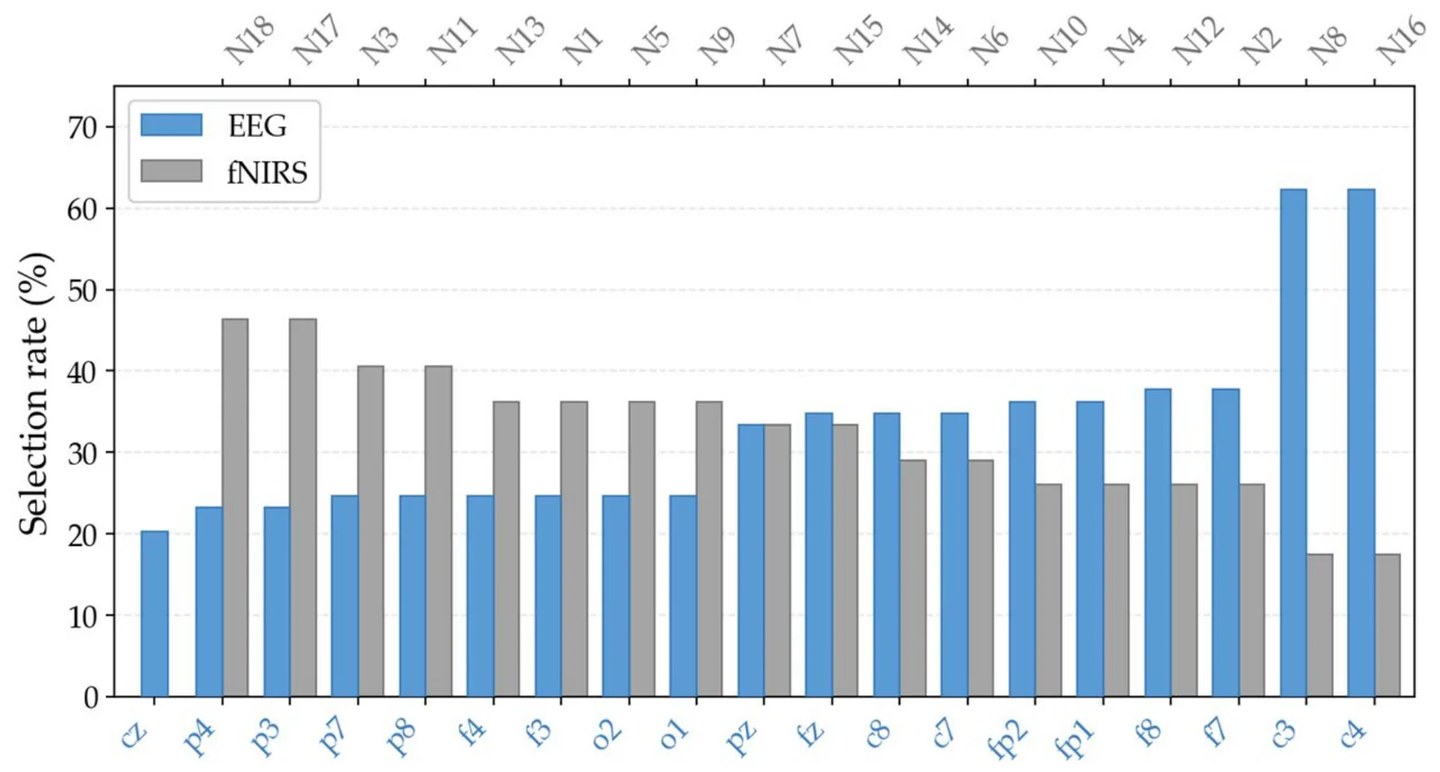
For channel selection, a genetic algorithm identified C3 and C4 as the most informative EEG channels, while optimal fNIRS placement required individual optimization rather than a single fixed montage. Within the constraints of the classification and fusion pipeline used, the team concluded that signal acquisition modality did not significantly influence BCI-FES performance or sense of agency in healthy subjects.
The complete EEG-fNIRS dataset is publicly available through NITRC. The authors describe the work as a preliminary step toward optimizing such systems for clinical use, and note that the participants were healthy, leaving open whether the findings extend to post-stroke rehabilitation patients.