

BCIwiki (bciwiki.com) — A low-cost OpenBCI headset with 8 electrodes distinguished imagined left and right steering turns with an average accuracy of 66.80% using a new decoding model, researchers from Wuhan University of Technology and Guangxi Normal University reported in Sensors on September 14, 2026 (DOI: 10.3390/s26185810).
The team argues that conventional motor imagery tasks, such as imagining left-hand versus right-hand movement, do not match what drivers actually do. In the new paradigm, participants imagine turning a steering wheel left or right with the right hand, which the authors say aligns more closely with real steering at the action level. EEG data were collected from 12 participants.
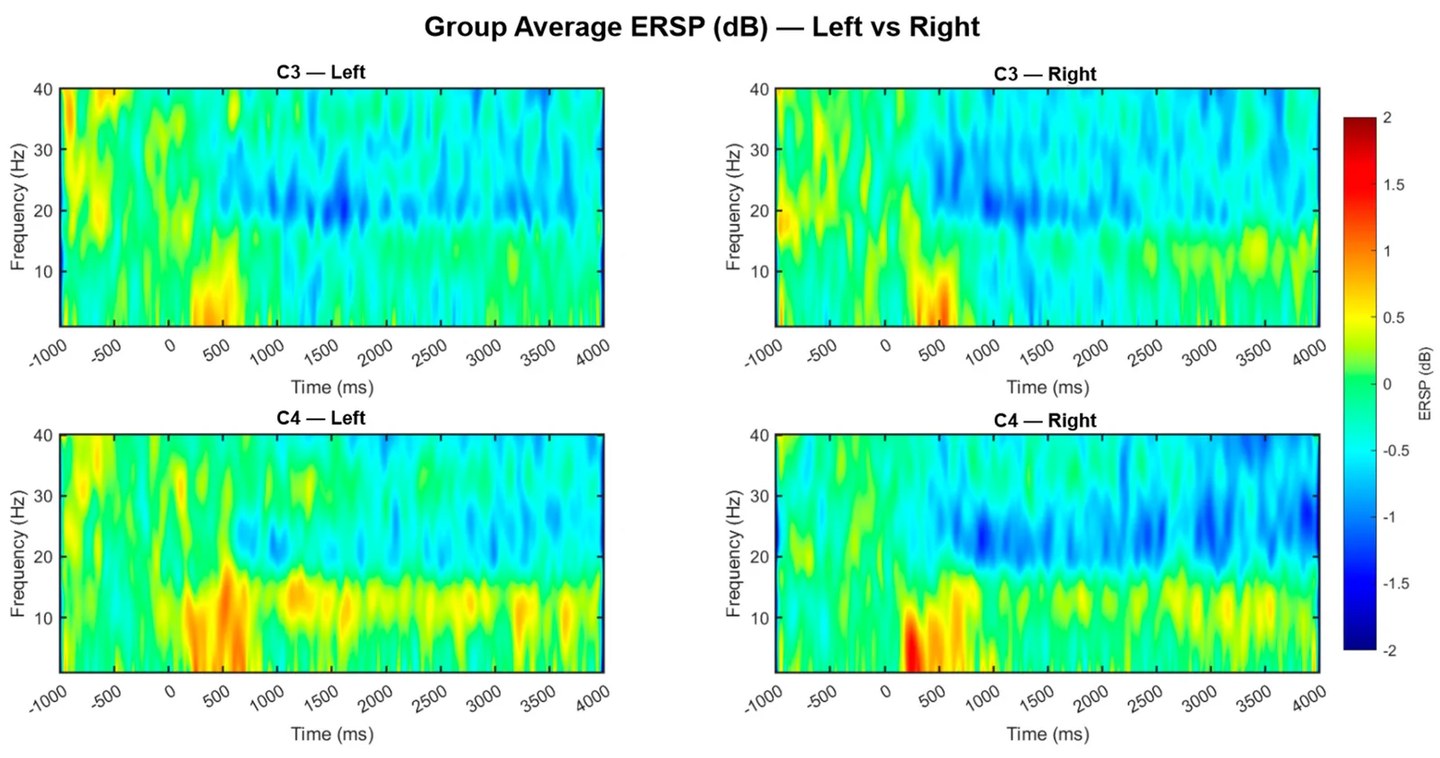
Time-frequency analysis showed event-related desynchronization (ERD) at electrode C3 in both the mu and beta bands during steering imagery. Electrode C4 also showed ERD in the beta band but mainly event-related synchronization in the mu band. Common spatial pattern (CSP) analysis produced discriminative weight distributions over the central region linked to steering direction, which the researchers say indicates the paradigm elicits direction-specific neural patterns.
The team first tested 5 baseline methods, CSP, FBCSP, EEGNet, EEG-TCNet and ATCNet, on separating left and right turns performed with the same hand. It then built SMB-TCSAN, a model combining Sinc convolution, multi-branch temporal convolution and multi-head self-attention, to improve decoding.
The authors describe the results as a preliminary validation of low-cost, few-channel EEG for steering motor imagery decoding and a conceptual reference for future driving-assistive brain-computer interface (BCI) systems. The abstract does not report real-time control or on-road testing.