

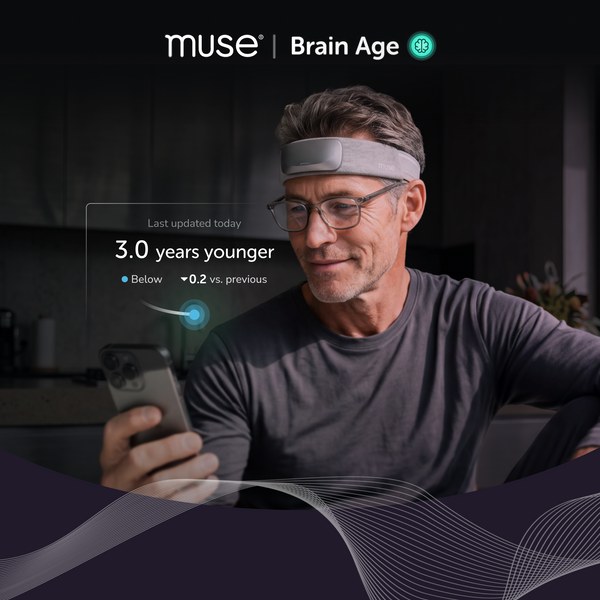
BCIwiki (bciwiki.com) — According to product information from Muse, Muse Brain Age is scheduled to launch on October 19, 2026. It will combine EEG recorded during regular headband sessions with four one-time cognitive tests to provide weekly brain age estimates. The company says results will show a difference in years from chronological age, rather than an absolute brain age, indicating whether the estimate is younger than, aligned with, or older than the user's actual age.
According to Muse, EEG data come from eyes-closed Mind, Body, Breath, Heart, or Guided sessions. Session types can be combined, with each lasting at least 2 minutes and totaling 10 minutes per qualifying day. The four cognitive tests assess processing speed, spatial memory, impulse control, and selective attention. All four must be completed to unlock the first reading.
The first reading requires qualifying sessions on 7 different days, which do not need to be consecutive. It arrives on the Monday following completion of the 7th day. Afterward, 3 qualifying days per week keep the reading current. Muse says a break from sessions makes the reading out of date rather than lowering or resetting it; resuming sessions brings it current again. Supported headbands are Muse 2, Muse S, and Muse S Athena. The first reading is free, while subsequent weekly readings, full history, and trend views are included in Muse Premium.
Muse says the feature builds on a peer-reviewed study by Banville et al., published in Imaging Neuroscience in 2024, using more than 5,200 at-home Muse recordings across ages 18 to 81. The company distinguishes that research from the app's own model, which was developed on that foundation. Muse reports that its estimates fall within about 3.8 years of chronological age on average. This is company-reported age-estimation performance, not evidence of validated clinical use.
Muse describes Brain Age as a general wellness feature and states that Muse is not a medical device. Its readings are not intended for disease diagnosis, prediction, or treatment. The company does not promise that practice changes brain age. Muse also says cognitive test scores can be affected by practice and therefore presents cognitive performance separately from EEG readings; changes in test scores should not be equated with improvements in brain age or health.