

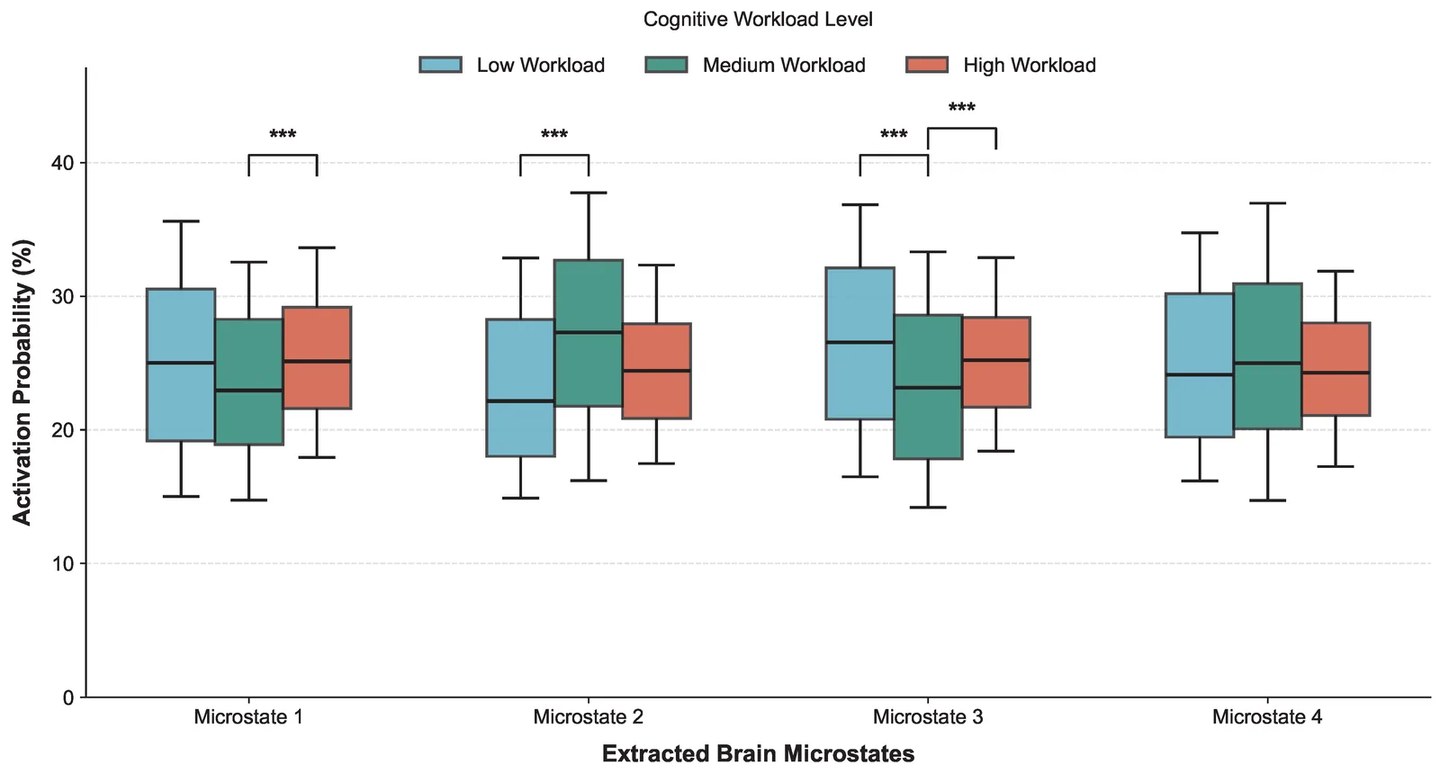
BCIwiki (bciwiki.com) — Individual differences in EEG signals among air traffic controllers limit the generalization of passive brain-computer interfaces (pBCIs) in cognitive workload decoding. Researchers from Nanjing University of Aeronautics and Astronautics and collaborators proposed a Dynamic Microstate-Guided Graph Convolutional Network (DMG-GCN) that achieved an average accuracy of 80.30% and an average F1-score of 78.63% in cross-subject evaluations on simulated multi-level control tasks, as reported in Biosensors on August 26, 2026.The model uses a Dynamic Selective Kernel Temporal Convolutional Block to adaptively extract multi-scale temporal-spectral features, and a Microstate-Guided Dynamic Graph Block to construct a time-evolving adjacency matrix that disentangles topological sub-networks. A spatiotemporal graph convolution module then aggregates these representations, and a temporal self-attention mechanism focuses on task-critical transition moments. Exploratory interpretability analysis suggested that the extracted topological sub-networks exhibit spatial patterns consistent with specific brain network reorganizations, including a transition from global distributed monitoring to temporal multimodal integration and parietal-occipital parallel processing during workload regulation. The team said the framework provides a robust and analytically transparent pBCI solution for adaptive automation in modern aviation.