/ EN

Invasive BCI

92 entries

Invasive brain-computer interfaces record neural signals directly from electrode arrays implanted in the cortex, achieving the highest signal resolution and decoding accuracy of any BCI approach. This topic tracks clinical trials, device engineering, and regulatory milestones across leading players including Neuralink, Blackrock Neurotech, Paradromics, and Precision Neuroscience.

September 2026

Peking University Third Hospital Joins Chinese Invasive BCI Trial for Spinal Cord Injury

Peking University Third Hospital, a top-tier (Grade 3A) general hospital in Beijing whose neurosurgery department is one of its key specialties, is taking part in a clinical trial of a Chinese-developed invasive brain-computer interface (BCI), neurosurgeons Yang Jun and Yu Tao wrote in the 16th issue of China Hospital CEO magazine. The trial enrolls patients with spinal cord injury and relies on a multidisciplinary team (MDT) to restore hand function after implantation. Invasive BCIs read neural signals through electrodes placed inside the skull or on the cortical surface, so surgery and rehabilitation depend on close coordination among neurosurgery, rehabilitation and imaging departments. The disclosure marks one step in Chinese hospitals' clinical validation of domestic systems. Public information has not named the system or disclosed enrollment, follow-up milestones or primary endpoints, and no efficacy or safety data have been released.
StairMed Plans 4-Patient Trial of Wireless Implant for Mandarin Speech

Shanghai-based StairMed has taken its wireless implantable brain-computer interface system into human evaluation for people with speech impairments. The prospective, single-arm trial (NCT07647315) actually began on September 1, 2026, is now recruiting, and plans to enroll 4 participants. Subjects will undergo surgical implantation and brain-control training, followed by an expected 12 months of follow-up recording adverse events, serious adverse events and device deficiencies, along with efficacy data on brain-controlled interaction and communication. Primary completion is expected on August 30, 2028, and the study as a whole on December 30, 2028. The registry record does not disclose the implant site, decoding method or detailed eligibility criteria, and no interim results have been posted, so conclusions on safety and efficacy will have to wait for follow-up data.

Neuracle Registers Cortical Electrode in China's NMPA Device Identifier Database

Neuracle Medical Technology (Shanghai) Co., Ltd. has registered a cortical electrode, model 1014-35, in the medical device unique identification (UDI) database of China's National Medical Products Administration (NMPA), under registration certificate Guoxiezhuzhun 20263120536. Neuracle's product line spans EEG acquisition equipment and implantable electrodes. The electrode belongs to an implantable EEG electrode kit (cortical electrode, blank electrode, electrode dilator, tunneler, torque wrench, lead fixation clip, fixation screws and electrode protective sleeve) that holds its own registration certificate and is also a component of an implantable BCI hand motor function compensation system. That system comprises a BCI implant, the electrode kit, an EEG signal transceiver, a pneumatic glove, a single-use surgical toolkit, and three software packages for EEG decoding, medical testing and clinical management.

Passenger EEG Helps Self-Driving AI Spot Road Risks Early With 95.3% Balanced Accuracy

Researchers recorded passengers' EEG as they watched driving scenes in a highly automated vehicle, then trained models to judge whether a risk lay ahead and where the hazard appeared. A 3D-CRNN reached 95.3% ± 2.7% balanced accuracy in risk prediction and raised hazard identification from 80.9% to 85.0%. In cross-subject tests on passengers the model had not seen, balanced accuracy fell to 64.9% ± 8.5%, showing the approach is still some way from deployment.

Parkinson's Patients Learn to Control Deep Brain Stimulation Through a BCI Game

Researchers at the University of California, San Francisco (UCSF), a public research university known for its neuroscience work, had two Parkinson's disease patients train at home with a brain-computer interface (BCI) airplane-simulator game, learning to down-regulate cortical beta activity and thereby control the intensity of their own deep brain stimulation (DBS). The work, posted as a preprint on medRxiv on August 17, 2026, points to BCI applications in neuromodulation and to more personalized treatment for Parkinson's and other conditions; its conclusions have not yet been peer reviewed.

Preprint: A 10 mW Comms Budget Can't Carry 1,000-Channel Brain Implants

To move from lab prototypes to long-term clinical systems, implantable brain-computer interfaces must place thousands to millions of electrodes several millimeters to centimeters deep in brain tissue without heating it by more than about 1 degree Celsius. This review benchmarks inductive, mid-field, RF, ultrasonic, magnetoelectric, optical, UWB and electro-quasistatic wireless links against three clinical axes (depth, size and data rate), noting that almost every clinically relevant implant is weakly coupled, with coupling coefficients of only 10^-3 to 10^-1. Within a communication budget of about 10 mW, narrowband high-Q links suit power transfer and low-speed data, but at 1-10 nJ/b they cannot deliver the more than 10 Mbps to tens of Gbps uplinks that interfaces with a thousand or more channels require. The study is a preprint and has not been peer reviewed.

Endovascular EEG Records 3.7 Times the Power of Scalp EEG in 5 Patients

Endovascular EEG recorded approximately 3.7 times the power of concurrent scalp EEG in 5 patients undergoing an intracarotid amobarbital injection, known as the Wada test, and the nearest endovascular-scalp electrode pairs showed consistently higher coupling in every participant, a mean difference of 4.9 percentage points ranging from 1.8% to 7.6% across individuals and most pronounced at separations under 30 mm. Endovascular EEG has emerged as a brain monitoring technique that balances signal fidelity against invasiveness, the authors write, matching subdural recordings in bandwidth and signal-to-noise ratio in animal studies, but its signal properties have been sparsely quantified in people. All signals were preprocessed with artifact rejection and independent component analysis, then assessed with power spectral density, imaginary coherence, phase-locking value and amplitude envelope correlation.

EEG Signal Lifts Team Decision Accuracy to 88%, but Only Under High Workload

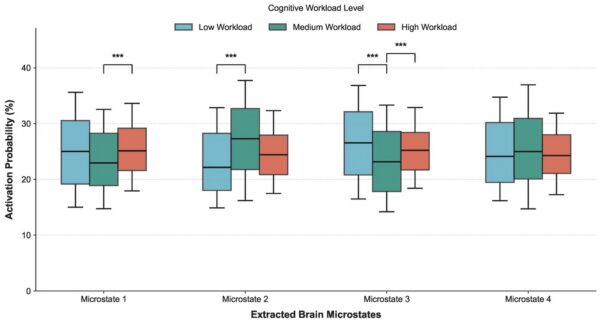
Spatial-covariance EEG features can flag whether an operator's decision will be correct before the response is committed, and weighting group votes by that signal raised accuracy on contested trials from 57% to 88% as team size grew from 2 to 16, according to a preprint. Twenty-three participants ran a virtual reality target-detection task under high and low cognitive workload, and the gain appeared only in the high-workload condition; under low workload the weighting hurt performance. EEG-based decision-reliability signals are therefore workload-conditional rather than a general-purpose team augmentation tool, the authors write; the preprint has not been peer reviewed.

Anti-Fouling Coating Shields Neural Electrode, Signal Stays Clear for Six Months

Researchers at the Technical Institute of Physics and Chemistry of the Chinese Academy of Sciences and collaborating institutions have developed a neural electrode interface that, they report, significantly extended electrode operational lifetime and improved signal fidelity over six months of in vivo implantation. The material, a benzyloxycarbonyl-substituted poly(ornithine-alt-glycine) coating abbreviated OGCbz, resists biofouling and immunogenic rejection without degrading electrical performance, targeting what the authors call the critical obstacle to electrodes that combine long-term recording with tunable biofunctional control: an immune-mediated foreign body response in which glial scar encapsulates implants like cement. Substituting the Cbz group with other functional moieties preserves those antifouling and biocompatibility properties while adding new ones, and as a proof of concept the peptide sequence IKVAV and the antibody cetuximab gave the interface neuron affinity and tumor cell proliferation inhibition respectively; the six-month result came from the IKVAV-functionalized version.

Transdural Link Hits 500 Mbps for Brain Implants

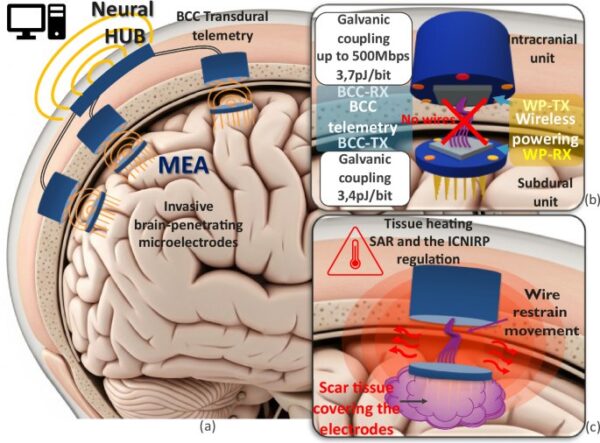
Researchers at imec, Eindhoven University of Technology and Erasmus MC propose a two-stage wireless architecture for intracortical BCIs: a transdural galvanic-coupled body channel link carries data from a free-floating microelectrode array to an intracranial unit, and a transcutaneous link then relays it outside the body. In phantom tests and ex vivo experiments on a human cadaveric head, the transdural link reached 500 Mbps at 20% duty cycling with bit error rates below 10⁻⁵. A built-in send-on-delta encoder (SODA) compresses data by up to 11.4x to cut thermal load, and brain-on-a-chip models showed no unintended neural activity. The study appeared in Communications Engineering on September 1, 2026.
August 2026

Review Charts the Shift From Rigid Silicon to Soft Brain Implant Electrodes

Implantable brain-computer interfaces are shifting from rigid silicon architectures to soft, structurally adaptive systems built for seamless, long-term integration with neural tissue, according to a review of flexible electrode materials and structural design published in SmartMat on August 31, 2026. Breakthroughs in materials science and micro/nanofabrication have given this generation of devices mechanical compliance, robust interfacial adhesion and high-fidelity signal acquisition that earlier designs could not reach, the review says. Long-term stability at the electrode-tissue interface remains one of the core bottlenecks for invasive BCI.

Roadmap Counts More Than 150 Children Worldwide With Implanted BCIs

Researchers report that more than 150 children worldwide have received implanted brain-computer interfaces, a number expected to grow quickly as the devices reach the market. A 2026 paper in Neurorehabilitation and Neural Repair spells out a roadmap for pediatric iBCI development, including work from the first International Virtual Summit on Implanted BCIs for Children with Complex Needs and workshops at the 11th International BCI Society Meeting. It highlights unresolved questions about early-life implantation and pediatric indications that must be answered before the technology is deployed widely in children.

Memory Prosthetics Near First-in-Human Trials

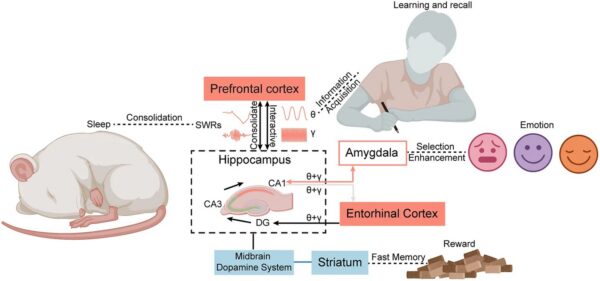
Memory prosthetics — closed-loop brain-computer interfaces that decode hippocampal activity and deliver adaptive stimulation — are moving from animal proof-of-concept toward first-in-human trials, according to a review in iScience. The authors argue that chronically implantable systems require co-design of three subsystems that have been treated in isolation: biocompatible electrode interfaces, on-chip neuromorphic computation, and closed-loop control hardware. The review maps neuroscientific findings such as theta-phase tracking, theta-gamma coupling and sharp-wave ripple detection onto engineering specifications for latency, sampling and charge injection, and onto materials requirements for impedance, switching endurance and chronic stability. It also flags where small-cohort clinical results have been over-generalized.

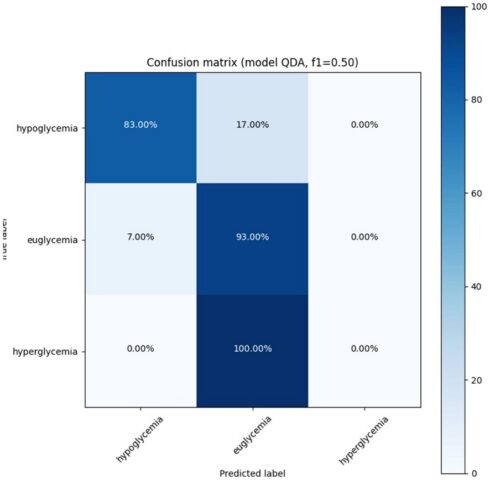
EEG Classifier Flags Hypoglycemia in Type 1 Diabetes at 96.2% Accuracy

A proof-of-concept study reports that a non-invasive EEG-based approach can separate hypoglycemic from non-hypoglycemic states in people with type 1 diabetes, with a quadratic discriminant analysis classifier reaching 96.2% accuracy on a limited dataset. Hypoglycemia was accompanied by characteristic changes in the delta and beta bands, which the authors say points to a non-invasive, real-time route to early warning.

ERP-XTTN: Calibration-Free ERP Decoder Comes within 0.025 AUROC of the Best Baseline

Researchers at the University of Colorado Boulder have built ERP-XTTN, a cross-attention model that classifies event-related potentials (ERPs) in users it has never seen, with no per-user calibration. Across three public datasets and eight ERP components, it trailed the best baseline by 0.025 AUROC on average using only three channels. The work appeared in the Journal of Neural Engineering.

Xi'an Jiaotong Team Uses Inkjet-Printed Conductive Patterns to Align Neural Cells

Researchers at the Second Affiliated Hospital of Xi'an Jiaotong University in northwestern China and the Key Laboratory of Biomedical Information Engineering of the Ministry of Education have built an in vitro screening platform combining electrospun PLCL with inkjet-printed reduced graphene oxide (rGO) and growth-factor micropatterns. Because it varies conductive, biochemical and topographical cues together, the platform can evaluate printing parameters and electric-field strength in a single system. Under 150 mV/cm direct-current stimulation, PC-12 cells showed more neurite-like outgrowth and better alignment than with no stimulation or at 300 mV/cm.

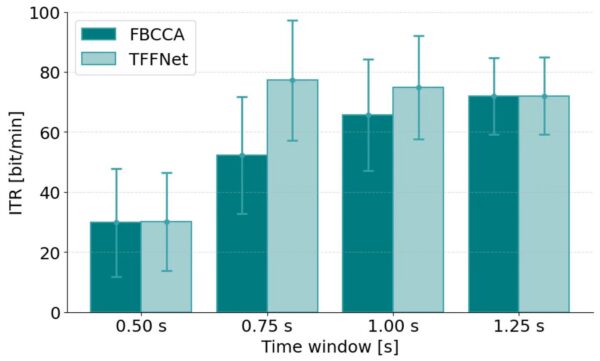
SSVEP-TFFNet Beats FBCCA in XR Headsets, Even at Four Electrodes

Researchers at the University of Naples Federico II in Italy report that the SSVEP-TFFNet deep-learning model outperforms filter bank canonical correlation analysis (FBCCA) at classifying steady-state visual evoked potentials (SSVEP) recorded in extended reality (XR), where headset visuals degrade EEG quality. They used an open XR benchmark dataset of 30 subjects and 1200 trials acquired with Microsoft HoloLens 2. Cutting the montage from 8 channels to 6 or 4 left performance close to the full set, supporting lightweight, wearable XR-BCI designs.

Embodiment and Simulator Sickness Map to Distinct EEG Patterns in XR-BCI

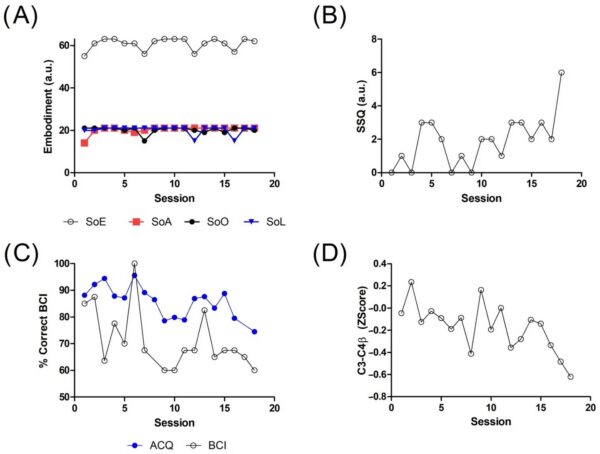
A single-case study of a participant with chronic spinal cord injury found that sense of embodiment was positively associated with frontal theta activity, while simulator sickness was negatively associated with sensorimotor beta activity, during extended reality brain-computer interface (XR-BCI) use. Analyzing 17 XR-BCI sessions with Bayesian correlation and multiple linear regression, researchers at Escola Superior de Saúde do Alcoitão, Universidade de Aveiro and Universidade Católica Portuguesa found simulator sickness to be the only variable independently associated with sensorimotor beta activity, a result they report as robust; the study appeared in Life on August 27, 2026. Different dimensions of subjective experience during XR-BCI operation therefore appear to have partly distinct neurophysiological correlates, a basis for reading user experience from EEG in real time and tuning BCI training and interaction design.

Kunming Team Maps Why BCI Performance Has a Ceiling, and How to Push It

A team at Kunming University of Science and Technology, in southwestern China's Yunnan province, has published a paper in the Journal of Biomedical Engineering analyzing how inherent limitations set the capability boundaries of brain-computer interfaces (BCIs). Dynamic neural coding, inter-individual variability, low signal-to-noise ratio, partial observability and paradigm dependence jointly impose upper limits on decoding accuracy, information transfer rate, complex intention decoding, user experience and system stability. The authors propose information enhancement, adaptive decoding, human-machine collaboration and system optimization, arguing that gains will come from extracting more from the neural signal rather than from overcoming the underlying limits.

UC Berkeley Team Proposes DustNet, a Wireless Network of Ultrasonic Neural Implants

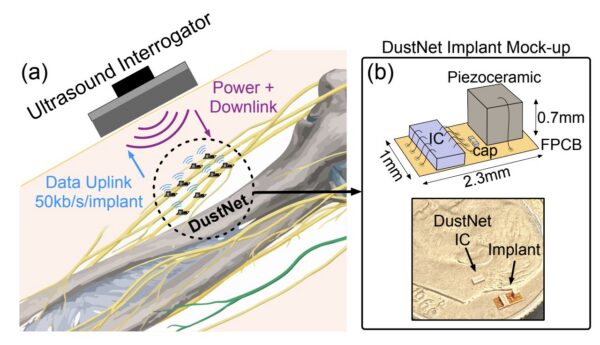
Engineers in the Muller Lab at the University of California, Berkeley have described DustNet, a wireless network of miniaturized ultrasonic implants that acquire and transmit neural signals without wires, in a paper in IEEE Transactions on Biomedical Circuits and Systems. The lab announced the work on its website on August 27, 2026. DustNet follows the lab's earlier MRDust ultrasonic neural interface.

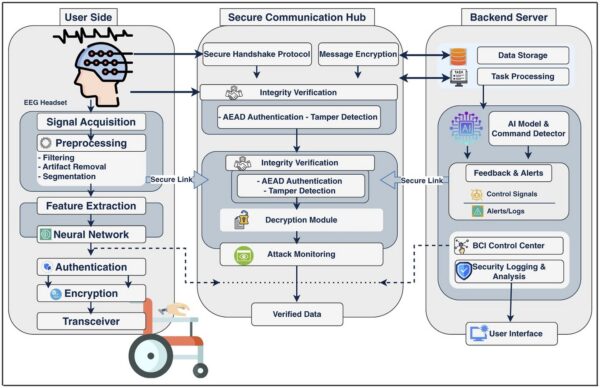
Post-Quantum Encryption Adds Just 0.45 ms of Latency to a BCI Link

A framework called PQ-NeuroLink adds just 0.45 ms of p95 latency over an unsecured baseline in the most constrained Bluetooth Low Energy single-hop condition, while holding packet delivery at 99.0%. Wireless links between brain-computer interface devices have to be both secure and low-latency, and quantum computers threaten the cryptography they currently rely on. By separating authenticated session establishment from the symmetric streaming path, the framework offers a reproducible communication-layer foundation for secure next-generation BCI deployments.

BCI Society Workshop Tackles Outcome Measures for Pivotal Trials

A workshop at the BCI Society Meeting 2025, run with the Implantable BCI Collaborative Community (iBCI-CC), took up how clinical outcome assessments (COAs) for pivotal BCI trials should be selected, developed and validated. Participants pointed to patient heterogeneity, the absence of widely validated COAs, and the difficulty of capturing outcomes that matter in home and daily-life settings. The discussion lays groundwork for the iBCI-CC Clinical Study Endpoints Workgroup to build a transparent process for identifying meaningful aspects of health and concepts of interest, in support of regulatory approval and reimbursement.

DMG-GCN Decodes Air Traffic Controller Workload From EEG at 80.30% Accuracy

In cross-subject decoding across simulated multi-level air traffic control tasks, the DMG-GCN model reached 80.30% average accuracy and a 78.63% average F1-score, outperforming state-of-the-art baselines. Built by researchers at Nanjing University of Aeronautics and Astronautics and other institutions, the dynamic microstate-guided graph convolutional network targets the inter-subject variability in controllers' EEG that has held back passive brain-computer interfaces for adaptive automation.

Wireless EEG Use Climbs in Children With Developmental Disabilities, BCI at 28.1%

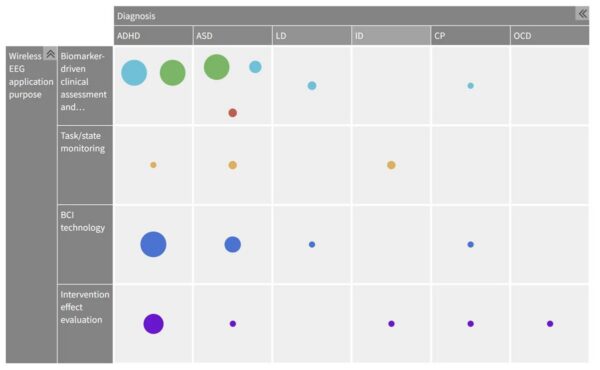
Researchers at Yonsei University in South Korea and the University of Toronto reviewed 64 studies covering 3,103 participants and found wireless EEG increasingly used in research on children with developmental disabilities, with brain-computer interfaces accounting for 28.1% of the included studies. BCI work favored low-channel, dry-electrode, consumer-grade devices, while biomarker-driven studies used higher channel counts and signal fidelity; reporting on data quality was thin, with 85.9% of studies giving no validation against wired EEG and 79.7% not specifying impedance thresholds. Published August 25, 2026 in the Journal of Medical Internet Research, it is the first scoping review to map wireless EEG use across a broad spectrum of developmental disabilities in children.

BCIFlex Begins China Trial of Implantable Wireless BCI in Tetraplegia

BCIFlex Medical Technology has begun a clinical trial in China evaluating the safety and efficacy of an implantable wireless brain-computer interface in patients left tetraplegic by spinal cord injury. The trial is registered on ClinicalTrials.gov as NCT07784088 and is recruiting. The sponsor is a Chinese device maker headquartered in the Haidian district of Beijing with an office in Shanghai, working on invasive ultra-thin flexible electrodes; its products include digital EEG systems and stereo-EEG depth electrodes.

Children Designing Their Own P300 BCI Interface Choose Animation, Color and Sound

Thirty-eight typically developing children aged 8 to 12 used a design application to build their own picture-based interface for a P300 brain-computer interface augmentative and alternative communication (P300-BCI-AAC) system, in a study of what children themselves want from such interfaces. They consistently chose preferred colors, animation — zooming most of all — and sound cues: animation aided visual accessibility and target location, background color changes carried preferred colors into the display, and video GIFs and picture overlays added personal relevance. The authors call motion, color, personalization and visual clarity preliminary priorities for pediatric BCI-AAC design, and point to follow-up work with children who use AAC daily and with people who have motor difficulties.

Arctop Unveils RLbF, Which Trains LLMs on Real-Time EEG Feedback

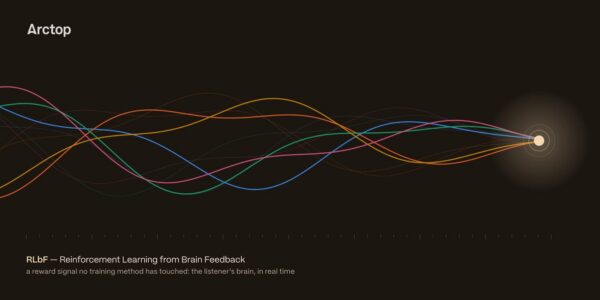
Arctop has published a companion article to its paper introducing Reinforcement Learning from Brain Feedback (RLbF), a framework that decodes real-time EEG into cognitive states such as workload and stress and uses them as reward signals to train large language models. Unlike RLHF, which depends on sparse, subjective feedback given after the fact, RLbF supplies continuous, involuntary signals that let a model sense in real time how its words land in a listener's brain, which the article says improves communication. It is the first use of brain signals to train a language model and is already running in Arctop's Isaac app, though it adapts on a single dimension, cognitive workload, and technical details are not fully public.

Preprint: Quantum-Inspired Circuits Lift Neural Decoding Accuracy in 3 of 4 Seeds

A preprint bolts parameterized quantum circuits onto a ResNet-50 backbone as residual sidecar modules and tests them on 31-class decoding of neural population activity from imagined handwriting. The backbone-gradient variant improved accuracy in three of four seeds and consistently lowered linear CKA similarity to the baseline features, which the authors read as a structural reorganization of the learned representation. They claim no quantum advantage.

Review Proposes 'Brain-Inspired BCIs' for Low-Power, Closed-Loop Neurotech

A review published on August 20, 2026 in npj Biomedical Innovations proposes brain-inspired brain-computer interfaces (BI-BCIs), a framework that unifies neuromorphic computing with BCI design to make neurotechnology lower-power, smaller and capable of closed-loop operation. The authors, from Aarhus University, Stanford University, the University of Southern Denmark, the University of Genoa, Forschungszentrum Jülich and RWTH Aachen University, say the approach could advance neuroprosthetics and neuromodulation for neurological disorders.

Stanford Team Records Psychiatric Brain Circuits at Millisecond Precision

A Stanford program is recording brain activity in psychiatric inpatients at millisecond precision, combining noninvasive electrode arrays with deep brain recording electrodes to trace the circuits behind schizoaffective disorder, borderline personality disorder, autism and cancer-induced depression. The Human Neural Circuitry program, led by neuroscientist Karl Deisseroth at the Wu Tsai Neurosciences Institute, has run for three years and moves data over fiber-optic and copper links fast enough for round trips of under half a millisecond, allowing the system to sense and respond in a closed loop. Deisseroth said the key innovation is getting results at millisecond precision, which he called a crucial step toward understanding complex psychiatric symptoms.
© 2026 BCIwiki.com Digest Topics Tips Subscribe Revisions About