
/ EN
2026-08-29 00:00 United States Papers Foundations & Methods Translated from EN

UT Dallas Team Quantifies How Overlapping ICMS Activation Volumes Erode Discrimination

Summary Researchers at the University of Texas at Dallas paired a biophysically realistic computational model with rat behavioral data and found that discrimination accuracy falls off exponentially as the neuronal activation volumes evoked by intracortical microstimulation (ICMS) overlap (R² = 0.88). With minimal overlap, an intersection-over-union below 1%, rats averaged 85% accuracy, while IoU above 20% left them near chance. The work, published in Frontiers in Computational Neuroscience, gives a mechanistic basis for setting electrode spacing in sensory neuroprosthetics.
Why it matters Sensory neuroprosthetics have been scaling contact counts on the assumption that more electrodes mean finer sensation; this argues the ceiling is set by overlapping tissue volumes rather than contact number, so past a point extra electrodes buy nothing and may cost discrimination. It hands array designers a spacing criterion they can compute instead of discovering it in an animal study, though the thresholds come from rats and may not transfer to human cortex.

皮层内微刺激激活体积重叠与感知辨别能力的关系被量化
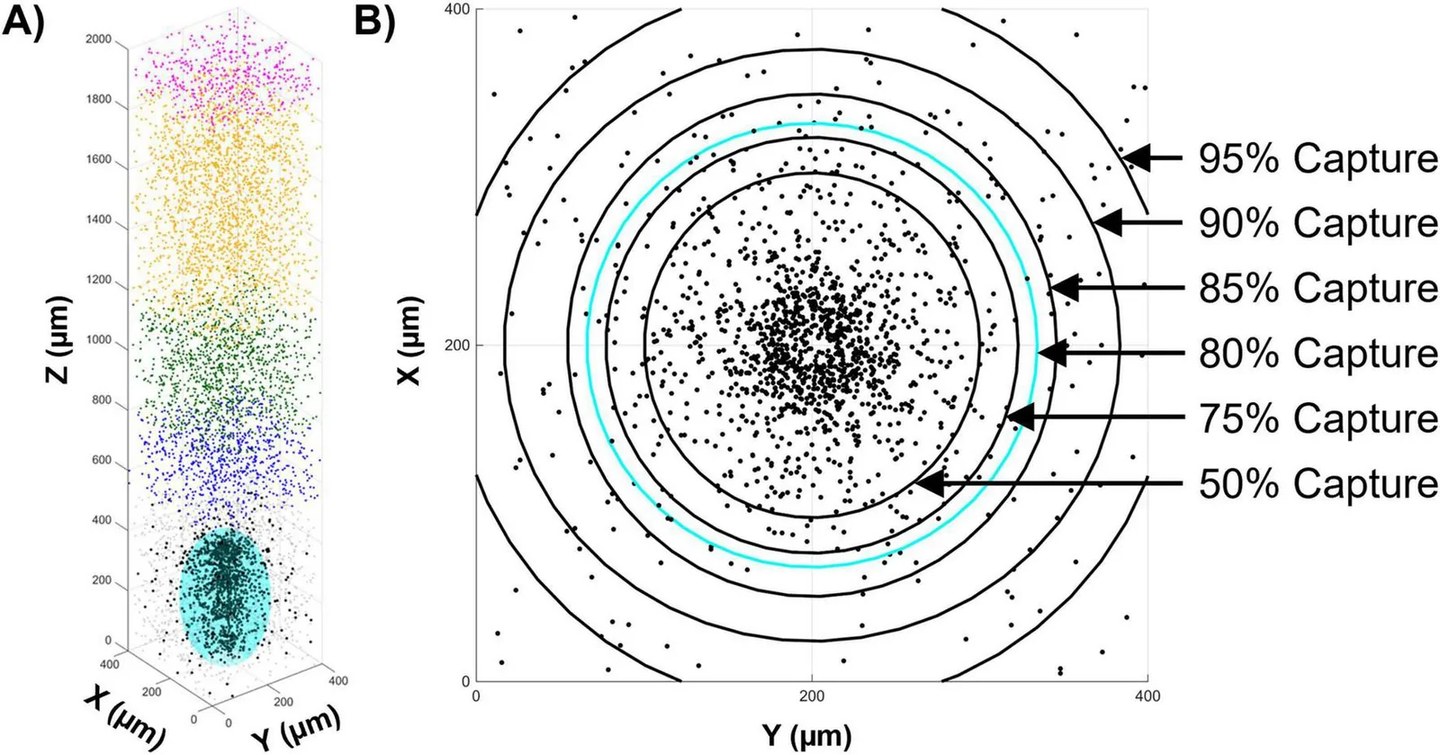
ICMS-evoked somatic activation and its spatial representation across ellipsoid capture thresholds. (A) Spatial distribution of activated somata for a centralized four-shank pattern at 2.40 nC/ph per electrode; black dots denote activated somata, the teal ellipsoid visualizes an 80% capture threshold. Image: Frontiers in computational neuroscience, CC BY 4.0

BCIwiki (bciwiki.com) — Discrimination accuracy in rats declined in an exponential decay-like relationship (R² = 0.88) as overlap in neuronal activation volumes evoked by intracortical microstimulation (ICMS) increased, researchers at The University of Texas at Dallas reported in Frontiers in Computational Neuroscience on August 29, 2026.

The team combined simulated data from a biophysically realistic computational model of the somatosensory cortex with previously collected behavioral data from rats. ICMS patterns used in behavioral experiments were simulated, activation volumes were estimated by fitting 50–100% capture ellipsoids to the spatial distribution of activated somata, and overlap between pairs was quantified using the intersection-over-union (IoU) metric. Across both single- and four-shank microelectrode array configurations, minimal overlap (IoU < 1%) was associated with high discrimination accuracy (>70%; average of 85%), whereas IoU values exceeding 20% corresponded to near-chance performance, independent of depth versus lateral separation.

The authors suggest that ICMS-evoked activation volume overlap may provide mechanistic insight into the spatial limits of perceptual discrimination and may help guide future electrode spacing and stimulation strategies for sensory neuroprosthetic design.

Compiled by BCIwiki from public sources

Sources · 1

The University of Texas at Dallas timeline

2026-07 Spatial Proteomic Analysis of Antimicrobial Therapeutic-Releasing Intracortical Probes 2026-07 Ruthenium Oxide Electrode Coating Supports 25 Weeks of Intracortical Stimulation 2026-07 Sigmoidal Decoding of Locomotion Speed in Mouse M1 All entries →
Read original ↗
Suggest a correction Revisions · none / EN
© 2026 BCIwiki.com Digest Topics Tips Subscribe Revisions About