

BCIwiki (bciwiki.com) — According to the journal record from Frontiers in Neuroscience, a review of clinical safety assessment for implanted brain-computer interfaces (BCIs) by Baozhou Xing, Li Zhang and Wen-Jun Tu was published on October 28, 2026. The authors are affiliated with Shandong Second Medical University and Aerospace Center Hospital, Peking University Aerospace School of Clinical Medicine. It examines existing evidence and proposes a lifecycle assessment framework rather than establishing that any implanted BCI architecture is generally safe.
The review covers penetrating intracortical, cortical-surface (including subpial) and cerebral-venous systems, treating stimulation as an additional exposure. Published studies report perioperative neurological and wound complications, vascular patency, stimulation-related effects, changes in devices and materials, and loss of functions participants may depend on. The authors identify small and sometimes overlapping cohorts, varying exposure denominators, incomplete long-term surveillance and limited retrieval data as barriers to comparisons across architectures.
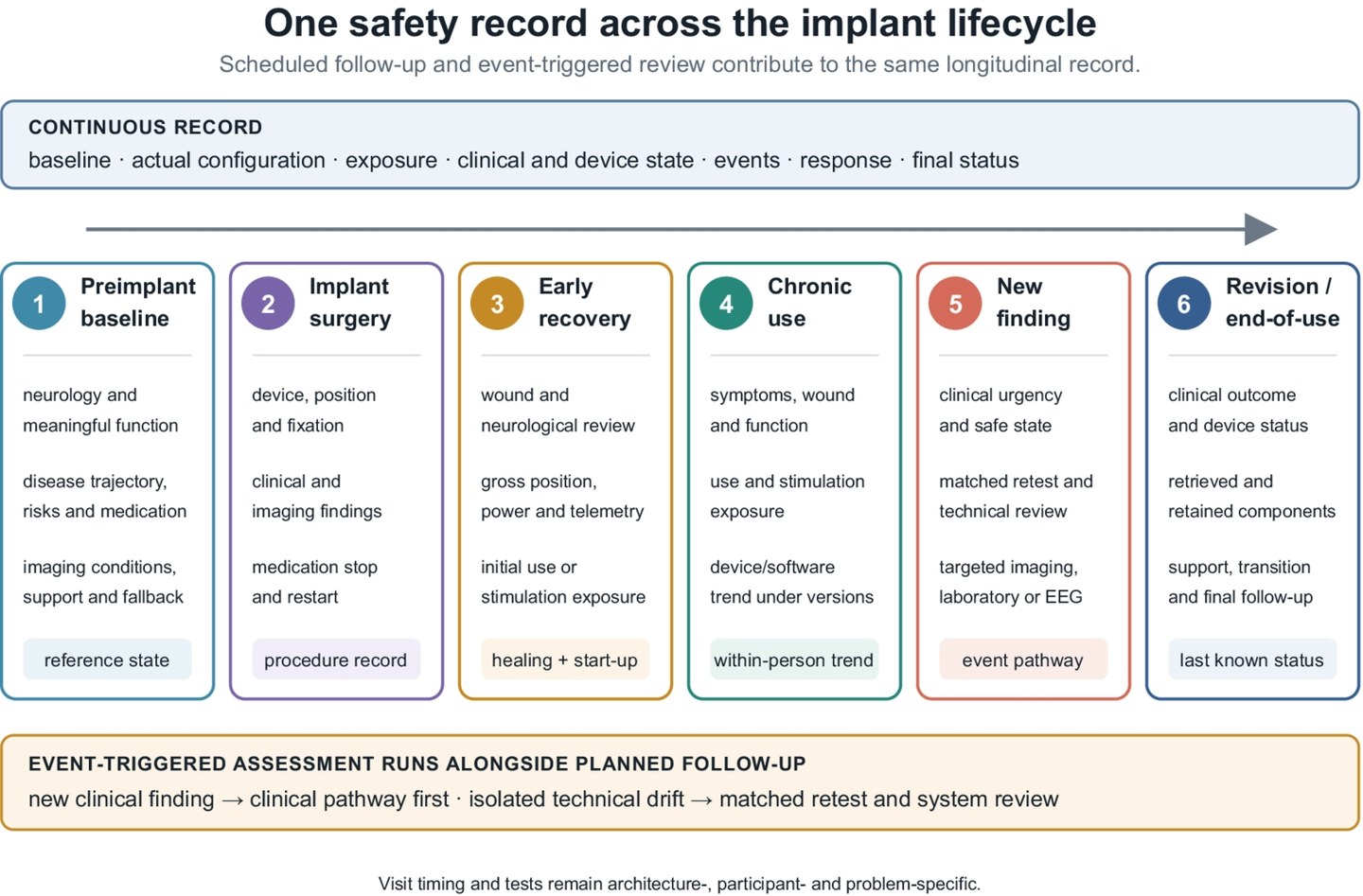
The authors argue that chronic safety cannot be inferred from a single test. Clinical review, problem-directed imaging, device interrogation and participant-level outcomes capture different parts of the safety record and should be assessed together over time. Their proposed framework spans preimplant baseline, implantation, recovery, chronic use, new findings and end-of-use. It combines a small common dataset with architecture-specific modules and an event-triggered process for confirmation, attribution, escalation and outcome recording.
Before the framework can inform formal guidance, the authors call for prospective multicentre testing, independent adjudication, input from participants and caregivers, registry follow-up and periodic revision. The near-term aim is to make safety evidence comparable and clinically useful without treating any implanted BCI architecture as generally safe.