

BCIwiki (bciwiki.com) — A post-quantum-ready secure communication framework for distributed brain-computer interfaces added just 0.45 ms of p95 latency in the most constrained Bluetooth Low Energy single-hop condition compared with an unsecured baseline, while maintaining 99.0% packet delivery. The study, by Tariq Qayyum, Asadullah Tariq, and Abdelkader Nasreddine Belkacem of the Inception Institute of Artificial Intelligence in the UAE, was published in Frontiers in Systems Neuroscience on August 26, 2026.
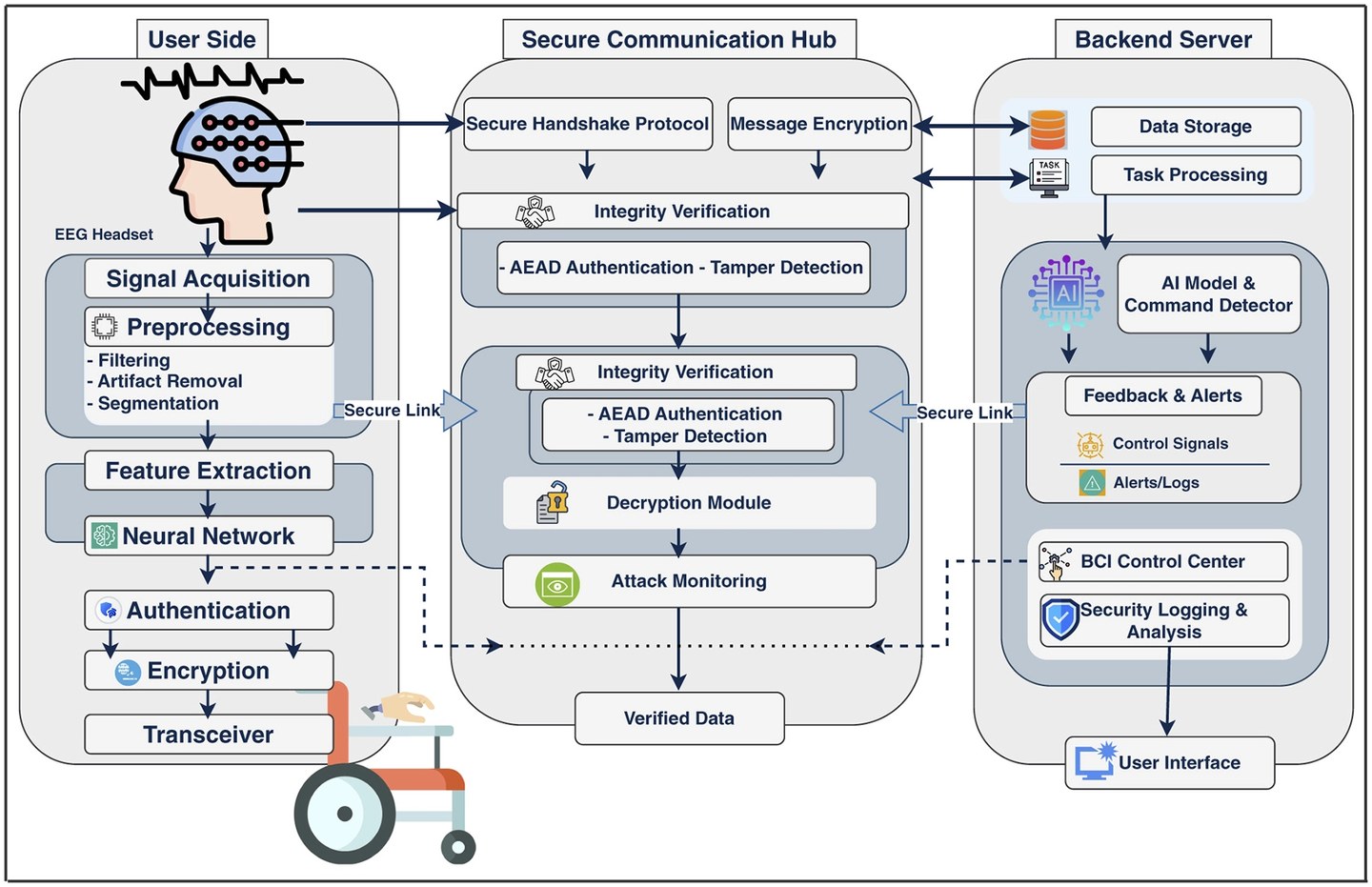
Distributed electroencephalography (EEG) BCI systems increasingly transmit neural data and control messages between a head-worn device, a nearby hub, and cloud-assisted services. These links require integrity, authenticity, replay protection, and low latency, while migration to post-quantum cryptography can increase session-establishment cost. PQ-NeuroLink separates authenticated session establishment from the symmetric streaming fast path, supporting classical X25519, post-quantum ML-KEM-768, and hybrid ML-KEM-768 plus X25519 key establishment, with pinned ML-DSA public keys for endpoint identity binding.
The prototype was evaluated using EEG-derived traffic from public datasets over BLE-like and Wi-Fi-like link profiles, 1-hop and 2-hop topologies, symmetric key-update and public-key refresh events, active tampering scenarios, and MCU-informed resource and processing-energy projections. Identity pinning and transcript binding prevented successful modeled session-splicing attempts. Post-quantum and hybrid modes primarily increased handshake bytes rather than steady-state streaming latency. The authors conclude that post-quantum-ready authenticated session establishment can be integrated into distributed EEG communication prototypes when public-key operations are kept off the per-frame path.