

BCIwiki (bciwiki.com) — According to device manufacturer MBrainTrain, a study in healthy adults compared Gabor-textured and plain flicker for visual brain-computer interfaces (BCIs). The initial frequency sweep involved 24 healthy adults. A five-target task followed two months later, with analysis including 18 of the original participants. The paper was published in Biocybernetics and Biomedical Engineering (DOI: 10.1016/j.bbe.2026.06.002). The study examined steady-state visual evoked potentials (SSVEPs), sustained EEG responses to periodic visual stimulation, alongside visual comfort.
MBrainTrain reports that the researchers used its Smarting PRO electroencephalography (EEG) system, comprising a wireless amplifier and a semi-dry 8-channel cap, with electrodes over occipital and parieto-occipital areas. Both stimuli were disks flickering sinusoidally against a black background. One was uniform; the other contained 75 randomly oriented Gabor patches. The primary difference was spatial texture rather than overall brightness.
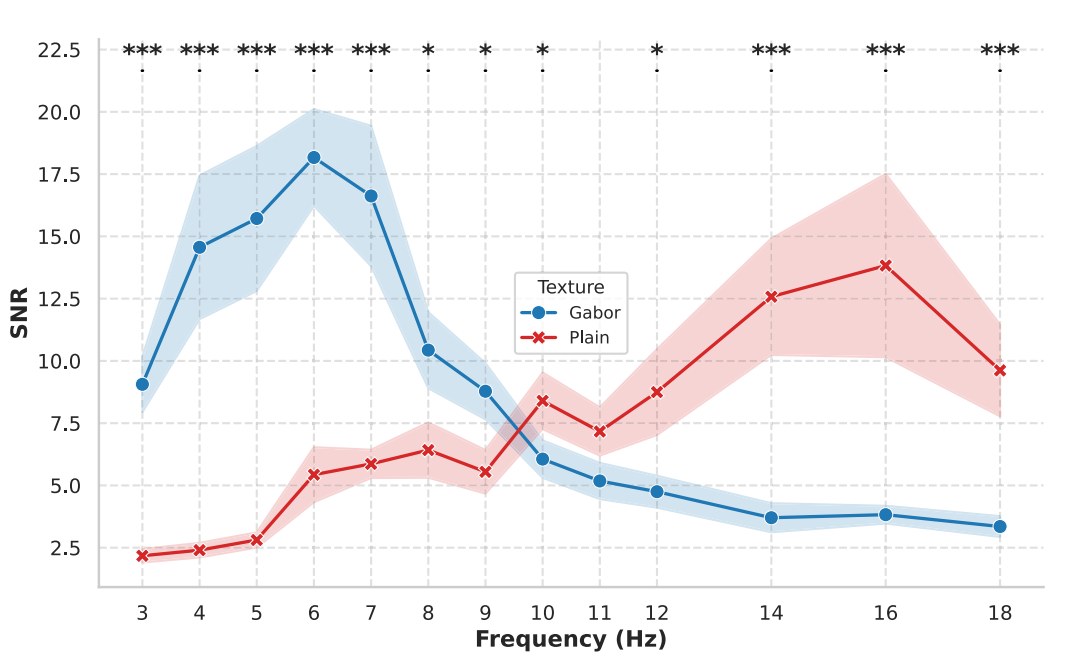
The first session tested both stimuli at 13 frequencies: 3-12 Hz in 1 Hz steps, followed by 14, 16, and 18 Hz. After each block, participants rated comfort and mental fatigue from 0 to 10. At 3-9 Hz, textured flicker produced higher SSVEP signal-to-noise ratios than plain flicker, peaking around 6 Hz. Above 10 Hz, plain flicker produced higher ratios, with its own peak near 16 Hz. Unlike the frequency-dependent signal advantage, textured flicker was rated more comfortable and less fatiguing at every tested frequency.
In the second session, participants looked at a cued sequence of digits among five flickering targets, resembling PIN entry. EEG classification was performed offline afterward. At 5-7 Hz, textured flicker achieved high accuracy with consistent performance across participants, whereas plain flicker was less reliable and more variable. At 14-16 Hz, plain flicker was more reliable. The account reports comparable accuracy for the two stimuli within their respective preferred bands, without giving percentages. Textured flicker was rated more comfortable and less distracting in both bands during the multi-target task. These healthy-adult experiments and offline results do not establish real-time control performance or clinical effectiveness.