
中 / EN

Media Coverage

6 entries
October 2026

Treated Parkinson's Patients Show Differences in Brain Activity Timing During Walking

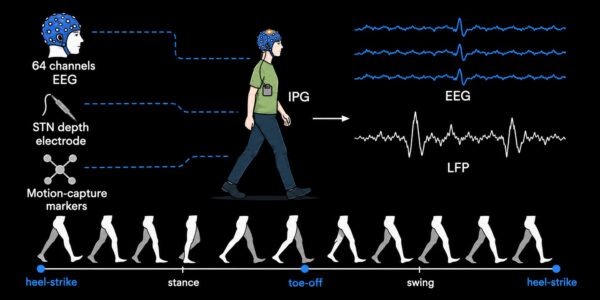
A study of 10 people with Parkinson's disease and 10 healthy controls found differences in how brain activity varied across walking phases while patients were on medication and receiving deep brain stimulation at their usual clinical settings. Researchers simultaneously recorded EEG, subthalamic nucleus signals, and whole-body movement, analyzing only straight walking segments. Group differences were limited in averaged spectra, but step-by-step analysis revealed prominent high-beta and gamma timing differences and gait-cycle modulation in the subthalamic nucleus. These signals are not yet established biomarkers of impaired gait; their relationships with walking speed, stride length, and step-to-step variability still need testing. This study is a preprint and has not been peer reviewed.

Textured Flicker Improves BCI Viewing Comfort as Decoding Performance Varies by Frequency
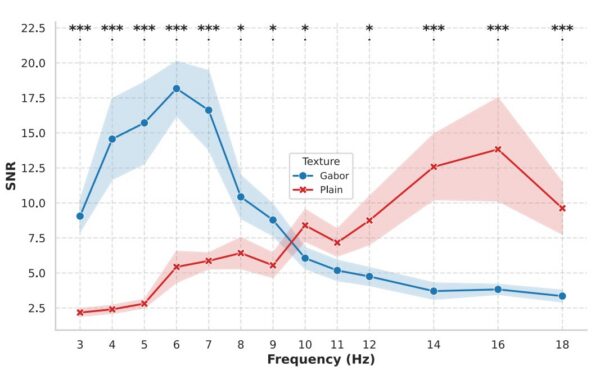
A study in healthy adults compared flickering disks filled with Gabor textures against plain flickering disks. An initial frequency sweep involved 24 participants; analysis of a five-target task two months later included 18 of them. Textured flicker produced higher EEG signal-to-noise ratios at 3-9 Hz and was rated more comfortable and less fatiguing at every tested frequency. In offline classification of the five-target task, textured flicker performed well at 5-7 Hz, while plain flicker was more reliable at 14-16 Hz. Accuracy was comparable within each stimulus's preferred band. Better comfort therefore did not mean better decoding at every frequency.

Arbor Neuroscience Plans Brain Maps to Link Symptoms With Neuromodulation Targets
Arbor Neuroscience plans to develop brain maps that track signal changes after neuromodulation and connect specific symptoms with neural circuits. Its goal is to guide treatment targeting by symptoms rather than diagnostic categories alone. Its predecessor, Forest Neurotech, developed Forest 17, a wearable functional ultrasound imaging device that observes brain activity through localized blood flow changes. A future version is intended to add focused ultrasound neuromodulation. These are research instruments for people who already have ultrasound-transparent skull-replacement implants, not devices that anyone can simply put on and use. Symptom-to-circuit mapping and treatment planning based on it remain organizational goals.
September 2026

Single ECoG Implant Lets Paralyzed Participants Speak and Gesture Through an Avatar

A research team has used a single high-density electrocorticography (ECoG) implant, an electrode array placed on the brain's surface, to decode speech and gestures simultaneously in people with paralysis, ApplySci reported. When participants simply attempted to speak or gesture, a personalized virtual avatar spoke or moved accordingly, either both at once or separately. The researchers expected the brain signals during combined expression to be a simple sum of the two, but the data differed clearly from speech or gestures alone. Participants practiced a limited vocabulary of up to 10 gestures and 10 words or phrases.
July 2026

Paradromics Names William Marks Chief Clinical Officer as Connexus Study Advances

Paradromics has named William J. Marks chief clinical officer; he brings nearly three decades of experience in clinical neuroscience and implantable devices. The appointment comes as the company advances Connect-One, an early feasibility study of its Connexus BCI system, which is intended to restore communication for people who have lost it to spinal cord injury, stroke or ALS.

Chinese Rehabilitation Association Sets July Workshop on Closed-Loop EEG-TMS

The Chinese Association of Rehabilitation Medicine will hold a workshop on EEG-driven closed-loop TMS in Guangzhou, southern China, on July 17, 2026, staged under its Naoke China (脑客中国) series and run by its committee on brain function monitoring and modulation in rehabilitation. The technique reads EEG in real time and triggers a TMS pulse when a target brain state appears, a 'brain-state-dependent stimulation' approach that pairs the spatial precision of TMS with the temporal resolution of EEG, and the program is built around moving BCI work out of the laboratory into neurorehabilitation and the precision diagnosis of brain disorders. Shenzhen Yingchi Technology, a subsidiary of Hanix United, is among the supporting organizations, and registration closes on July 17.
© 2026 BCIwiki.com Digest Topics Tips Subscribe Revisions About