
/ EN
2026-09-01 00:00 BelgiumNetherlands Papers Foundations & Methods Translated from EN

Transdural Link Hits 500 Mbps for Brain Implants

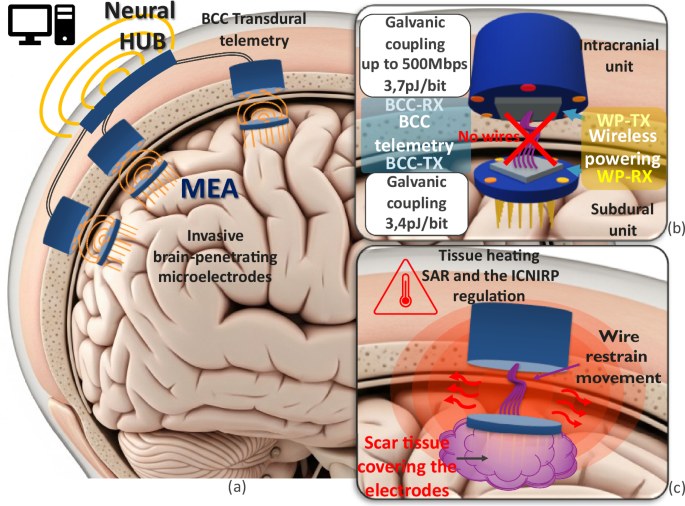
Summary Researchers at imec, Eindhoven University of Technology and Erasmus MC propose a two-stage wireless architecture for intracortical BCIs: a transdural galvanic-coupled body channel link carries data from a free-floating microelectrode array to an intracranial unit, and a transcutaneous link then relays it outside the body. In phantom tests and ex vivo experiments on a human cadaveric head, the transdural link reached 500 Mbps at 20% duty cycling with bit error rates below 10⁻⁵. A built-in send-on-delta encoder (SODA) compresses data by up to 11.4x to cut thermal load, and brain-on-a-chip models showed no unintended neural activity. The study appeared in Communications Engineering on September 1, 2026.
Why it matters Data from high-density arrays already exceeds what implant radios can carry, and every wireless iBCI roadmap runs into the same bandwidth, power and heat wall. This work attacks all three in one architecture and validates it on a cadaveric head rather than in simulation alone, which makes it a credible building block for high-channel-count implants.

皮层内脑机接口隔着硬膜无线传数据,速率做到500 Mbps
Image: Communications Engineering, CC BY 4.0

BCIwiki (bciwiki.com) — A transdural wireless link can carry data out of an intracortical brain-computer interface at up to 500 Mbps, according to a study by researchers at imec, Eindhoven University of Technology and Erasmus MC published in Communications Engineering on September 1, 2026.

High-density microelectrode arrays resolve neural activity in fine spatial and temporal detail, but the resulting surge in data is hard to move wirelessly from a miniaturized implant under limits on power, bandwidth, heat dissipation and device size. The team’s architecture has two stages: a transdural galvanic-coupled body channel communication (BCC) link from a free-floating microelectrode array to an intracranial unit, followed by a transcutaneous link to an external unit. The paper focuses on the transdural stage, which the authors describe as compact, wideband and energy-efficient.

In phantom tests and ex vivo experiments on a human cadaveric head specimen, the link reached 500 Mbps with 20% duty cycling and bit error rates below 10⁻⁵. A send-on-delta encoder (SODA) built into the system compresses data by up to 11.4x, which the researchers say reduces thermal load enough to meet safety guidelines. Brain-on-a-chip models showed the system did not evoke unintended neural activity, a result the authors say supports the platform’s long-term viability for high-resolution intracortical BCIs.

Compiled by BCIwiki from public sources

Sources · 1
doi.org 2026-09-01

imec timeline

2026-07 Neurotech Leaders Forum Returns to imec With Europe at an Inflection Point 2025-09 Neuropixels Ultra Doubles Neuron Yield With 6-Micrometer Site Spacing All entries →
Read original ↗
Suggest a correction Revisions · none / EN
© 2026 BCIwiki.com Digest Topics Tips Subscribe Revisions About