/ EN

Wireless Implants

9 entries

Wireless implant technology eliminates the infection risk and mobility constraints of percutaneous wires, a key step toward daily-use BCIs. This topic tracks engineering advances in wireless power transfer, data telemetry, and miniaturized packaging.

September 2026

StairMed Plans 4-Patient Trial of Wireless Implant for Mandarin Speech

Shanghai-based StairMed has taken its wireless implantable brain-computer interface system into human evaluation for people with speech impairments. The prospective, single-arm trial (NCT07647315) actually began on September 1, 2026, is now recruiting, and plans to enroll 4 participants. Subjects will undergo surgical implantation and brain-control training, followed by an expected 12 months of follow-up recording adverse events, serious adverse events and device deficiencies, along with efficacy data on brain-controlled interaction and communication. Primary completion is expected on August 30, 2028, and the study as a whole on December 30, 2028. The registry record does not disclose the implant site, decoding method or detailed eligibility criteria, and no interim results have been posted, so conclusions on safety and efficacy will have to wait for follow-up data.
Preprint: A 10 mW Comms Budget Can't Carry 1,000-Channel Brain Implants

To move from lab prototypes to long-term clinical systems, implantable brain-computer interfaces must place thousands to millions of electrodes several millimeters to centimeters deep in brain tissue without heating it by more than about 1 degree Celsius. This review benchmarks inductive, mid-field, RF, ultrasonic, magnetoelectric, optical, UWB and electro-quasistatic wireless links against three clinical axes (depth, size and data rate), noting that almost every clinically relevant implant is weakly coupled, with coupling coefficients of only 10^-3 to 10^-1. Within a communication budget of about 10 mW, narrowband high-Q links suit power transfer and low-speed data, but at 1-10 nJ/b they cannot deliver the more than 10 Mbps to tens of Gbps uplinks that interfaces with a thousand or more channels require. The study is a preprint and has not been peer reviewed.

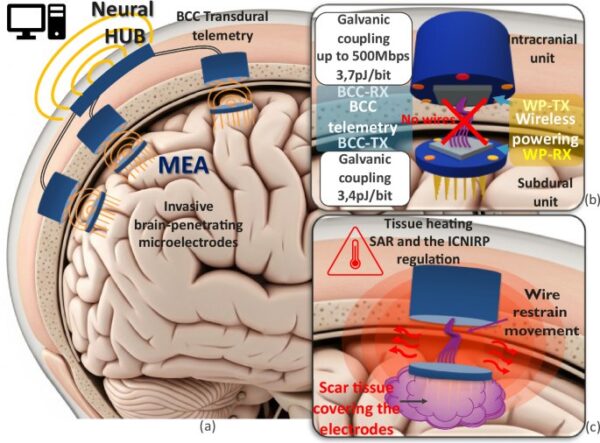
Transdural Link Hits 500 Mbps for Brain Implants

Researchers at imec, Eindhoven University of Technology and Erasmus MC propose a two-stage wireless architecture for intracortical BCIs: a transdural galvanic-coupled body channel link carries data from a free-floating microelectrode array to an intracranial unit, and a transcutaneous link then relays it outside the body. In phantom tests and ex vivo experiments on a human cadaveric head, the transdural link reached 500 Mbps at 20% duty cycling with bit error rates below 10⁻⁵. A built-in send-on-delta encoder (SODA) compresses data by up to 11.4x to cut thermal load, and brain-on-a-chip models showed no unintended neural activity. The study appeared in Communications Engineering on September 1, 2026.
August 2026

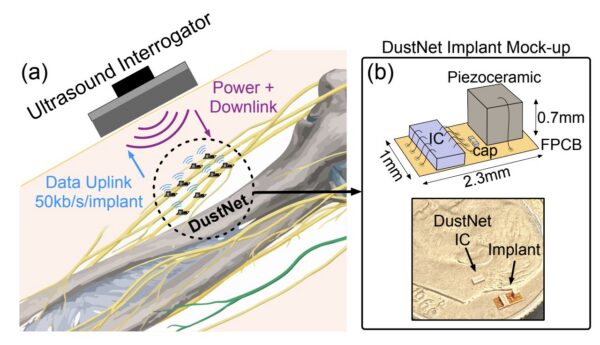
UC Berkeley Team Proposes DustNet, a Wireless Network of Ultrasonic Neural Implants

Engineers in the Muller Lab at the University of California, Berkeley have described DustNet, a wireless network of miniaturized ultrasonic implants that acquire and transmit neural signals without wires, in a paper in IEEE Transactions on Biomedical Circuits and Systems. The lab announced the work on its website on August 27, 2026. DustNet follows the lab's earlier MRDust ultrasonic neural interface.

BCIFlex Begins China Trial of Implantable Wireless BCI in Tetraplegia

BCIFlex Medical Technology has begun a clinical trial in China evaluating the safety and efficacy of an implantable wireless brain-computer interface in patients left tetraplegic by spinal cord injury. The trial is registered on ClinicalTrials.gov as NCT07784088 and is recruiting. The sponsor is a Chinese device maker headquartered in the Haidian district of Beijing with an office in Shanghai, working on invasive ultra-thin flexible electrodes; its products include digital EEG systems and stereo-EEG depth electrodes.
July 2026

Preprint: High Data Rate Battery-Free Implants for Brain-Machine Interfaces

A preprint uses radio-frequency backscatter and near-field wireless charging to tackle the wireless-link and power constraints of implantable brain-machine interfaces, noting that while high-resolution microelectrode arrays enable precise brain readout and stimulation, the 32–128 Mbps links they need are too power-hungry for a long-lived implanted battery. The approach strips the transceiver electronics out of the implant, moving complexity to the external reader to cut implant power, and powers the neural recording and stimulation chips via magnetic coupling. Preliminary tests validate the feasibility of the design; the study has not been peer reviewed.

NeuroXess Registers Fully Implanted Wireless Functional BCI Study for Upper-Limb Functional Replacement

NeuroXess registered a prospective, multicenter, single-arm trial (NCT07720882) enrolling people with tetraplegia caused by spinal cord injury to evaluate the safety and clinical efficacy of an implantable BCI system for compensatory hand movement and upper-limb functional replacement. The study is at the registration stage with no results yet.

32-Channel Event-Based Analog Front End Compresses Neural Signals Adaptively

Researchers have built a 32-channel event-based analog front-end chip in 180 nm CMOS that encodes biosignals in two modes, pulse frequency modulation and adaptive asynchronous delta modulation. The chip retunes its output data rate in real time to the envelope of the incoming signal, giving high compression and, the authors argue, a route to wireless transmission and online processing of neural signals in brain-computer interfaces.
May 2026

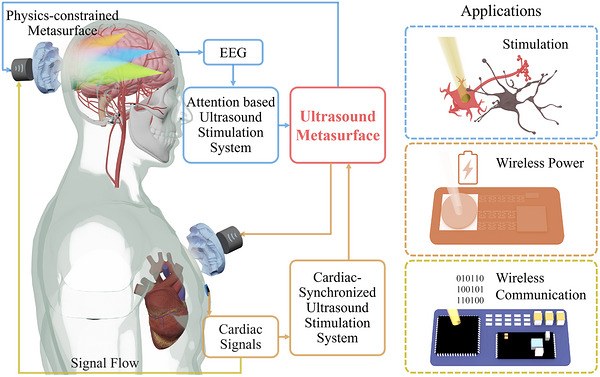
Integrated Ultrasonic Platform for Bioelectronic Control Through Biological Barriers Based on Metasurface

The study presents an integrated ultrasonic platform that delivers high-resolution, multi-point ultrasound energy through highly aberrating barriers such as the skull and ribs, with about ±6.5% intensity uniformity across foci, using a physics-constrained metasurface design framework, and demonstrates two adaptive stimulation paradigms — attention-gated and cardiac-synchronized stimulation. A dual-channel acoustic link sustains continuous transcranial wireless power and data streaming through a single ultrasonic metasurface, remaining robust even under a 400-fold power difference. The authors frame the platform as groundwork for next-generation ultrasound-based brain-computer interfaces (uBMI) and closed-loop bioelectronic therapies.
© 2026 BCIwiki.com Digest Topics Tips Subscribe Revisions About