
/ EN

Netherlands

5 entries
September 2026

Transdural Link Hits 500 Mbps for Brain Implants

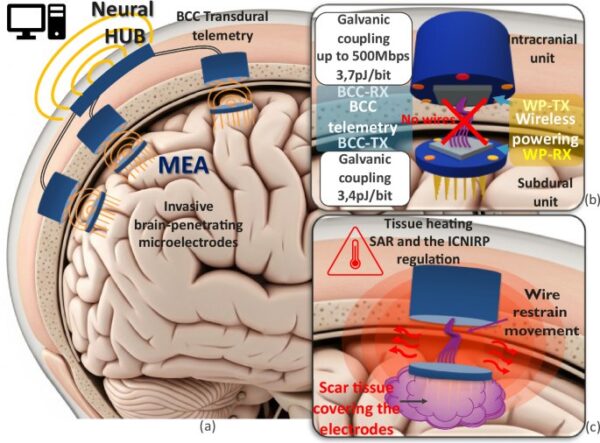
Researchers at imec, Eindhoven University of Technology and Erasmus MC propose a two-stage wireless architecture for intracortical BCIs: a transdural galvanic-coupled body channel link carries data from a free-floating microelectrode array to an intracranial unit, and a transcutaneous link then relays it outside the body. In phantom tests and ex vivo experiments on a human cadaveric head, the transdural link reached 500 Mbps at 20% duty cycling with bit error rates below 10⁻⁵. A built-in send-on-delta encoder (SODA) compresses data by up to 11.4x to cut thermal load, and brain-on-a-chip models showed no unintended neural activity. The study appeared in Communications Engineering on September 1, 2026.
August 2026

Utrecht Team Finds ECoG Grids Can Shrink up to 94% without Losing Decoding Accuracy
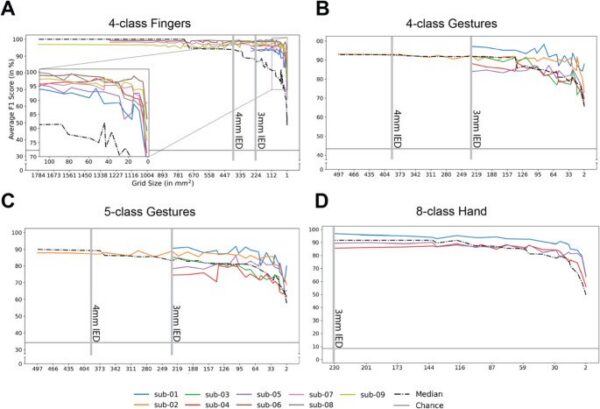
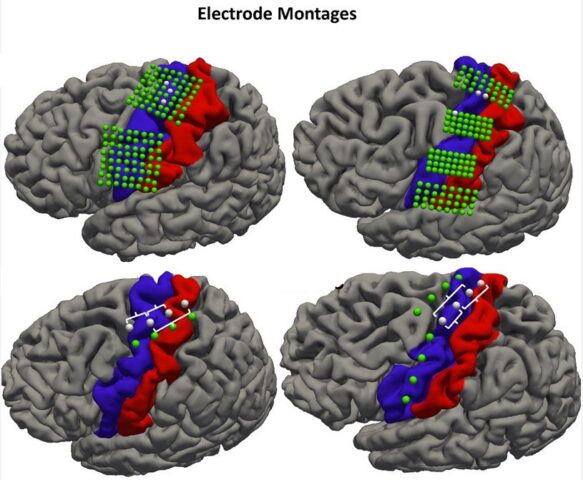
Researchers at University Medical Center Utrecht's Brain Center in the Netherlands and collaborators exhaustively tested every rectangular subgrid inside 32-, 64- and 128-channel ECoG arrays recorded from nine people with epilepsy. Grid area could be cut by 75% to 94% without meaningful loss of hand-movement classification accuracy, as long as the remaining electrodes sat over informative cortex; below a critical area of about 60 mm², performance fell sharply. The study appeared in the journal Neuroinformatics on August 7, 2026.
July 2026

Preprint: MRI Grey Matter Loss May Predict Who Can Control an ECoG BCI in ALS
A preprint from the Utrecht-BCI Lab at the UMC Utrecht Brain Center in the Netherlands, the invasive-BCI group led by Nick Ramsey, asks why some people with ALS control an implanted brain-computer interface (BCI) better than others. It found that preservation of grey matter in the motor cortex is associated with higher-quality brain signals, suggesting an MRI-based measure could help identify who is a suitable candidate for implantation. The preprint was posted to medRxiv on June 23, 2026 (DOI 10.64898/2026.06.23.26355654).
January 2026

Researchers Say BCIs Should Decode User Goals, Not Motor Cortex Signals

Researchers in Germany, the Netherlands and Japan argue in an opinion piece that brain-computer interface design should be rebuilt around ideomotor theory, which treats voluntary action as driven by internally represented sensory outcomes. BCI research has made remarkable technical progress but remains limited in scope, the authors write, typically relying on motor and visual cortex signals in a narrow range of patient populations, and they describe this underused framework as a principled basis for next-generation interfaces that align more closely with the brain's own intentional and action-planning architecture. Reorganizing BCIs around the purpose of an action, meaning the user's goals and anticipated effects, would be a more intuitive, generalizable and scalable path, they suggest, and advances in neural recording and artificial intelligence-based decoding of sensory representations make the shift feasible and timely, potentially easing persistent usability and generalizability problems in BCI design.
September 2025
© 2026 BCIwiki.com Digest Topics Tips Subscribe Revisions About