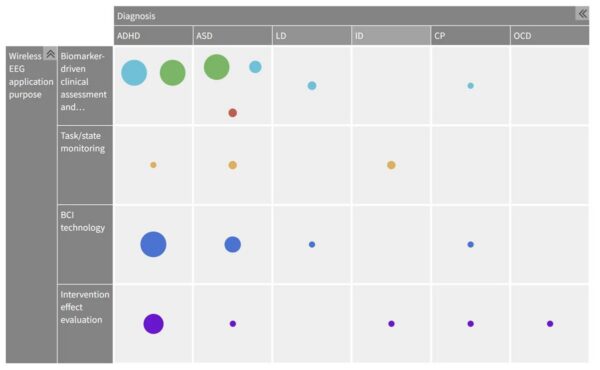
Researchers at Yonsei University in South Korea and the University of Toronto reviewed 64 studies covering 3,103 participants and found wireless EEG increasingly used in research on children with developmental disabilities, with brain-computer interfaces accounting for 28.1% of the included studies. BCI work favored low-channel, dry-electrode, consumer-grade devices, while biomarker-driven studies used higher channel counts and signal fidelity; reporting on data quality was thin, with 85.9% of studies giving no validation against wired EEG and 79.7% not specifying impedance thresholds. Published August 25, 2026 in the Journal of Medical Internet Research, it is the first scoping review to map wireless EEG use across a broad spectrum of developmental disabilities in children.
University of Toronto researchers use diffusion latent representations as an intermediate layer for neural speech decoding, with word error rate varying sharply by timestep.