
/ EN
September 2026

SPAR-EEG Single-Channel Denoiser Lifts P300 Speller Accuracy by 7.8 Points

Wearable neurotechnology and BCI applications, from assistive interfaces to clinical monitoring, favor single-channel EEG because it needs few electrodes and is light to wear. But muscle, eye and motion artifacts are hard to remove from a single channel, especially without auxiliary channels, artifact labels or hand-picked clean baseline segments. SPAR-EEG needs none of these: it applies three artifact-specific attenuation passes to each EEG segment, one based on variational mode decomposition for high-frequency muscle bursts and two based on singular spectrum analysis for blink-like ocular transients and slow motion drift. It achieved the best artifact-region SNR improvement at all 26 SNR levels tested and raised final accuracy by 7.8 percentage points in a P300 speller task using only the FP1 and FP2 leads.
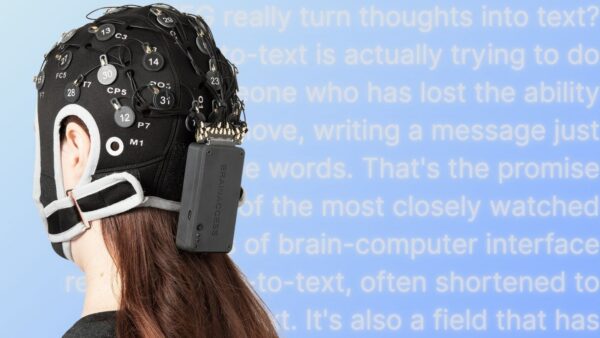
EEG-to-Text Results Overstated as Random Noise Fools Some Decoders

Translating scalp EEG directly into free-form text has long been seen as one of the most ambitious goals for non-invasive brain-computer interfaces. But when researchers fed random noise instead of real EEG into several published decoders, some models still produced fluent sentences and scored about as well as they did on real brain data, suggesting the language model was doing most of the work. The field has since made noise-baseline tests and decoding without teacher forcing standard validation practice, and has used magnetoencephalography (MEG) as a comparison to quantify how far EEG trails cleaner signals.

More Components Can Hurt P300 Spellers, Full-Factorial Study Finds

P300 BCI spellers are often built by switching on every component that works on its own, on the assumption that more is better. A preprint study tested that assumption with a four-component full-factorial experiment and found that a component's value is conditional, not additive. Subject calibration was the strongest single contributor; Euclidean Alignment made up for the lack of calibration in zero-calibration settings; and stacking components that are each useful on their own could lower performance, an effect the authors call component anti-synergy. Language model support was not universally beneficial either: its effect depended strongly on how strong the underlying EEG pipeline was.
August 2026

Interpretable BCI Framework Pairs Emotion Recognition With Thought-to-Speech Decoding

A new study proposes an interpretable brain-computer interface framework that combines affective state recognition with EEG decoding to enable emotion-aware thought-to-speech. Tested on public imagined-speech EEG datasets in subject-independent settings and scored on accuracy, precision, recall, F1-score, inference speed and interpretability, the framework improved decoding reliability over conventional opaque models and produced clinically meaningful explanations, the authors report. They present it as a practical basis for assistive communication tools for people with paralysis, amyotrophic lateral sclerosis, locked-in syndrome and other conditions that disrupt natural speech.

Children Designing Their Own P300 BCI Interface Choose Animation, Color and Sound

Thirty-eight typically developing children aged 8 to 12 used a design application to build their own picture-based interface for a P300 brain-computer interface augmentative and alternative communication (P300-BCI-AAC) system, in a study of what children themselves want from such interfaces. They consistently chose preferred colors, animation — zooming most of all — and sound cues: animation aided visual accessibility and target location, background color changes carried preferred colors into the display, and video GIFs and picture overlays added personal relevance. The authors call motion, color, personalization and visual clarity preliminary priorities for pediatric BCI-AAC design, and point to follow-up work with children who use AAC daily and with people who have motor difficulties.

Dual-View Network Reaches 67.74% on Handwriting-Imagery EEG

DRDNet separates spatial EEG features into two temporal views, models them with a bidirectional Mamba encoder and a Transformer, and then combines them through dynamic fusion and LSTM aggregation. On a public dataset, it reached 67.74% accuracy for imagined Chinese-character strokes and 62.51% for imagined pinyin vowels, outperforming seven EEG-decoding baselines.

EEG-fNIRS fusion decodes imagined handwriting

Researchers report FRED, a principled EEG-fNIRS fusion framework for imagined handwriting decoding, posted to arXiv as a preprint on August 4, 2026 and not yet peer reviewed. Imagined handwriting offers a temporally rich paradigm for non-invasive neural decoding, and EEG-fNIRS fusion promises complementary neural information, but fusion is typically heuristic and lacks principled treatment of frequency-band redundancy. FRED builds frequency-decorrelated temporal ensembles for imagined handwriting decoding. The ensemble reaches 0.8076/0.7242/0.7492 accuracy on the public/private/overall test partitions without test-set adaptation or output constraints, and the complete system reaches 0.8498/0.7718/0.7952, ranking fourth on the private split. A modality audit finds fNIRS-only decoding at chance (0.2511 overall), while adding fNIRS to EEG changes accuracy by only +0.0025.

EEG-guided extraction switches speakers in 2.04 s

Researchers report SAGE, a switch-aware EEG-guided soft gating framework for target speaker extraction, posted to arXiv as a preprint on August 3, 2026 and not yet peer reviewed. Under in-trial auditory attention switching, neural noise and intrinsic latency can delay or destabilize attention tracking, and conventional methods often cause discontinuities at switching points. SAGE treats in-trial switching as dynamic selection, generating two candidate speech streams with a robust separator and using an EEG-guided switch-aware gating module to produce smooth fusion weights and suppress transition artifacts. It integrates latency-compensated alignment and an uncertainty-driven conservative strategy, outperforms baselines, achieves 8.67 dB SI-SDR and 88.24% STOI, and reduces average switching latency to 2.04 s.
July 2026

Multi-User Speech BCI Model Needs Fewer Than 200 Sentences for a New User

UC Davis researchers trained a transformer-based speech decoder across six people with intracortical BCIs. The pooled model cut relative word error rates by more than 50% on average compared with subject-only models and, after fine-tuning on fewer than 200 sentences from an unseen user, achieved a word error rate below 7%. The bioRxiv preprint has not been peer reviewed.

N400 Window Shapes Semantic Decoding

Aalto University researchers connected the classic N400 evoked response with semantic-vector decoding in a controlled MEG word-priming experiment. The study involved 25 native Finnish speakers who read word groups with different levels of semantic relatedness. Unrelated primes produced larger N400 responses and supplied the most useful training examples for a decoder mapping distributed MEG activity to semantic vectors. The researchers report that semantic information could be decoded from about 100 to 500 ms after stimulus onset. After the N400 peak, however, neural responses no longer mapped reliably to context-invariant semantic vectors. The result suggests that the end of the N400 window may mark a transition from word-specific representation toward broader contextual meaning. This bioRxiv preprint has not been peer reviewed.
June 2026

Dynamic Wavelets Boost Imagined-Speech EEG

A study published in Computers in biology and medicine proposes dynamic wavelet-basis selection to improve non-invasive EEG imagined-speech classification. For each EEG epoch, the method minimizes wavelet entropy to select an informative basis and then injects Gaussian noise into the corresponding coefficients. A convolutional neural network with channel-wise excitation classifies the augmented signals. The dataset contains 32 channels, 8 stimuli, and recordings from 10 participants. The words-vowels combination reached a highest classification accuracy of 98% with a Cohen's kappa of 0.95, although performance was lower for the full class set. The researchers report that the method outperformed conventional augmentation strategies and static wavelet approaches, offering an adaptive way to address noise and non-stationarity in EEG decoding.
© 2026 BCIwiki.com Digest Topics Tips Subscribe Revisions About