
/ EN

Canada

8 entries
August 2026

Roadmap Counts More Than 150 Children Worldwide With Implanted BCIs

Researchers report that more than 150 children worldwide have received implanted brain-computer interfaces, a number expected to grow quickly as the devices reach the market. A 2026 paper in Neurorehabilitation and Neural Repair spells out a roadmap for pediatric iBCI development, including work from the first International Virtual Summit on Implanted BCIs for Children with Complex Needs and workshops at the 11th International BCI Society Meeting. It highlights unresolved questions about early-life implantation and pediatric indications that must be answered before the technology is deployed widely in children.
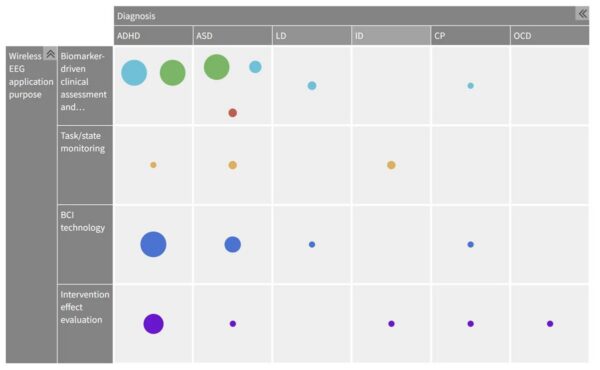
Wireless EEG Use Climbs in Children With Developmental Disabilities, BCI at 28.1%

Researchers at Yonsei University in South Korea and the University of Toronto reviewed 64 studies covering 3,103 participants and found wireless EEG increasingly used in research on children with developmental disabilities, with brain-computer interfaces accounting for 28.1% of the included studies. BCI work favored low-channel, dry-electrode, consumer-grade devices, while biomarker-driven studies used higher channel counts and signal fidelity; reporting on data quality was thin, with 85.9% of studies giving no validation against wired EEG and 79.7% not specifying impedance thresholds. Published August 25, 2026 in the Journal of Medical Internet Research, it is the first scoping review to map wireless EEG use across a broad spectrum of developmental disabilities in children.

BiGSTF-Net: Inter-Modal Mutual Guidance and Intra-Modal Spatio-Temporal Fusion for EEG-fNIRS Cognitive Classification

The study proposes BiGSTF-Net, a multimodal architecture that exploits the complementary properties of EEG and functional near-infrared spectroscopy (fNIRS) for cognitive-state decoding: heterogeneous spatio-temporal extractors capture each modality's representations, a modal residual interaction unit provides bidirectional cross-modal guidance, and a spatio-temporal gating unit fuses intra-modal features. Under cross-session evaluation on multiple BCI datasets, BiGSTF-Net consistently outperformed representative multimodal fusion baselines; ablations validated each component and visualizations matched the known neurophysiological features of the two signals.
July 2026

BCI Decoder Rankings Change When Accuracy Is Not the Only Metric

University of British Columbia researchers released BEND-BCI, an open benchmark comparing 23 neural decoders across 16 real or synthetic recordings in motor, visual, speech and spatial tasks. Rankings often changed when robustness, computational cost and cross-recording representation consistency were considered alongside held-out accuracy, and simpler baselines sometimes matched or beat much larger deep networks. The bioRxiv preprint has not been peer reviewed.

Preprint: Differentiable Logic Gate Networks for Low-Latency EEG Classification on Edge Devices

A preprint evaluates differentiable logic gate networks (Diff-Logic), compiled into pure boolean circuits, as a low-latency EEG classification option for resource-constrained BCIs. Across four EEG datasets and two task types — binary dementia screening and three-class emotion recognition — Diff-Logic reached 80.2% Macro F1 on dementia screening, 6.8 points above the multilayer perceptron baseline, and on power-constrained devices the MLP ran 2.3× slower and occupied 14× more memory, while Diff-Logic's inference time stayed nearly flat as model size grew 10×. The study has not been peer reviewed.
February 2026

Children With Cerebral Palsy Show Keen Interest in BCI-Controlled Boccia Ramp

Researchers designed an assistive Boccia ramp controlled by a brain-computer interface so that children with severe motor impairments who cannot speak can take part in the Paralympic sport. Six caregivers took part in semi-structured interviews and six children completed a newly developed 21-item survey; the children showed keen interest in playing Boccia with a BCI. The study also maps current barriers and facilitators to sport participation, and the issues that must be resolved before such technology can be rolled out.
© 2026 BCIwiki.com Digest Topics Tips Subscribe Revisions About